Explained
Shower Heads, Explained
After reading this, you'll be able to look at any shower head listing and know whether it will actually feel good in your bathroom - and whether its filter claims are real.
In this guide
A shower head is one of the cheapest upgrades you feel every single day, but the category splits into three camps - high-pressure, rain, and filtered - that solve completely different problems. What trips people up is that every head is capped at the same regulated flow rate, so the marketing battle is fought with vague words like 'high-pressure' and inflated numbers like '20-stage filtration'. This guide decodes the jargon so you can match a head to your actual water, plumbing, and problem.
The 30-second version
- Flow is capped by regulation, so every head works with roughly the same amount of water - the difference is how cleverly the nozzles shape it into force or coverage.
- Pressure and coverage are a trade-off: a small face with engineered nozzles feels intense, a wide rain face feels soft and enveloping. One fixed head can't fully deliver both.
- Judge filters by chemistry, not stage count: KDF and calcium sulfite are used to reduce chlorine; '15-stage' and '20-stage' bead cartridges are mostly a marketing number.
- No screw-on filter softens hard water - screw-on filters do not remove the dissolved minerals that cause scale, so scale problems need a whole-home solution.
- Build material predicts lifespan: metal bodies tend to hold up longer, while all-plastic heads are fine but should be treated as consumable.
The products this guide is about
Our verdict on each, with the full reasoning on the companion review.
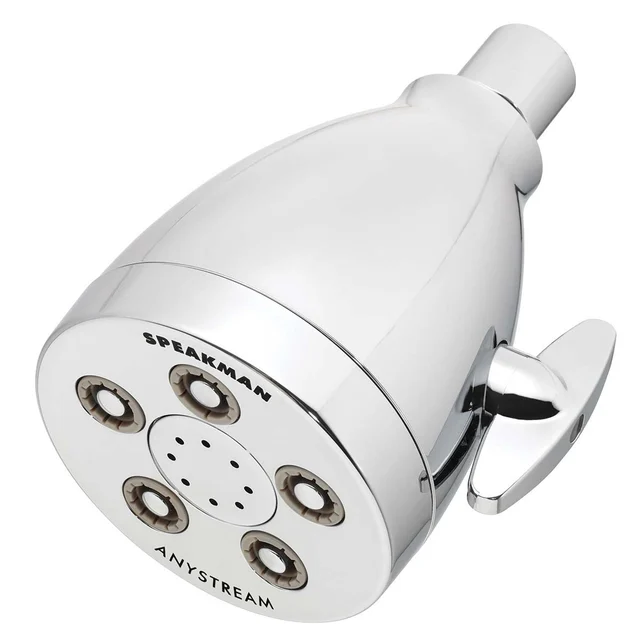
- Buy Speakman Hotel Anystream Shower Head (S-2005-H) A hotel-style classic with an adjustable spray - and built to last. Amazon
- Buy SparkPod 6-Inch Round Rain Shower Head The budget rain head: wide rainfall coverage with easy, tool-free installation. Amazon
- It depends Jolie The Jolie Filtered Showerhead A premium filtered showerhead - if you accept what shower filters can and can't do, and the recurring filter cost. Amazon
- Skip AquaHomeGroup 20-Stage Handheld Filtered Shower Head A '20-stage' bead cartridge and 'vitamin-infused' water sound impressive - the claims are hard to back up. Amazon
What actually matters
- Spray engineering at regulated flow - since every head gets the same capped water supply, the whole game is how well the nozzle design converts that flow into a satisfying spray. This is what separates a great head from a cheap one, and it's the thing spec sheets rarely show you.
- Head type vs. your problem - high-pressure heads fix weak-feeling showers, rain heads deliver soft full-body coverage, filtered heads reduce chlorine. Pick the camp that matches your actual complaint before comparing models.
- Your home's supply pressure - big rain faces need decent pressure to feel good, while compact high-pressure designs shine even on marginal plumbing. If your pressure is weak, the head type matters more than the brand.
- Build material - brass and metal bodies tend to last longer; plastic is lighter, cheaper, and shorter-lived. Handheld models add hoses and swivel joints, which are the most common leak points.
- Total cost of ownership - a filtered head is effectively a subscription, with cartridges needing regular replacement. Unfiltered heads have zero ongoing cost.
- Installation and reversibility - twist-on tool-free heads swap in minutes and swap back when you move out, which makes them the default choice for renters.
- Honesty of the claims - this category is thick with marketing that is hard to verify: stage counts, vitamin infusions, and 'pressure-boosting' promises. Skeptical reading pays off more here than in most categories.
The specs, in plain English
Green flags vs red flags
Green flags
- Brass or metal body with a long warranty - a good sign of a head that will last
- Reviewers specifically praise spray feel at low or restricted flow, not just 'good pressure' in general
- Filter models that name their chemistry (KDF, calcium sulfite) and state a realistic cartridge lifespan
- Tool-free twist-on installation with a supplied washer and thread tape - a sign the maker thought about real installs
- Silicone or self-cleaning nozzles that can be wiped clear of limescale
- A design that has stayed on the market largely unchanged for years - in this category, longevity of the design itself is evidence it works
Red flags
- '20-stage' or '15-stage' filtration as the headline claim - stage count is marketing, not performance
- 'Vitamin C and E infused' water promising skin and hair benefits - not supported by credible evidence
- Claims that a filter softens hard water or removes minerals - screw-on shower filters do not do this
- 'Pressure-boosting' language on a filtered head - adding a filter restricts flow; owners of some of these models report pressure drop
- Metal-look plastic with chrome paint at a mid-range price - you're paying metal money for plastic durability
- Owner reports clustering around leaking swivel joints or cartridges that exhaust far sooner than claimed
Who's who: the brands
- Speakman - A commercial plumbing brand behind the classic hotel shower head - known for brass-and-plastic builds and spray engineering offered at several flow rates.
- SparkPod - A direct-to-consumer budget brand that made its name on easy tool-free rain heads with strong owner satisfaction for the price.
- Jolie - A premium filtered-showerhead brand with upscale hardware - sold on a recurring filter-replacement model.
- Moen - A mainstream faucet-and-shower giant with wide availability, magnetic-dock handhelds, and dependable mid-range quality.
- Delta - Moen's big rival; known for wide-pattern spray technologies and handheld combos across budget to mid-range tiers.
- AquaHomeGroup - A marketplace filter brand built around multi-stage bead cartridges and vitamin-infusion claims - the style of filter we are most skeptical of.
How to read a listing without getting fooled
Start with the head type, because it defines what the product can actually do: fixed high-pressure, rain, handheld, or filtered. Then look past the adjectives to the few specs that matter - flow rate (they're all capped near the same number), face size (bigger means softer per-jet feel), body material (brass or metal versus plastic), and spray settings (a genuinely adjustable dial versus one fixed pattern). On filtered models, skip straight to the media list: if you see KDF or calcium sulfite named, the chemistry is a good sign; if the listing leads with a stage count, vitamin infusions, or beauty promises, assume the filter is decorative. Finally, scan owner reports for the failure patterns spec sheets never show - leaking swivel joints, pressure drop with the filter installed, and cartridges that die early. A listing that's specific about materials and chemistry, and modest in its claims, is almost always the better product.
How much should you spend?
Cost in this category is driven by three things: body material, filtration, and brand polish. The value sweet spot for most bathrooms is a mid-range fixed head from a proven plumbing brand - that's where you get metal construction and real spray engineering without paying for spa aesthetics. Budget heads can be genuinely good, especially rain heads, as long as you accept plastic construction and treat them as a several-year purchase rather than a lifetime one. Spending up makes sense in two cases: a brass-bodied classic built for long service, or a filtered head with credible chemistry if chlorinated city water is genuinely bothering your skin or hair - but remember a filtered head is a subscription, and a year of replacement cartridges can add up quickly. What's rarely worth paying more for: stage counts, vitamin claims, and chrome-look plastic priced like metal.
Questions, answered
Do filtered shower heads actually work?
Partially. Filters built on KDF and calcium sulfite are used to reduce free chlorine at shower temperatures, and some owners report softer-feeling hair and skin on chlorinated city water. Screw-on filters do not soften hard water or remove dissolved minerals. Judge any filter by its chemistry, not its stage count.
Will a new shower head fix my low water pressure?
Often, but it depends on the cause. If your old head is clogged with scale or badly designed, a well-engineered replacement can transform the feel. If your home's supply pressure is genuinely low, choose a compact high-pressure design that performs at low flow - and avoid large rain faces and filtered heads, which will feel weakest.
What's the real difference between a rain head and a high-pressure head?
They shape the same capped flow differently. A rain head spreads it across a wide face for soft, enveloping coverage with less force per jet; a high-pressure head concentrates it through fewer engineered nozzles for a stronger, massaging spray. It's a trade-off between coverage and intensity - one fixed head can't fully give you both.
Can I remove the flow restrictor to get more pressure?
We don't recommend it. Restrictors keep the head at its regulated flow rate, and removing one may violate local plumbing codes and void the warranty. The better fix is a head engineered to feel strong at legal flow - the good ones genuinely do.
How often do filter cartridges need replacing, and what does that really cost?
Follow the maker's stated interval, which varies by model, and replace sooner with hard or heavily chlorinated water. Exhausted cartridges can stop working before they look spent, so the recurring cost is real - before buying any filtered head, price out a full year of replacements and treat that as part of the purchase.
Are handheld shower heads worth it?
If you bathe kids or pets, rinse the shower walls, or need flexibility for accessibility reasons, yes - the hose earns its keep. The trade-offs are more joints that can leak and often a slightly weaker spray than an equivalent fixed head, so buy a handheld because you'll use the hose, not because the kit looks like more product for the money.
Or jump to the head-to-head: Speakman Hotel Anystream Shower Head (S-2005-H) vs SparkPod 6-Inch Round Rain Shower Head.