Explained
Power Banks, Explained: What to Look For
Everything you need to judge a power bank honestly, minus the marketing math.
In this guide
Power banks are rated in numbers that rarely match what you actually get. This guide translates the specs so you can tell real capacity and speed from wishful advertising.
The 30-second version
- The big mAh number is inflated. Because of voltage conversion and heat, you typically get 60-70% of the printed capacity delivered to your phone. Watt-hours (Wh) tell the truer story than mAh.
- Speed is watts, not mAh. How fast a bank charges your device depends on output wattage and whether it supports USB-C Power Delivery - not on how many milliamp-hours it holds.
- Match the bank to the job. A pocket top-up for a phone, a mid-size for a day out, and a laptop-capable brick are three different tools. Bigger isn't automatically better; it's heavier and slower to recharge.
- Airlines cap capacity at 100Wh. Anything above roughly 27,000mAh may be refused at the gate or barred from carry-on. If you fly, this number matters as much as the specs.
- Safety certification is not optional. Lithium cells hold real energy. Look for recognized safety testing and avoid no-name banks with implausible specs and no listed certifications.
The products this guide is about
Our verdict on each, with the full reasoning on the companion review.
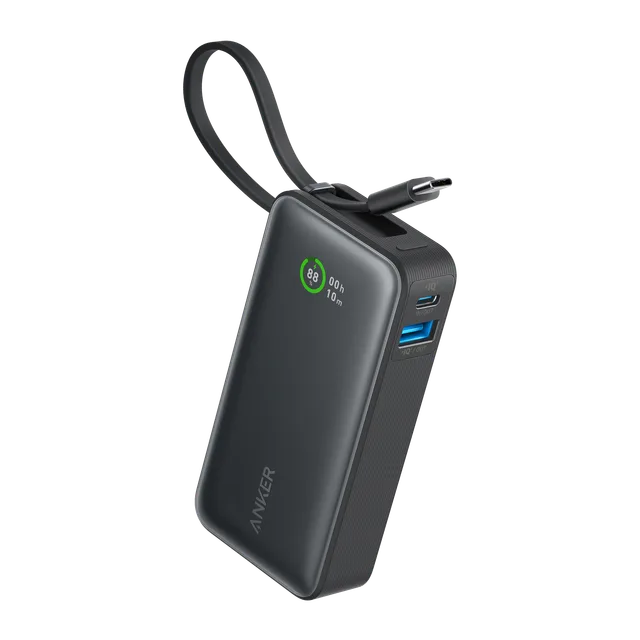
- Buy Anker Nano Power Bank (30W, 10K, Built-In USB-C Cable) The best everyday carry: a pocketable 10,000mAh pack with its own cable and a screen that never lies to you. Amazon
- Buy UGREEN Nexode 145W 25000mAh 3-Port Power Bank A do-everything travel brick that fast-charges a laptop and two phones at once. Amazon
- It depends Anker MagGo Power Bank (10K, Qi2) A cable-free MagSafe pack that's excellent for iPhones and pointless for everyone else. Amazon
- Skip Generic / unbranded No-name 'high-capacity' Amazon power bank (30,000mAh+ for a bargain price) The giant number is fiction: testing shows many deliver a fraction of the claim, with real fire risk.
What actually matters
- Real usable capacity - the printed mAh is measured at the internal cell voltage (3.6-3.7V), but your phone charges at 5V or higher. Converting between them loses energy to heat, so plan on getting roughly two-thirds of the label out the other end.
- Output wattage and Power Delivery - a bank can be huge yet charge slowly. Fast phone charging generally needs 20W or more; laptops need 45-100W over USB-C Power Delivery (PD), the standard that lets a device and charger negotiate higher speeds safely.
- Ports and how many devices at once - count the USB-C and USB-A ports, and check whether total output drops when several are in use. One fast port beats three slow ones for most people.
- Weight and size versus what you actually carry - capacity is dense and heavy. A bank that never leaves a drawer because it's a brick is worse than a smaller one you actually bring.
- Recharge time and input speed - a large bank with a slow input can take all night to refill. USB-C input wattage tells you how quickly the bank itself tops back up.
- Airline compliance if you travel - the 100Wh limit is a hard ceiling for carry-on lithium batteries on most airlines, and power banks are never allowed in checked luggage.
The specs, in plain English
Green flags vs red flags
Green flags
- Capacity listed in both mAh and Wh, with the Wh figure making the mAh claim plausible
- Clear output wattage stated per port, not just a total
- USB-C Power Delivery support named explicitly, with a specific wattage
- Recognized safety certification listed (UL, ETL, or equivalent)
- Honest recharge (input) time and weight given in the specs
- Airline-friendly capacity clearly flagged if the bank is near the 100Wh line
Red flags
- A giant mAh number with no Wh figure and no realistic weight to back it up
- 'Fast charging' claimed with no wattage or standard actually named
- Total output that quietly drops when more than one port is used
- No safety certifications mentioned anywhere on the listing
- Implausible specs at a suspiciously low tier from an unknown brand
- Wireless charging hyped while the wired speed goes unstated
Who's who: the brands
- Anker - One of the most widely stocked names in portable charging; broad range from pocket banks to laptop-capable bricks.
- Belkin - Focuses on accessory quality and wireless charging; common in phone-ecosystem circles.
- UGREEN - Known for USB-C and GaN products; a frequent pick for people who want fast wired charging.
- Baseus - Wide, value-oriented lineup that leans into displays and higher-wattage output.
- Mophie - Long associated with phone-shaped and magnetic banks aimed at Apple users.
- INIU - Budget-tier brand that competes on capacity-per-size and warranty claims.
- Zendure - Positions toward rugged and higher-capacity travel and outdoor use.
- Nimble - Emphasizes recycled materials and sustainability alongside standard bank features.
How to read a listing without getting fooled
Start with the Wh figure, or calculate it, before trusting the mAh headline - that tells you the real energy and whether it clears the airline limit. Then look at output wattage and Power Delivery to judge speed, since a bank can be enormous yet slow. Check how many ports stay fast under load, confirm a recognized safety certification, and weigh the physical weight against what you'll actually carry. If a listing hides wattage, omits Wh, or skips certifications, treat the missing information as the answer.
How much should you spend?
Entry-tier banks usually mean small capacity, slower output, or thinner build quality, and often skip the certifications and Power Delivery you'd want. The middle tier is where most people find the sweet spot: honest capacity, real fast charging, and named safety testing without paying for features they'll never use. Higher tiers add laptop-grade wattage, wireless charging, GaN compactness, rugged builds, or displays - genuinely useful for some, overkill for a phone-only user. Spend for the wattage and certification you need, not for the biggest mAh number on the shelf.
Questions, answered
Why does my power bank charge my phone fewer times than the mAh suggests?
Because the printed mAh is measured at the battery's low internal voltage. Converting that up to your phone's charging voltage loses energy as heat, so you typically receive 60-70% of the label. Watt-hours reflect the real amount; use that number to set expectations.
What size power bank can I bring on a plane?
Most airlines cap lithium power banks at 100 watt-hours for carry-on, which is roughly 27,000mAh, and ban them from checked bags entirely. Banks above that need airline approval or aren't allowed. Always check the Wh rating and your specific airline before you fly.
Does a higher mAh mean faster charging?
No. Capacity (mAh or Wh) is how much energy the bank holds; speed is set by output wattage and whether it supports USB-C Power Delivery. A large bank with low wattage charges slowly. For quick phone charging, look for 20W or more, not a bigger capacity number.
Is wireless charging on a power bank worth it?
It's convenient for topping up without a cable, especially with magnetic alignment like MagSafe or Qi2. But it's slower and less efficient than a wired connection, so more of the stored energy is lost to heat. Treat it as a nice extra, not a replacement for the cable.
Can I charge the power bank and my phone at the same time?
Only if it supports pass-through charging, and not every model does. When it works it's handy as a bedside hub, but it can run warm and may charge both more slowly. Check the specs directly, since manufacturers don't always guarantee or recommend it.
How do I know a power bank is safe?
Look for recognized independent safety testing, such as UL or ETL marks, listed on the product. Lithium cells store real energy, so certification is a baseline. Be wary of unknown brands advertising huge capacity with no certifications, implausible weight, or specs that seem too good for the tier.
Or jump to the head-to-head: Anker Nano Power Bank (30W, 10K, Built-In USB-C Cable) vs UGREEN Nexode 145W 25000mAh 3-Port Power Bank.