Explained
Mandoline Slicers, Explained
After reading this you'll understand what makes one mandoline slice cleaner and safer than another, and which features actually matter for how you cook.
In this guide
A mandoline is a flat cutting board with a fixed, razor-sharp blade set into it: you slide food across the blade to produce fast, uniform slices instead of laboring with a knife. The category swings from professional-grade Japanese hand tools to bargain multi-blade kits, and the specs that sound impressive on the box aren't always the ones that matter. What trips people up most is treating safety as an afterthought, because the same sharpness that gives clean slices is exactly what makes cuts a real risk.
The 30-second version
- Sharpness and safety are linked, not opposed. A truly sharp blade glides through food so you never force it, which is safer than pushing hard on a dull edge that suddenly gives.
- The hand guard is the feature you'll rely on most. A guard that actually grips your food keeps fingers away from the blade, so judge it as carefully as you judge the cut quality.
- Continuous thickness beats a handful of presets. A dial or screw that adjusts smoothly gives you paper-thin to thick, while fixed-preset models limit you to a few set steps.
- Handheld versus standing is a comfort choice, not a quality one. Handhelds are compact and slice over a bowl; standing models free both hands and feel more stable for beginners.
- More blades is not more value. Five-in-one kits spread quality thin and add loose parts to lose; a focused slicer usually cuts better and lasts longer.
The products this guide is about
Our verdict on each, with the full reasoning on the companion review.
- Buy Benriner Classic Japanese Mandoline A long-time professional-kitchen favorite with sharp, precise cuts for the money. Amazon
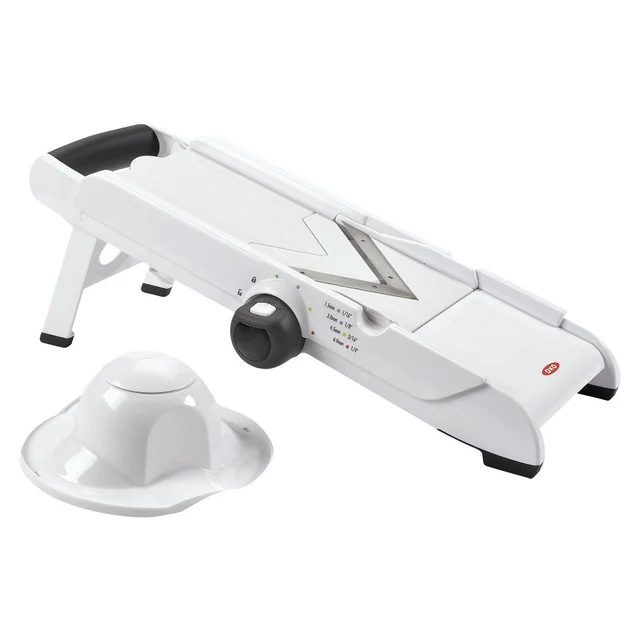
- Buy OXO Good Grips V-Blade Mandoline Slicer A stable, safety-minded all-rounder that is the easiest pick for most home kitchens. Amazon
- It depends Kyocera Advanced Ceramic Adjustable Mandoline Slicer A rust-proof ceramic blade that shines on soft produce but tires on the hard stuff. Amazon
- Skip Mueller Austria V-Pro 5-Blade Adjustable Mandoline Slicer A cheap five-in-one kit that spreads itself thin and does not hold up like the others. Amazon
What actually matters
- Blade sharpness - the single biggest driver of cut quality; a sharper edge slices cleanly through tomatoes and potatoes without tearing, and needs less force, which is also safer.
- Thickness adjustment - whether you get a smooth continuous range or just a few fixed presets determines how versatile the tool is across thin chips, even slices, and thick planks.
- Safety design - a food holder that truly grips, a stable base or grippy feet, and (for standing models) legs that don't wobble matter more than any single spec.
- Handling and stability - a handheld you brace over a bowl demands steadier technique, while a standing model that grips the counter is more forgiving for newcomers.
- Versatility - interchangeable blades for julienne (matchsticks), waffle, or crinkle cuts add range, but only if you'll actually use them.
- Cleaning and durability - fewer parts, dishwasher-safe materials, and an edge that holds up over time separate a keeper from a drawer-clogger.
- Blade material - stainless steel is the versatile all-rounder; ceramic resists rust and won't react with acidic food but can struggle on hard, dense produce.
The specs, in plain English
Green flags vs red flags
Green flags
- A food holder that grips small and round items securely, not just large ones
- A stable base with grippy feet, or folding legs that lock firmly for standing use
- Smooth continuous thickness adjustment, or at least clear, repeatable settings
- A blade widely described in owner reports as staying sharp over time
- Simple construction with few loose parts and easy, safe cleanup
Red flags
- A guard that only works on large items and lets small food wobble near the blade
- Owner reports of blades dulling quickly or build quality slipping with use
- A tippy base or wobbly legs that shift while you slice
- A pile of interchangeable parts that add fiddliness without clear benefit
- Marketing that leads with the number of blades rather than cut quality or safety
Who's who: the brands
- Benriner - A Japanese handheld used in professional kitchens, known for sharp, precise cuts at a budget price.
- OXO - Housewares maker known for stable, safety-minded, beginner-friendly designs with easy-to-use controls.
- Kyocera - Ceramics specialist whose ceramic blades resist rust and don't react with acidic foods.
- Mueller - Budget brand offering multi-blade all-in-one kits; heavy on features, more variable on long-term durability.
How to read a listing without getting fooled
Read a mandoline listing from the safety and sharpness angle first, and treat the flashy numbers with suspicion. "5 blades" or "9-in-1" tells you about accessory count, not cut quality, and every extra insert is one more thing to lose, wash, and store. Look instead for how the hand guard grips food (does it handle small and round items, or only big ones?), whether thickness is continuous or just a few presets, and what the base or legs do to keep the tool from sliding. Blade material is a real trade-off, not a ranking: steel is the versatile default, while ceramic resists rust and acids but can struggle on hard produce like winter squash. Photos that show the guard actually holding food, and descriptions that mention grippy feet or folding legs, tell you more than any spec table. Finally, weigh owner reports on how the edge holds up after months of use, since a blade that dulls fast turns a good-looking tool into a frustrating, and more dangerous, one.
How much should you spend?
You do not have to spend much to get an excellent cut. Some of the sharpest, most precise slicers are among the least expensive because they focus on doing one thing well, while a higher price often buys stability, safety features, and beginner-friendly convenience rather than a better edge. The value sweet spot sits with a focused slicer, handheld or standing, that grips food securely and holds its edge, rather than a cheap multi-blade kit that spreads its quality across five mediocre attachments. Spending more is worth it when you want folding legs, a repeatable dial, and a guard that makes the tool safer and easier for a nervous or occasional user. Spending more is not worth it when the extra money mostly buys blade count or gadgetry, and there's rarely a reason to reach for the very cheapest bargain kit, whose thin build and quicker-dulling blades can cost you in frustration and risk what they save at checkout.
Questions, answered
Is a mandoline worth it over a good knife?
For repetitive, uniform cuts, thin potato rounds, even cucumber coins, matchstick julienne, a mandoline is far faster and more consistent than a knife. If you rarely need that uniformity, a sharp knife is enough. The real trade-off is safety: a mandoline delivers speed and evenness in exchange for a genuine need for care every single time.
How do I use a mandoline without cutting myself?
Always use the included hand guard or food holder, and consider adding a cut-resistant glove on the hand that holds the food. Set the tool on a stable surface or over a bowl so it can't slide, keep your fingers behind the guard, and never slice the last small stub by hand, discard it or save it for another use. Injuries commonly happen on that final piece or when someone skips the guard to go faster.
What's the difference between a straight and a V-blade?
A straight blade makes plain, even slices and handles most everyday work. A V-blade (or angled blade) draws food into the cut from both sides, so it grips slippery, firm-skinned items like tomatoes more securely and can require a bit less force. Neither is strictly better; a straight blade is the versatile default, and a V shines on foods that tend to slide.
Steel or ceramic blade, which should I get?
Steel is the versatile all-rounder: sharp, tough, and comfortable on hard and soft produce alike. Ceramic stays sharp for a long time, won't rust, and won't react with acidic foods like tomatoes and citrus, which is a real plus, but it's more brittle and can labor on hard, dense items like winter squash. Choose ceramic if you mostly slice soft produce and value rust-free convenience; choose steel if you want one blade for everything.
Can mandolines go in the dishwasher?
Many are labeled dishwasher safe, but hand washing extends the life of plastic parts and preserves the edge. Whichever way you clean it, treat the blade as the most dangerous part of the whole process, wash it deliberately and never wipe blindly across it, since cleanup is a common moment for cuts.
Handheld or standing, which is better for a beginner?
Standing models with folding legs or a stable base are the friendlier starting point: they hold themselves steady and let you use both hands, so there's less to manage while you learn. Handheld models are more compact and let you slice directly over a bowl, but they ask for steadier technique. If you're new or nervous about safety, start with a standing design.
Or jump to the head-to-head: OXO Good Grips V-Blade Mandoline Slicer vs Benriner Classic Japanese Mandoline.