Explained
Mini Fridges, Explained
After this guide you'll be able to read any mini fridge listing and tell whether it will genuinely freeze food, fit the space you have, and stay quiet enough to live with.
In this guide
A mini fridge looks like the simplest appliance you can buy, which is exactly why listings get away with vague specs. Two boxes with the same cubic-foot number can differ enormously in how they cool, whether their freezer freezes anything, and how much of that space you can actually use. The two things that trip up first-time buyers are a "freezer" that is really just a chiller box, and a capacity number that counts space no food will ever occupy.
The 30-second version
- Compressor versus thermoelectric is a major quality divide. A compressor model refrigerates the way a full-size fridge does and holds its setting even in a warm room. A thermoelectric unit can only pull the interior a fixed amount below room temperature, so it drifts warm on hot days and cannot freeze anything.
- A chiller compartment is not a freezer. Most single-door compacts have a small ice box inside the fridge cavity that gets very cold but will not hold ice cream firm or keep frozen meals safely frozen. Only a separate compartment with its own door reliably does that.
- Cubic feet overstates what fits. The rating measures the whole cavity, including the space taken by shelves, the chiller box, and the compressor hump at the back. Shelf spacing and door bins decide how much really goes in, so compare layouts rather than numbers.
- Clearance is part of the spec sheet. Most compacts vent heat out the back and sides and need a gap around them. Box one into a cabinet or a desk cubby and it runs almost constantly, gets louder, uses more power, and wears out sooner.
- Manual defrost is normal at this size. Nearly every compact freezer is manual-defrost, so frost builds up and you empty the compartment and melt it out a few times a year. Frost-free compacts exist but are rare and cost far more.
The products this guide is about
Our verdict on each, with the full reasoning on the companion review.
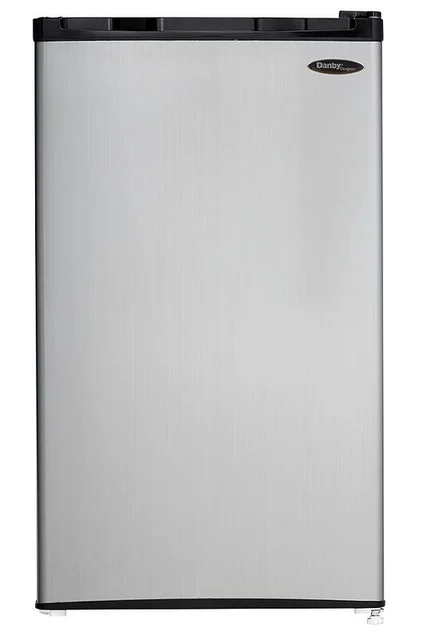
- Buy Danby Designer 3.2 cu. ft. Compact Refrigerator (DCR032C1BSLDD) The quiet, roomy all-rounder that owners keep for years without drama. Amazon
- Buy Midea 3.1 cu. ft. Two-Door Mini Fridge (WHD-113FSS1) The value pick with a separate freezer door that actually freezes. Amazon
- It depends Newair 126-Can Freestanding Beverage Fridge (AB-1200) A superb drinks fridge that is the wrong tool if you also need to store food. Amazon
- Skip Frigidaire Retro 3.2 cu. ft. Mini Fridge with Top Freezer (EFR840) The photogenic retro look hides a freezer that frosts and a build owners question. Amazon
What actually matters
- Cooling type (compressor or thermoelectric) - compressor units actively refrigerate, hold a set temperature in a warm room, and can support a real freezer. Thermoelectric units are lighter and vibration-free but only cool relative to ambient temperature, which makes them unreliable in a hot dorm room or garage and useless for freezing.
- Freezer type: chiller box or separate compartment - a single-door model's little ice box chills but does not dependably freeze. A two-door model with its own insulated freezer door reaches true freezing temperatures. Decide which you need before anything else, because it rules out half the category.
- Usable layout over headline capacity - a full-width shelf, adjustable spacing, door bins deep enough for a two-liter bottle, and a can rack determine how much really fits. Two fridges rated the same can differ by several drinks and a whole shelf of leftovers.
- Noise in the room you'll put it in - compressors cycle on and off with a low hum and an occasional gurgle. Noise ratings are given in decibels (dBA), where lower is quieter and a few points is a bigger difference than it sounds. Placement matters as much as the rating: hard floors and walls amplify vibration.
- Venting, clearance, and door swing - check whether the model vents from the front (can sit flush or under a counter) or the back and sides (needs breathing room). A reversible door hinge lets you flip the swing so the door opens away from a wall, and leveling legs stop the rattle that makes a fridge sound broken.
- Energy certification and running cost - a mini fridge runs every hour of every year, so efficiency compounds. ENERGY STAR certification means the model beats the federal minimum efficiency standard, and the yellow EnergyGuide label lists estimated yearly electricity use in kilowatt-hours, which is the number to compare between models.
The specs, in plain English
Green flags vs red flags
Green flags
- The listing says compressor cooling outright, rather than dodging the question
- A separate freezer compartment with its own door, if you need to freeze food
- ENERGY STAR certification and a stated kilowatt-hours-per-year figure
- A reversible door hinge, adjustable leveling legs, and published clearance requirements
- A described shelf layout: full-width shelf, adjustable spacing, door bins that take a tall bottle
- Long-running owner reports of quiet operation and units still working after several years
Red flags
- "Thermoelectric", "solid-state", or "whisper quiet, no compressor" on a unit you want to keep food cold in a warm room
- A "freezer" pictured as a small box inside the main cavity but marketed as a real freezer
- Big cubic-foot claims with no interior photo, shelf dimensions, or layout description
- No mention of venting or required clearance, especially on models sold for cabinets and desks
- Retro or novelty styling as the main selling point, with cooling specs buried or missing
- Repeated owner reports of frost forming within days, loose door seals, or units arriving damaged
Who's who: the brands
- Danby - A compact-appliance specialist known for everyday mini fridges with organized interiors.
- Midea - A huge global appliance maker; its two-door compacts are among the most widely owned value picks.
- GE - Mainstream appliance brand with conventional single- and two-door compacts and easy parts support.
- Frigidaire - A familiar name, but many retro-styled compacts carrying it are licensed and built by third parties, so build quality varies.
- Newair - Focused on beverage centers and specialty coolers rather than general-purpose food fridges.
- Galanz - Budget-oriented compacts, including retro looks, with simple mechanical controls.
How to read a listing without getting fooled
Start with the freezer question, because it eliminates most of the field: if you need to actually freeze food, you need a two-door model with a separate freezer door, not a single-door unit with a chiller box. Next, confirm the listing says compressor cooling; if it only says quiet, silent, or vibration-free, treat it as thermoelectric and expect it to struggle in a warm room. Then ignore the headline cubic-foot number and look at the interior photo instead, checking for a full-width shelf, adjustable spacing, and door bins that will take the bottles you actually buy. Measure your spot including the clearance the manual asks for, and check whether the door swing can be reversed. Finally, look for ENERGY STAR and the yearly kilowatt-hours figure, and read owner reports from a year or more out, since frost, door seals, and compressor noise are problems that only appear after months of daily use.
How much should you spend?
The bottom of the market is where thermoelectric coolers and flimsy single-door boxes live. They are fine as a drinks cabinet next to a desk, and a poor idea as a real fridge in a warm room. Step up to the budget end of compressor-cooled models and you get proper refrigeration, often a genuine two-door freezer, and ENERGY STAR certification, which is a big jump in value. The middle tier buys refinement rather than capability: quieter running, thicker walls and better seals, a smarter shelf layout, better lighting, and the reliability record that keeps a unit going for years. Above that, extra money mostly goes to styling, glass doors, and specialty beverage features, none of which make food colder. Retro and designer models are the clearest case of paying for looks, since several charge a premium while cooling and building no better than the value picks. The sensible plan is to spend enough to get a compressor and the freezer type you need, add a little for quiet and a usable interior if the fridge lives in a bedroom or office, and stop there.
Questions, answered
Will a mini fridge freezer actually freeze food?
Only if it is a separate compartment with its own door. The small chiller box inside a single-door compact gets cold enough to make ice cubes or keep something hard, but it shares air with the fridge, so every time you open the door it warms up. It will not keep ice cream firm and is not dependable for storing frozen food. A two-door model reaches genuine freezing temperatures and holds them.
What is thermoelectric cooling and should I avoid it?
Thermoelectric cooling uses an electric plate and a fan instead of a compressor. It has no vibration and is often marketed as silent, but it can only pull the interior a fixed number of degrees below the surrounding room. In a cool room it works; in a hot dorm, garage, or summer bedroom, the inside drifts warm with it. It also cannot freeze. If the fridge is holding food rather than sealed drinks, choose a compressor model.
What size should I get for a dorm room or office?
Around 3 to 3.5 cubic feet suits one person who wants drinks, lunches, and some leftovers without the fridge dominating the room. Between roughly 1.6 and 2.5 cubic feet is a drinks-and-snacks box for tight spaces. Go larger only if two people share it or you want real freezer capacity. Remember that the rating counts space you cannot use, so check the shelf layout before trusting the number.
Are mini fridges loud enough to bother you at night?
Most modern compacts cycle on and off with a low hum rather than running constantly, and owners generally find them easy to ignore. Where they get annoying is placement: a hard floor, a wall right behind the vents, or an unlevelled cabinet turns a quiet compressor into a rattle. Leave the clearance the manual asks for, adjust the leveling legs until the unit does not rock, and put a mat underneath on a hard floor.
How often do I have to defrost it, and why does frost build up?
Compact freezers are almost always manual-defrost, so plan on emptying and melting the ice out once or twice a year. Frost forms when humid room air gets in and condenses on the cold walls, which means it builds faster if you open the freezer often, live somewhere humid, or put warm food straight in. Frost that returns within days usually points to a door seal that is not closing properly.
Can a glass-door beverage fridge be my only fridge?
Not really, unless drinks are all you keep in it. Beverage centers have shallow shelves shaped for cans and bottles, no freezer, and often a warmer temperature range than a food fridge. The glass door also insulates less than a solid one, so it works harder in a warm room and can fog or gather condensation. For groceries and leftovers, a standard compact with a solid door is the better everyday choice.
Or jump to the head-to-head: Danby Designer 3.2 cu. ft. Compact Refrigerator (DCR032C1BSLDD) vs Midea 3.1 cu. ft. Two-Door Mini Fridge (WHD-113FSS1).