Explained
Panini Presses, Explained
You'll be able to read any panini press listing and know which specs actually change how your sandwiches turn out.
In this guide
A panini press looks like a simple appliance, but a handful of design choices separate the ones that earn counter space from the ones that end up in a cupboard. Most buyers get tripped up by two things: assuming all lids press the same way, and not realizing that 'panini press' can mean anything from a dedicated single-purpose gadget to a multi-mode contact grill.
The 30-second version
- The hinge matters more than the wattage. a floating hinge that self-adjusts to sandwich thickness presses evenly, while a fixed lid flattens the middle and leaves the edges undercooked.
- Plate material decides your cleanup routine. nonstick plates that pop out for the dishwasher save real time over fixed cast-iron or die-cast plates you have to wipe in place.
- Removable plates are a bigger deal than they sound. melted cheese and grease bake onto grill plates fast, and hand-cleaning around a hinge and cord is the single most common owner complaint.
- A single heat setting is fine for basics, not for everything. adjustable temperature lets you go gentle on stuffed or delicate bread and hot for a fast, crisp crust.
- Multi-mode contact grills often out-value dedicated presses. a machine that also grills and griddles earns its footprint in a way a single-purpose press rarely does.
The products this guide is about
Our verdict on each, with the full reasoning on the companion review.
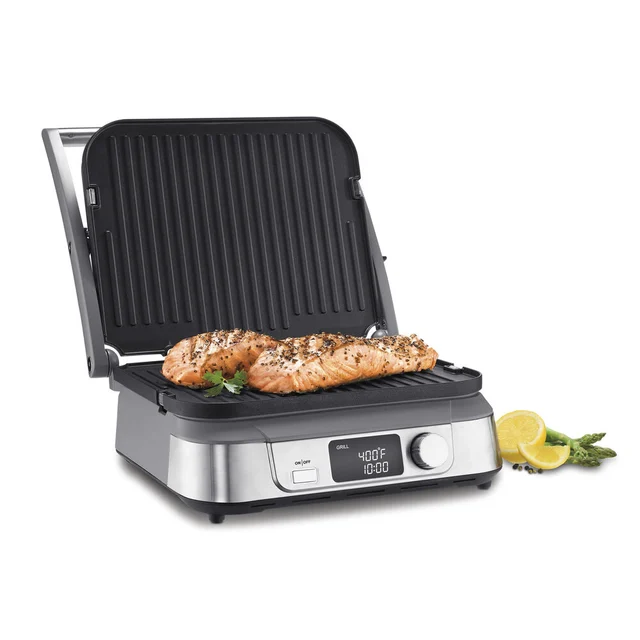
- Buy Cuisinart Griddler Five (GR-5B) The do-everything contact grill that also makes an excellent panini - and cleans up in the dishwasher.
- Buy Breville the Sear & Press Grill (BGR700BSS) The premium pick that browns deepest and handles the thickest artisan loaves without crushing them.
- It depends Hamilton Beach Panini Press Gourmet Sandwich Maker (25460A) The cheap, simple, reliable panini-only press - great value, but it does one thing.
- Skip De'Longhi Retro Contact Grill & Panini Press (CGH800) Handsome retro styling, but fixed plates and dated cleanup make it hard to recommend over the others.
What actually matters
- Hinge type - a floating hinge moves independently of the base so it can press a thick, overstuffed sandwich as evenly as a thin one; a fixed hinge presses at one set height regardless of what's underneath.
- Plate material - nonstick-coated plates release food easily and heat quickly but wear out over years of use; cast iron or die-cast plates hold heat longer and brown deeper but need more careful cleaning and, in some cases, seasoning.
- Removable vs fixed plates - removable plates unclip for a full wash (often dishwasher-safe); fixed plates are wiped in place while still attached to the hinge and cord, which is harder and slower.
- Temperature control - a single on/off heat setting keeps things simple but can scorch the outside of a sandwich before thick fillings warm through; an adjustable dial or presets let you match heat to what you're cooking.
- Wattage and preheat time - higher wattage generally means faster preheat and more consistent heat recovery when you open the lid, which matters if you're making sandwiches back-to-back.
- Plate size and footprint - bigger cooking surfaces fit more or larger sandwiches at once but take up more counter and storage space.
- Versatility (modes) - some machines are panini-only; others open flat to double as a grill or griddle for burgers, eggs, and pancakes, which changes how often the appliance actually gets used.
The specs, in plain English
Green flags vs red flags
Green flags
- A floating or height-adjustable hinge, described in the listing or shown in photos pressing a thick sandwich
- Removable plates explicitly labeled dishwasher-safe
- An adjustable temperature dial or multiple heat presets, not just an on/off switch
- Clear wattage listed, generally in the mid-to-upper range for the category
- Owner reports specifically mentioning even browning and easy cleanup
- A drip tray or grease channel if you plan to press meats or oily fillings
Red flags
- No mention of hinge type at all, which usually means a basic fixed lid
- Plates described as fixed or non-removable with no dishwasher claim
- Only a single indicator light for heat, with no way to adjust temperature
- Vague or missing wattage specs
- Owner reports repeatedly flagging uneven browning or a middle-of-sandwich crush
- Complaints about cleaning around the hinge or cord in reviews
Who's who: the brands
- Cuisinart - Known for multi-mode contact grills with removable, dishwasher-safe plates and real temperature dials at accessible prices.
- Breville - Positioned at the premium end, with heavier-duty plates, precise heat control, and hinges built for tall, thick sandwiches.
- Hamilton Beach - Budget-focused, simple dedicated presses that do one job - pressing sandwiches - without extra modes or controls.
- De'Longhi - Known for retro-styled countertop appliances; panini presses in this line tend to prioritize looks and can lag on removable-plate convenience.
- Proctor Silex - Another budget-tier maker of simple, no-frills sandwich presses aimed at occasional use.
How to read a listing without getting fooled
Start with the hinge and the plates, since those two specs predict daily usability more than anything else. If a listing doesn't mention how the top plate moves, assume it's fixed. If it says 'nonstick' but doesn't say 'removable' or 'dishwasher-safe,' assume you'll be wiping the plates in place while they're still attached to the machine. Wattage is a useful tiebreaker between similar models but shouldn't be the deciding factor on its own - a well-designed lower-wattage machine with a floating hinge will outperform a high-wattage one with a fixed lid. Finally, check whether 'panini press' in the title actually means a dedicated single-purpose gadget or a multi-mode grill that presses paninis as one of several functions; the product description or mode list will clarify this.
How much should you spend?
Simple, dedicated panini presses with a single heat setting and fixed plates sit at the low end of the category, and that price mostly buys you basic functionality rather than poor build quality - they can still make a fine sandwich. Spending more typically buys a floating or height-adjustable hinge, removable dishwasher-safe plates, and adjustable temperature control, all of which matter for how often you'll actually use the machine and how much you'll dread cleaning it. At the top of the range, the extra cost usually goes toward multi-mode versatility (grill and griddle functions), heavier-duty plates for deeper browning, and sturdier overall build. The sweet spot for most kitchens is a mid-range multi-mode machine with removable plates and real heat control; paying a premium only makes sense if you'll actually use the extra grill or sear modes, not just the panini function.
Questions, answered
What's the difference between a floating hinge and a fixed lid?
A floating hinge lets the top plate move independently as it comes down, so it can adjust to a sandwich's thickness and press evenly across the whole surface. A fixed lid closes to one set position regardless of what's inside, which works fine for thin, evenly filled sandwiches but tends to crush the middle and leave the edges under-pressed on anything thick or overstuffed.
Do I need dishwasher-safe plates, or is nonstick coating enough?
Nonstick coating helps food release easily, but it doesn't solve cleanup on its own if the plates are fixed to the machine - you'll still be wiping melted cheese and grease off in place, working around the hinge and cord. Removable, dishwasher-safe plates are what actually make cleanup fast, and owner reports consistently flag this as the difference between a press that stays in rotation and one that gets buried in a cupboard.
Is a higher wattage panini press always better?
Not on its own. Wattage mainly affects preheat time and how quickly the plates recover heat between sandwiches, which matters if you're cooking for a group. But a lower-wattage machine with a good floating hinge and adjustable heat will give you a better sandwich than a high-wattage one with a fixed lid and no temperature control. Treat wattage as a secondary spec, not the headline one.
Do I really need adjustable temperature control?
It helps more than it seems like it would. A single fixed heat setting is fine for a quick cheese sandwich, but it can scorch bread before a thick or cold filling warms through. Adjustable control lets you run cooler for delicate bread or dense fillings and hotter when you want a fast, crisp crust, which gives you more consistent results across different kinds of sandwiches.
Should I buy a dedicated panini press or a multi-mode contact grill?
It depends on how often you'll use the extra modes. A dedicated press is smaller, simpler, and usually cheaper, which suits anyone who only wants quick pressed sandwiches occasionally. A multi-mode contact grill costs more and takes more storage space, but it also grills and griddles, so it can replace two or three other appliances if you'll actually use those functions.
How do cast iron or die-cast plates differ from nonstick plates in daily use?
Cast iron and die-cast plates hold heat longer and tend to brown more deeply and evenly once they're up to temperature, but they take longer to preheat and, if they aren't also nonstick-coated, need more careful cleaning and drying to avoid sticking or rust. Nonstick-coated plates heat faster and release food more easily, which is why most consumer presses use a nonstick surface even on heavier plates.
Or jump to the head-to-head: Cuisinart Griddler Five (GR-5B) vs Breville the Sear & Press Grill (BGR700BSS).