Explained
Portable Washing Machines, Explained
After reading, you'll be able to read a portable washer listing and know exactly what you're getting before it shows up at your door.
In this guide
Portable washing machines look like a simple category until you're staring at a listing full of cu. ft., RPM, and "semi-automatic" claims with no context. The category splits into two genuinely different kinds of machine, and the spec that trips up most first-time buyers isn't capacity or price, it's how much manual work the machine expects from you every single load.
The 30-second version
- Full-automatic or twin-tub is the first decision, not the last. it determines whether you press start and walk away or fill, transfer, and drain by hand every load.
- Capacity numbers exaggerate. a machine's rated pounds or cu. ft. is a lab maximum, not what fits comfortably with clothes that still move around and rinse clean.
- Spin RPM predicts your drying time more than anything else on the spec sheet. a low-RPM machine leaves clothes damp and headed for a dryer or a drying rack for hours.
- Every portable needs somewhere to drain. measure your sink, faucet, and floor space before you buy, not after it arrives.
- Noise and vibration are a hard-floor problem as much as a machine problem. the same washer can be tolerable on carpet and unbearable on tile or hardwood.
The products this guide is about
Our verdict on each, with the full reasoning on the companion review.
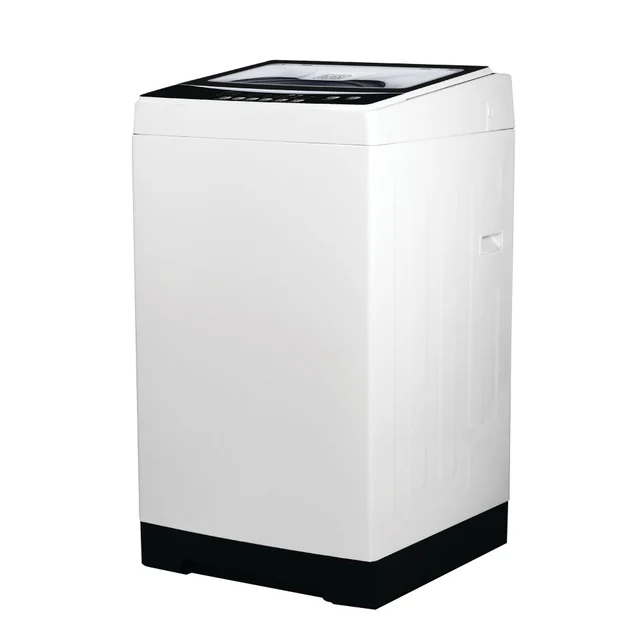
- Buy BLACK+DECKER BPWM16W 1.6 Cu. Ft. Portable Washer The closest a portable gets to a real apartment washer, with a recognized US brand behind the warranty.
- Buy COMFEE' 0.9 Cu. Ft. Portable Washing Machine A slim, efficient full-automatic that slides into a closet or under a counter and just works.
- It depends Auertech Twin Tub Portable Washing Machine (28 lbs) The cleaning and spin-dryness champ of the group - if you don't mind babysitting every load.
- Skip Giantex 1.5 Cu. Ft. Full-Automatic Portable Washing Machine A feature-packed spec sheet undercut by recurring reports of leaks, error codes, and thin support.
What actually matters
- Automation level: whether the machine fills, washes, rinses, and spins on its own, or needs you to move clothes and water by hand at each stage.
- Wash capacity: how much laundry actually fits per load without overcrowding, usually listed in pounds or cubic feet.
- Spin speed (RPM): how fast the drum spins water out of clothes at the end of a cycle, which sets how damp or dry laundry comes out.
- Drain method: whether the machine has a built-in pump and hose, or drains by gravity into a sink, tub, or bucket.
- Hookup compatibility: whether the included adapter fits your faucet threading, and whether you have a place nearby to drain.
- Wash action (agitator vs impeller): how the drum physically moves clothes through the water, which affects both cleaning and fabric wear.
- Noise and vibration: how loud the motor and spin cycle are, and how much the unit shakes or walks on the floor it sits on.
The specs, in plain English
Green flags vs red flags
Green flags
- Clear statement of full-automatic vs semi-automatic in the listing, not just implied by photos
- Specific RPM number listed for the spin cycle, rather than vague language like "powerful spin"
- Included drain hose and faucet adapter with stated thread compatibility
- Owner reports mentioning years of use without leaks or error codes, not just first-week impressions
- A brand with reachable customer support and available replacement parts
- Capacity described in a way that matches a real load, like "fits a week of laundry for one person"
Red flags
- No mention of automation level anywhere in the listing, forcing you to guess from photos
- Capacity claims that seem inflated relative to the drum size shown in photos
- Recurring owner complaints about leaks, drain pump failures, or error codes appearing within months
- No spin speed listed at all
- Vague or missing information about drain hose length and hookup requirements
- A brand with no clear support channel or replacement-parts availability
Who's who: the brands
- BLACK+DECKER - A mainstream US home-goods brand that also makes portable washers, valued for reachable support and parts availability.
- COMFEE' - A budget-focused appliance brand known for compact, efficient full-automatic portables aimed at small spaces.
- Auertech - A budget twin-tub specialist, known for simple, mechanically straightforward semi-automatic machines with strong spin performance.
- Giantex - A generalist import brand covering many small-appliance categories, including full-automatic portables with long feature lists.
- Panda - A long-running portable and compact appliance brand offering both full-automatic and twin-tub washers across a range of sizes.
How to read a listing without getting fooled
Start by finding the automation type, since it's the single biggest factor in daily effort and it's sometimes buried below fold in bullet points rather than stated up front. Next, treat the rated capacity as an upper bound and mentally size it down for a realistic load. Look for an actual spin RPM number; if a listing only says "strong spin" or "efficient spin" without a figure, assume it's on the lower end. Check whether a drain pump and hose are included versus gravity-drain only, and confirm the faucet adapter's thread size against your own faucet. Finally, weigh owner reports about reliability over time as heavily as the feature list, since a machine that leaks or errors out in month three erases every convenience it offered in week one.
How much should you spend?
Cost in this category tracks a few things: capacity, automation, and brand support. Full-automatic machines generally cost more than twin-tubs of similar capacity because they pack in a pump, sensors, and electronic controls that a twin-tub skips. Within full-automatics, a larger tub and a recognized brand with real warranty support push the price up; a compact machine from a lesser-known brand sits at the low end. Twin-tubs are usually the cheapest way into strong cleaning and spin performance, since the mechanical simplicity that keeps the price down is also what keeps the machine reliable. Spending more mainly buys you capacity, automation, and support you can actually reach when something breaks, not necessarily better cleaning. It's rarely worth stretching for extra program modes or add-on features on a spec sheet if the brand behind them has a poor reliability track record.
Questions, answered
Do portable washing machines actually get clothes clean?
Yes, for everyday loads and normal soil levels. Full-automatics handle regular laundry well, and twin-tubs can clean even more aggressively since you control wash time directly. The trade-off versus a full-size washer is capacity and dryness: portables hold less, and unless the machine has a high-RPM spin, clothes come out damper and need hang-drying or a dryer afterward.
What's the real difference between a full-automatic and a twin-tub portable washer?
A full-automatic fills, washes, rinses, and spins on its own after you connect it to a faucet and press start. A twin-tub is semi-automatic: it has a separate wash tub and spin tub, and you manually add water, move clothes between tubs, and drain it yourself. Twin-tubs typically cost less, clean hard, and spin drier, but demand hands-on attention every single load.
Do I need special plumbing, or can I hook it up to my kitchen sink?
Most portable washers connect to a standard kitchen or bathroom faucet using an included quick-connect adapter and drain into a sink, tub, or bucket. You don't need dedicated laundry plumbing, but you do need a faucet the adapter actually fits and a nearby place to drain, so check both before buying.
How dry are clothes after the spin cycle?
It depends almost entirely on spin speed. Lower-RPM spin cycles, common on compact full-automatics, leave laundry damp-dry, meaning it still needs hang time or a dryer. A high-RPM twin-tub spin tub wrings out far more water, getting clothes close to dry, which matters most if you air-dry or want to cut down dryer time.
Will a portable washer be too loud or shake too much on a hard floor?
Noise and vibration are usually worse on hard floors like tile or hardwood than on carpet, because there's less surface to absorb the motor's vibration during spin. A rubber mat or non-slip pad under the unit reduces both noise and walking. Twin-tubs tend to run louder overall than full-automatics, and any machine will get louder if the load is unbalanced, so distribute clothes evenly before starting a spin cycle.
Are the cheapest portable washers worth it, or do they break quickly?
Price alone doesn't predict reliability, build simplicity and brand support do. A simple, budget twin-tub with fewer moving parts can be more mechanically dependable than a feature-heavy full-automatic from a brand with thin support. Look at owner reports for recurring complaints like leaks or error codes rather than assuming a higher price guarantees fewer problems.
Or jump to the head-to-head: BLACK+DECKER BPWM16W 1.6 Cu. Ft. Portable Washer vs COMFEE' 0.9 Cu. Ft. Portable Washing Machine.