Explained
Portable Generators, Explained
After reading, you'll know how many watts you actually need, what inverter, THD, and dual fuel really mean, and how to run a generator without risking carbon-monoxide poisoning.
In this guide
A 'portable generator' can be a 63-pound suitcase or a 234-pound open-frame beast, and the spec sheets are a wall of watts, THD percentages, and fuel-type acronyms. What trips up most first-time buyers isn't buying too little power, it's buying too much, then wrestling with the weight, fuel appetite, and noise, or misreading the difference between peak and running watts and coming up short when the pump kicks on. This guide decodes the numbers so you can size a unit to your real loads and run it safely.
The 30-second version
- Running watts, not peak, size your generator. add up what actually runs at the same time; the big peak number is only a brief startup surge, not what the unit sustains.
- Inverter vs. conventional is about power quality, not fuel. inverters deliver cleaner, quieter power that's safe for electronics; conventional open-frame units give you the most watts per dollar.
- 'Dual fuel' means gasoline or propane, and nothing about power type. propane does not go stale the way gasoline can, while gasoline needs stabilizer and rotation.
- A built-in CO auto-shutoff sensor is a 2026 baseline, not a bonus. insist on one, then still run the unit far outdoors, because the sensor is a backup, not a license to place it carelessly.
- Many homes are over-generatored. a 9,000-to-9,500-watt dual-fuel unit covers whole-home essentials; 13kW is more weight, noise, and fuel cost than many buyers will use.
The products this guide is about
Our verdict on each, with the full reasoning on the companion review.
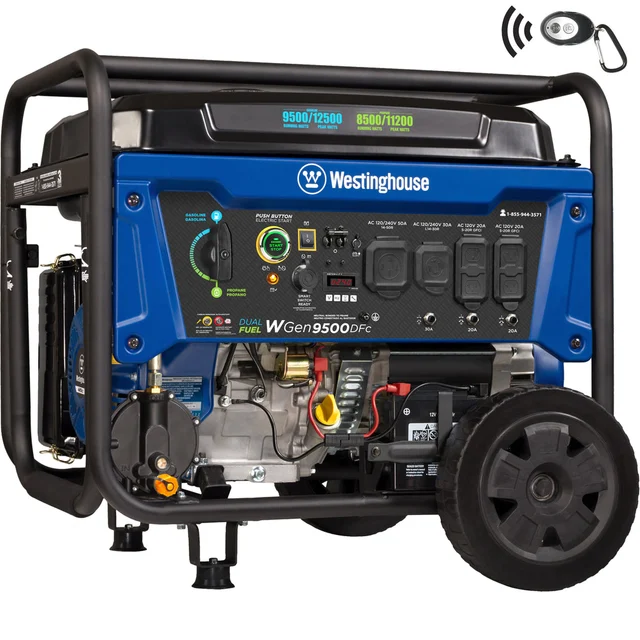
- Buy Westinghouse WGen9500DFc The no-drama dual-fuel workhorse that covers a whole home for a sensible spend. Amazon
- Buy Westinghouse iGen12000DFc Whole-home output with inverter-clean power, if you can stretch the budget. Amazon
- It depends Champion 4500W Electric Start Dual Fuel Inverter (201278) A quiet, mid-size dual-fuel inverter for essentials, RVs, and small backup needs, not the whole house. Amazon
- Skip DuroMax XP13000EH A powerful, all-metal beast that is overkill for typical home backup. Amazon
What actually matters
- Usable running watts - the wattage the generator can sustain, on both gasoline and propane. This, not the headline peak number, determines whether it can actually keep your loads running.
- Peak (starting) watts - the brief surge capacity for motors. Fridges, well pumps, and AC compressors draw several times their running watts for a second or two at startup, so this must clear your largest motor's surge.
- Power quality (THD) - how clean the electricity is. Sensitive electronics (laptops, modern TVs, some furnace control boards) want low-distortion power; a cheap conventional unit can run 'dirty' enough to stress them.
- Fuel flexibility - gasoline for maximum output, propane for clean long-term storage and easy cold starts. Dual-fuel units give you both and are far more forgiving if you store fuel for months between outages.
- Carbon-monoxide safety - a built-in CO auto-shutoff sensor that kills the engine if CO builds up. This is the single most important safety feature and should be non-negotiable.
- Livability - noise and weight. You live with both; a 61 dBA, 99-pound inverter is a different animal from a 74 dBA, 212-pound open-frame unit you can barely reposition.
- Starting method - electric or remote start versus a pull cord. When the power fails at 3 a.m. in bad weather, push-button or key-fob start earns its keep.
The specs, in plain English
Green flags vs red flags
Green flags
- A built-in CO auto-shutoff sensor is listed as a standard feature, not an add-on.
- The listing states both peak and running watts, separately, for both gasoline and propane.
- Inverter units quote a specific THD figure (e.g., under 3%), showing the maker stands behind power quality.
- Electric or remote start is included, and the unit ships with the cord, battery, and any needed adapters.
- Noise (dBA) and weight are published up front rather than buried or omitted.
- Dual-fuel capability with clear runtime figures at a stated load and fuel type.
Red flags
- Only a single big 'watts' number is advertised, with no split between peak and running, or no propane rating for a 'dual fuel' unit.
- No mention of a CO shutoff sensor anywhere in the specs.
- A conventional (non-inverter) unit marketed as safe for sensitive electronics without any THD figure.
- Wildly optimistic runtime claims with no stated load level ('runs all day').
- The wattage is far larger than your real loads, a sign you're about to overpay in cost, weight, fuel, and noise.
- Missing or vague weight/noise numbers, often a tell that they're unflattering.
Who's who: the brands
- Westinghouse - Broad home-backup lineup spanning value open-frame units and quieter dual-fuel inverters; with CO sensors and remote start listed on the models reviewed here.
- DuroMax - Rugged, high-output open-frame and dual-fuel machines favored for large homes and job sites; heavy and powerful rather than quiet.
- Honda - Premium inverter generators with a reputation for reliability, quiet running, and clean power, at a price to match.
- Champion - Popular mainstream maker offering dual-fuel and inverter units across a wide price range, a common value pick for essentials backup; its CO Shield models add a carbon-monoxide auto shutoff.
- Generac - Well-known generator brand spanning portable inverters and larger backup units, widely available and beginner-friendly.
How to read a listing without getting fooled
Start with the running (rated) watts, not the giant peak number on the front of the box, then check whether that rating is quoted on gasoline or propane, because propane output is usually a bit lower. Confirm the peak/surge figure clears your single largest motor load (typically a well pump, AC compressor, or fridge) on top of whatever else is already running. If the seller only shows one 'watts' number, be suspicious. For a 'dual fuel' claim, look for a real propane rating and hose; for an 'inverter' or 'electronics-safe' claim, look for a stated THD figure under about 3%. Then read the livability specs, dBA and weight, since a spec-sheet champion you can't move or tolerate the noise of is the wrong buy. Finally, verify the CO auto-shutoff sensor is standard, and treat any runtime claim without a stated load level as marketing, not data.
How much should you spend?
Spend where it maps to a real need, not to a bigger headline number. The value sweet spot for whole-home essentials is a conventional dual-fuel unit in the roughly 9,000-to-9,500 running-watt range: it covers a fridge, furnace, well pump, and lights for the least money per usable watt. Paying up for an inverter is worth it when you'll run sensitive electronics or want meaningfully quieter operation, that premium buys clean power and lower noise, not more watts. Paying up for a compact inverter is worth it if your true need is essentials, an RV, or portability rather than the whole house. Where spending more is usually wasted: buying far more wattage than your loads require. Oversized units cost more to buy, burn more fuel, weigh more, and run louder, every day, for capacity you'll rarely touch. Over-buying is a common regret.
Questions, answered
How do I run a portable generator without risking carbon-monoxide poisoning?
This is the single most important rule and it outranks every spec: a running generator produces carbon monoxide, an invisible, odorless gas that can kill within minutes. Never run a generator indoors, in a garage, in a shed, on a covered porch, or in any partially enclosed space, even with the doors and windows open, ventilation does not make it safe. Place it outdoors on dry ground, well away from the house (at least 20 feet is the widely recommended distance), and point the exhaust away from all doors, windows, and vents so fumes can't drift back inside. Strongly favor a model with a built-in CO auto-shutoff sensor, which automatically kills the engine if CO builds up, but treat that sensor as a backstop, not a license to place the unit carelessly. Also install battery-powered CO alarms inside your home. If anyone feels dizzy, nauseous, headachy, or weak while the generator is running, get everyone to fresh air immediately.
How many watts do I actually need to back up my home?
Add up the running watts of everything you truly need on at once. Bare essentials, a fridge, a few lights, Wi-Fi, and phone chargers, are a modest load that a compact inverter can handle. Add a furnace blower, a sump or well pump, and a window AC and the total climbs quickly, which is where a 9,000-to-9,500 running-watt dual-fuel unit comes in. Then make sure your peak (starting) wattage clears the surge of your largest motor, since fridges, pumps, and AC briefly draw several times their running watts at startup. Sizing to your real simultaneous loads, rather than to the biggest number you can afford, is how you avoid overpaying.
What's the difference between conventional, inverter, and dual-fuel generators?
Conventional (open-frame) generators run the engine at a fixed speed to make power directly, they're the most output-per-dollar but louder and produce higher-THD ('dirtier') power. Inverter generators condition the output down to very low THD (under about 3%), making them quieter and safe for sensitive electronics like laptops and modern TVs, at a higher price per watt. 'Dual fuel' is a separate axis entirely: it describes the fuel source (gasoline or propane), not the power type. A generator can be dual-fuel and conventional, or dual-fuel and an inverter.
How do I connect a generator to my house safely?
For a handful of devices, run heavy outdoor-rated extension cords from the generator to each appliance. To power hardwired circuits like a furnace or well pump, have a licensed electrician install a manual transfer switch or an interlock kit at your panel. Never plug a generator into a wall outlet to 'backfeed' the house, it can electrocute utility workers down the line and destroy your equipment. Use the transfer switch to isolate your home from the grid whenever the generator is running.
Can I run a generator in the rain, and how should I store fuel?
Don't operate a generator in rain or standing water unprotected. Use a purpose-made open-sided generator cover or canopy that shields it while still allowing airflow and heat to escape, and always plug into GFCI-protected outlets. For fuel, dual-fuel units have a real edge: propane does not go stale the way gasoline can, while gasoline should be treated with stabilizer and rotated so it doesn't gum up the carburetor. Store fuel in approved containers away from living spaces and ignition sources, and always let the engine cool before refueling.
Is a built-in CO sensor really necessary if I always run it outside?
Yes. Human error is exactly what the sensor protects against, running too close to an open window, tucking it under an overhang during a storm, or a wind shift blowing exhaust back toward the house. The sensor is an automatic backstop that shuts the engine down before CO reaches dangerous levels, and in 2026 there's no good reason to buy a unit without one. Just remember it's a second line of defense: correct outdoor placement, far from doors and windows, is still the first.
Or jump to the head-to-head: Westinghouse WGen9500DFc vs Westinghouse iGen12000DFc.