

Home & Kitchen
The Best Portable Generators for Home Backup: 4 Compared (and One to Skip)
We compared four current gas and dual-fuel/inverter portable generators for home backup on power, power quality, noise, portability, and carbon-monoxide safety.
The short version
Most homeowners should buy the Westinghouse WGen9500DFc: it delivers dual-fuel whole-home output, remote start, and a carbon-monoxide auto-shutoff sensor for a sensible price. If you want quieter, inverter-clean power for sensitive electronics and can spend more, the iGen12000DFc is the upgrade. The Champion 4500W dual-fuel inverter is excellent but only if your goal is essentials, an RV, or a small setup, not the whole house. We'd skip the DuroMax XP13000EH for typical home backup: it's a capable, powerful machine, but at 234 pounds, non-inverter, and 13kW it's more generator than most homes need. Whatever you buy, insist on a model with a built-in CO shutoff sensor and never run it indoors or near windows. Best for: homeowners who want reliable, safe, whole-home backup without overpaying for capacity they'll never use.
Our picks at a glance
- Westinghouse WGen9500DFc - Buy. The no-drama dual-fuel workhorse that covers a whole home for a sensible spend.
- Westinghouse iGen12000DFc - Buy. Whole-home output with inverter-clean power, if you can stretch the budget.
- Champion 4500W Electric Start Dual Fuel Inverter (201278) - It depends. A quiet, mid-size dual-fuel inverter for essentials, RVs, and small backup needs, not the whole house.
- DuroMax XP13000EH - Skip. A powerful, all-metal beast that is overkill for typical home backup.
The verdict in 30 seconds
What mattered most
- Power, gas (peak / running)
- Power type & quality
- CO auto-shutoff sensor
- Noise (about)
- Weight
- Fuel & starting
When the power goes out, a portable generator keeps your fridge cold, your furnace running, and your phones charged. But 'portable generator' covers everything from a compact inverter to a 234-pound open-frame beast, and the wrong choice means wasted money, wasted fuel, or power too dirty for your electronics. We worked from maker specifications and owner reports on four current 2026 models: two we'd buy, one that's the right call only for specific buyers, and one capable machine that's simply the wrong tool for most homes. Every pick here has a built-in carbon-monoxide shutoff sensor, because in 2026 there is no good reason to buy one without it.
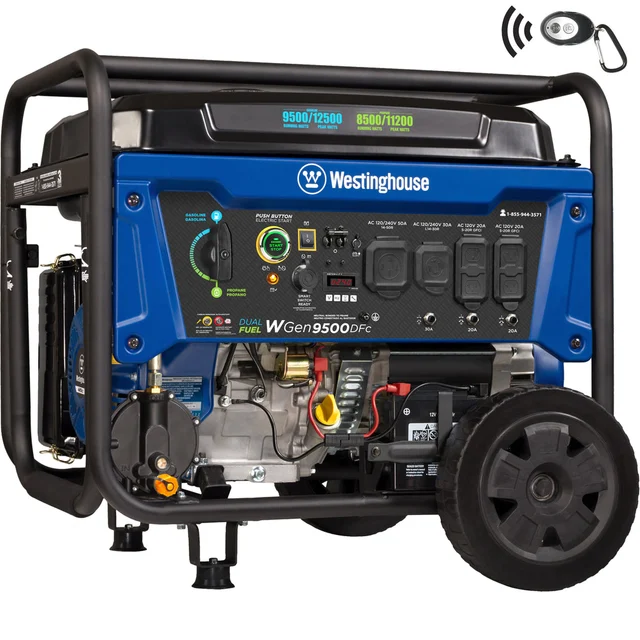
The no-drama dual-fuel workhorse that covers a whole home for a sensible spend.
Best for: Homeowners who want dependable whole-home backup and value output-per-dollar over whisper-quiet running.
- 12,500 peak / 9,500 running watts on gas comfortably runs a fridge, furnace, well pump, and lights at once
- Dual fuel: run gasoline for max output or propane for cleaner storage and easy long-term fuel keeping
- Push-button electric start with an included remote key fob, plus a backup recoil cord
- Built-in CO sensor that automatically shuts the engine down if dangerous carbon-monoxide levels build up
- Conventional open-frame design produces higher-THD power than an inverter, so it is not the first choice for the most sensitive electronics
- At around 212 pounds and roughly 74 dBA it is heavy to reposition and clearly audible from the yard
Own the Westinghouse WGen9500DFc? Tell us how it held up.
Thanks. Counted, and shown once enough owners have weighed in.
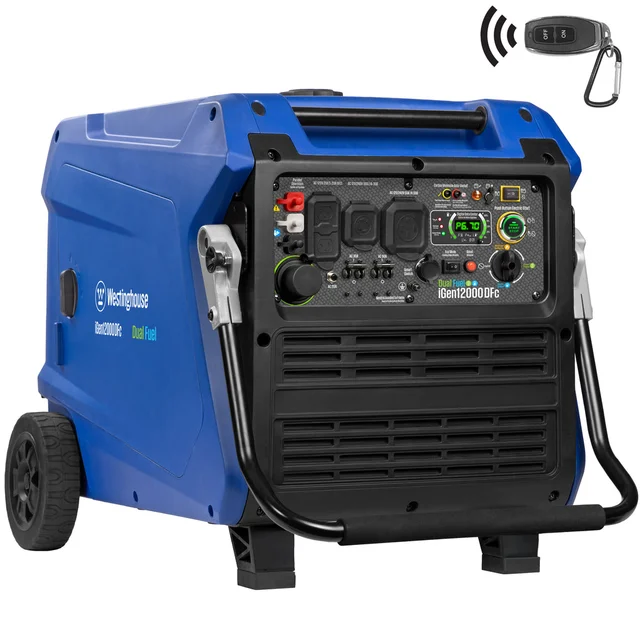
Whole-home output with inverter-clean power, if you can stretch the budget.
Best for: Homeowners who want to power the whole house including sensitive electronics, quietly, and will pay for inverter power quality.
- Inverter design delivers less than 3% total harmonic distortion, safe even for laptops, TVs, and other sensitive electronics
- 12,000 peak / 9,000 running watts on gas is enough for most whole-home essential loads
- Noticeably quieter than an open-frame unit at around 64 dBA, and lighter than you'd expect at about 189 pounds
- Dual fuel plus remote electric start and a built-in CO auto-shutoff sensor
- Costs meaningfully more than a conventional generator of similar output
- Still a large wheeled unit, not something you carry, and running watts sit slightly below the open-frame WGen9500DFc on gas
Own the Westinghouse iGen12000DFc? Tell us how it held up.
Thanks. Counted, and shown once enough owners have weighed in.
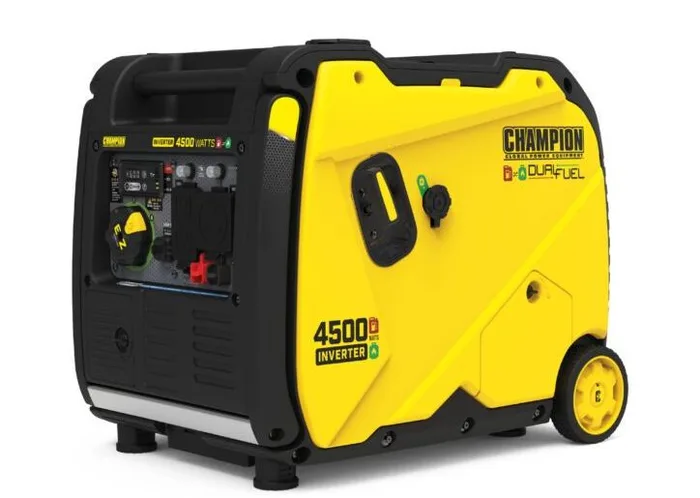
A quiet, mid-size dual-fuel inverter for essentials, RVs, and small backup needs, not the whole house.
Best for: Apartment dwellers, RVers, and homeowners who only need to keep the fridge, Wi-Fi, and a few lights alive.
- Champion rates it at 61 dBA from 23 feet, the lowest noise rating here, and at 99.2 pounds it is roughly half the weight of the whole-home units
- Clean inverter power (less than 3% THD), dual fuel, and Champion's CO Shield carbon-monoxide auto shutoff
- Long runtimes, with Champion listing up to 14 hours on gasoline and up to 21 hours on propane at 1/4 load
- 3,500 running watts on gas (3,150 on propane) covers essentials like a fridge and a few circuits, not a whole home with a well pump or central AC
- Electric and recoil start only, with no remote start listed
Own the Champion 4500W Electric Start Dual Fuel Inverter (201278)? Tell us how it held up.
Thanks. Counted, and shown once enough owners have weighed in.
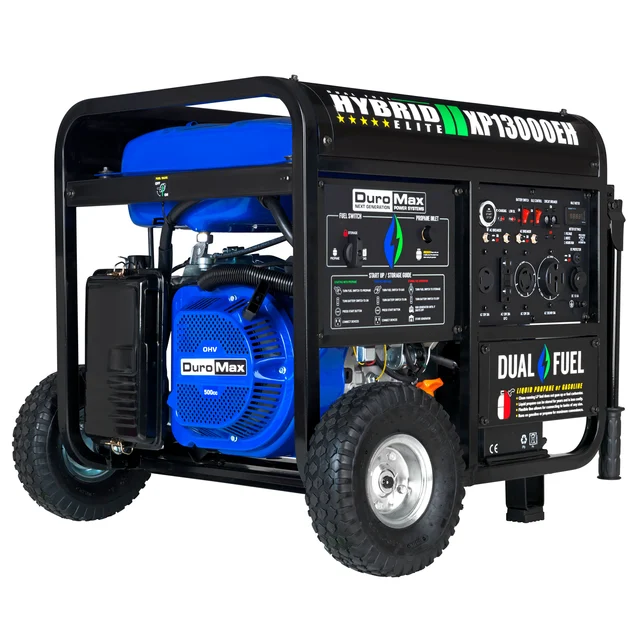
A powerful, all-metal beast that is overkill for typical home backup.
Best for: Large homes with heavy simultaneous loads or worksites that truly need 13kW and don't mind the size.
- Huge 13,000 peak / 10,500 running watts on gas for large homes or job sites
- Dual fuel and all-metal construction, with a CO shutdown sensor included
- Recoil and electric start, and DuroMax lists a 3-year warranty
- At 234 pounds it is hard to move, even on its wheels, and DuroMax lists 74 dB
- Conventional (non-inverter) power is less ideal for sensitive electronics
- 13kW is more than many homes will draw, so you pay in purchase cost, fuel, weight, and noise for capacity you may not use
Own the DuroMax XP13000EH? Tell us how it held up.
Thanks. Counted, and shown once enough owners have weighed in.
| Criteria | Westinghouse WGen9500DFc Top pick Buy it Buy | Westinghouse iGen12000DFc Buy it Buy | Champion 4500W Electric Start Dual Fuel Inverter (201278) It depends Buy | DuroMax XP13000EH Skip it Buy |
|---|---|---|---|---|
| Best for | Homeowners who want dependable whole-home backup and value output-per-dollar over whisper-quiet running. | Homeowners who want to power the whole house including sensitive electronics, quietly, and will pay for inverter power quality. | Apartment dwellers, RVers, and homeowners who only need to keep the fridge, Wi-Fi, and a few lights alive. | Large homes with heavy simultaneous loads or worksites that truly need 13kW and don't mind the size. |
| Price tier | $$$ · premium | $$$$ · flagship | $$ · mid-range | $$$ · premium |
| Power, gas (peak / running) | 12,500 / 9,500 W | 12,000 / 9,000 W | 4,500 / 3,500 W | 13,000 / 10,500 W |
| Power type & quality | Conventional open-frame | Inverter, <3% THD | Inverter, <3% THD | Conventional open-frame |
| CO auto-shutoff sensor | Yes | Yes | Yes | Yes |
| Noise (about) | ~74 dBA | ~64 dBA | 61 dBA at 23 ft | ~74 dBA |
| Weight | ~212 lb | ~189 lb | 99.2 lb | ~234 lb |
| Fuel & starting | Gas + propane, electric + remote | Gas + propane, electric + remote | Gas + propane, electric + recoil | Gas + propane, electric + recoil |
| Best use | Whole-home value backup | Whole-home clean power | Essentials / RV / small loads | Large home or job site |
| Price tier | $$$ · premium | $$$$ · flagship | $$ · mid-range | $$$ · premium |
Which one is right for you?
- Homeowners who want dependable whole-home backup and value output-per-dollar over whisper-quiet running. Buy it Westinghouse WGen9500DFc
- Homeowners who want to power the whole house including sensitive electronics, quietly, and will pay for inverter power quality. Buy it Westinghouse iGen12000DFc
- Apartment dwellers, RVers, and homeowners who only need to keep the fridge, Wi-Fi, and a few lights alive. It depends Champion 4500W Electric Start Dual Fuel Inverter (201278)
- Large homes with heavy simultaneous loads or worksites that truly need 13kW and don't mind the size. Skip it DuroMax XP13000EH
How we judged the field
We don’t run our own generator lab. Instead, we work from maker specifications and aggregated owner reports, then weigh what actually matters when the lights go out. Five things drove our verdicts:
- Usable power - not just the headline peak number, but the running watts on gasoline and propane, and whether the surge (starting) capacity can handle motor-driven loads like fridges and pumps.
- Power quality - conventional open-frame units are cheaper per watt but produce higher-THD power; inverters deliver cleaner power that’s safe for sensitive electronics.
- Carbon-monoxide safety - every pick here includes a built-in CO auto-shutoff sensor, which in 2026 we treat as a baseline requirement, not a bonus.
- Livability - noise, weight, fuel flexibility, and how easy the unit is to start and reposition.
- Value - whether you’re paying for capability you’ll actually use.
Across the field, one theme stood out in owner reports: the most common regret isn’t buying too little generator, it’s buying too much, and then wrestling with the weight, fuel appetite, and noise.
Westinghouse WGen9500DFc
Buy itThis is the default recommendation for a reason. On gasoline it puts out 12,500 peak and 9,500 running watts, enough to keep a fridge, furnace, well pump, and lights going together, and it runs on propane too when you’d rather store clean fuel long-term. Westinghouse lists push-button electric start with an included remote key fob, plus a backup recoil start, and the built-in CO sensor that shuts the engine down if carbon monoxide builds up. It’s a conventional open-frame unit, so at roughly 74 dBA and about 212 pounds it’s audible and heavy, and its power is a touch ‘dirtier’ than an inverter’s. For the vast majority of home-backup buyers, none of that outweighs the output-per-dollar.
Westinghouse iGen12000DFc
Buy itIf your budget stretches and you want the whole house and clean power, this is the upgrade. It’s an inverter, so output is conditioned to under 3% THD, safe for laptops, TVs, and anything else sensitive, at 12,000 peak and 9,000 running watts on gas. Westinghouse rates it as low as 64 dBA, versus 74 dBA for the WGen9500DFc, and at 189 pounds it is lighter than that unit. It’s dual fuel with remote electric start and the same CO auto-shutoff sensor. The trade-off is price: you pay a clear premium over a conventional generator of similar output, and its gas running watts sit just under the WGen9500DFc. For electronics-heavy homes that want quiet, clean, whole-home power, it’s worth it.
Champion 4500W Electric Start Dual Fuel Inverter (201278)
It dependsThis inverter is genuinely good, just at a different job. Champion rates it at 61 dBA from 23 feet, the lowest noise rating in this comparison, and at 99.2 pounds it is about half the weight of the whole-home units. It gives you clean inverter power (less than 3% THD), dual fuel, Champion’s CO Shield auto shutoff, and long runtimes: up to 14 hours on gasoline or 21 hours on propane at 1/4 load. But 3,500 running watts on gas (3,150 on propane) is an essentials budget: a fridge, Wi-Fi, chargers, and a few circuits, not a whole home with a well pump or central air. It also starts by electric start or recoil, with no remote fob listed. Buy it if that’s your actual need. If you’re backing up a house, it’s not enough generator.
DuroMax XP13000EH
Skip itLet’s be fair: this is a capable, rugged, well-liked machine, and it does include a CO shutdown sensor. But for typical home backup it’s the wrong buy. It’s a conventional (non-inverter) open-frame unit putting out 13,000 peak and 10,500 running watts, which is far more than most homes will ever draw, and you pay for that capacity in every way that matters day to day: it weighs 234 pounds and is a real chore to move even on its wheels, and DuroMax lists 74 dB, the same as the WGen9500DFc. Unless you’re running a large home with heavy simultaneous loads or a job site, you’ll get safer, quieter, cleaner, and cheaper-to-run backup from a 9,500-watt dual-fuel unit. Capable generator; wrong tool for the job.
Sources
Specs in this review come from these pages.
- Westinghouse, WGen9500DFc Dual Fuel with CO Sensor product page (westinghouse.com)
- Westinghouse, iGen12000DFc Inverter Generator Dual Fuel with CO Sensor product page (westinghouse.com)
- Champion Power Equipment, 4500W Electric Start Dual Fuel Inverter 201278 product page (championpowerequipment.com)
- DuroMax, XP13000EH 13,000 Watt Dual Fuel Portable Generator product page (duromaxpower.com)
Westinghouse WGen9500DFc vs Westinghouse iGen12000DFc: which should you buy?
These two are the head-to-head that matters, because both can back up a whole home, and the decision comes down to power quality versus price. The WGen9500DFc is the value champion: conventional open-frame power, slightly higher running watts on gas, remote start, CO shutoff, and a friendlier price. The iGen12000DFc costs meaningfully more, but its inverter design delivers under 3% THD, so it’s safe for sensitive electronics, and it runs quieter (about 64 vs 74 dBA) and a bit lighter. If your backup loads are the usual suspects, fridge, furnace, pump, lights, and you don’t obsess over electronics, the WGen9500DFc is the smarter spend. If your home leans heavily on sensitive electronics or you simply want the quietest, cleanest whole-home power available here, pay up for the iGen12000DFc. Either way, both include the CO safety sensor we consider mandatory.
What to look for
- A built-in CO auto-shutoff sensor - non-negotiable in 2026. All four picks have one.
- Running watts for your real loads - total up what runs simultaneously; don’t be seduced by the peak number alone.
- Power type - inverter for sensitive electronics and quiet running; conventional for maximum output-per-dollar.
- Dual fuel - gasoline for output, propane for clean, long-term fuel storage and easy starts.
- Electric/remote start - a huge convenience when the power fails at 3 a.m. in bad weather.
- Noise and weight - you’ll live with both; lighter and quieter is worth a lot if you’ll move or store the unit often.
- A transfer switch or interlock - budget for professional installation if you want to power hardwired circuits safely. Never backfeed through a wall outlet.
Our final take
For most homes, the Westinghouse WGen9500DFc is the right call: enough dual-fuel power to run the house, remote start, a CO shutoff sensor, and honest value. Step up to the iGen12000DFc if you want quieter, inverter-clean power for electronics and can spend more. The Champion 4500W dual-fuel inverter is a superb mid-size unit, but only for essentials, RVs, or small setups, not a whole house. And we’d skip the DuroMax XP13000EH for typical home backup, not because it’s bad, but because it’s far more generator than most homes need, at a cost in weight, noise, and fuel. Above all, remember the one rule that outranks every spec on this page: run your generator outdoors, far from windows and doors, never in a garage or enclosed space, and back up your CO sensor with CO alarms inside the home. The best generator is the one that keeps your lights on without ever putting your family at risk.
Questions, answered
How do I use a portable generator without risking carbon-monoxide poisoning?
This is the single most important thing to get right: a running generator produces carbon monoxide, an invisible, odorless gas that kills quickly. Never run a generator indoors, in a garage, in a shed, on a porch, or in any partially enclosed space, even with doors and windows open. Place it outdoors, well away from the house, and point the exhaust away from doors, windows, and vents, at least 20 feet from the building is the widely recommended distance. Buy a model with a built-in CO auto-shutoff sensor, which all four generators here have, but treat that as a backup, not a license to place it carelessly. Also install battery-powered CO alarms inside your home. If anyone feels dizzy, nauseous, or weak, get to fresh air immediately.
How many watts do I need to back up my home?
Add up the running watts of what you actually need on at once. Essentials, a fridge, a few lights, Wi-Fi, and phone chargers, add up to a modest load that a mid-size inverter like the Champion 4500W (3,500 running watts on gas) can handle. Add a furnace blower, sump or well pump, and a window AC and the load climbs fast, which is where the WGen9500DFc or iGen12000DFc (9,500 and 9,000 running watts on gas) come in. Remember that motors (fridges, pumps, AC) draw a brief surge several times their running watts at startup, which is why peak (starting) wattage is listed separately.
What's the difference between a conventional, dual-fuel, and inverter generator?
Conventional (open-frame) generators run the engine at a fixed speed and are the most output-per-dollar, but they're louder and produce higher total harmonic distortion (THD), or 'dirtier' power. Inverter generators electronically condition the output to under about 3% THD, making them quieter and safe for sensitive electronics like laptops and modern TVs. 'Dual fuel' refers to the fuel source, not the power type: it means the unit runs on gasoline or propane. All four models here are dual fuel; the WGen9500DFc and DuroMax are conventional, while the iGen12000DFc and the Champion 4500W are inverters.
How do I connect a portable generator to my house safely?
For a few devices, run outdoor-rated extension cords from the generator to each appliance. To power hardwired circuits (furnace, well pump), have a licensed electrician install a manual transfer switch or an interlock kit at your panel. Never plug a generator into a wall outlet to 'backfeed' the house, it can electrocute utility workers and destroy your equipment. Use the transfer switch to isolate your home from the grid whenever the generator is running.
Can I run a generator in the rain, and how should I store fuel?
Don't operate a generator in rain or standing water without protection, use a purpose-made open-sided generator cover or canopy that shields it while still allowing airflow and heat to escape, and always plug into GFCI-protected outlets. For fuel, dual-fuel units have a real advantage: propane does not go stale the way gasoline can, while gasoline should be treated with stabilizer and rotated. Store fuel in approved containers away from living spaces and ignition sources, and let the engine cool before refueling.
Deciding between the top two? See our head-to-head: Westinghouse WGen9500DFc vs Westinghouse iGen12000DFc.
More in Home & Kitchen
Portable Generators, Explained Plain-English guide → Westinghouse WGen9500DFc vs Westinghouse iGen12000DFc Head-to-head →  The Best Pressure Canners: 4 Compared (and One to Skip)
  The Best Range Hoods: 4 Compared (and One to Skip)
  The Best Reusable Food Storage Bags: 6 Compared (and One to Skip)
  The Best Reverse Osmosis Systems: 4 Compared (and One to Skip)