Explained
Nonstick Cookware Sets, Explained
After reading this, you will understand what makes a nonstick set last, which specs actually matter, and how to avoid the bundles that quit within months.
In this guide
Every nonstick pan is a consumable: the real question is not whether the coating will wear out, but how slowly. The category is crowded with look-alike bundles that promise easy eggs, yet many lose their slickness inside a year or two. Buyers usually get tripped up by shiny marketing terms and generous piece counts, when the things that decide longevity are the coating type, the body construction, and how the set is treated.
The 30-second version
- A nonstick coating is a wear part. You are buying a slick surface with a limited lifespan, so how you treat it matters as much as what you pay.
- Body construction beats the coating name. A thick, evenly heating base with a bonded stainless layer outlasts a thin stamped pan no matter what the surface is called.
- Metal utensils are the number-one killer. Unless a set is specifically rated for metal, a single scratch starts the decline, so buy for how you actually cook.
- PTFE and ceramic are a trade-off, not a ranking. PTFE releases better and lasts longer; ceramic avoids PTFE and PFAS and takes higher heat but fades sooner.
- Match your spend to your expectations. A budget set is fine as a stopgap you plan to replace; a premium set only pays off if you handle it gently.
The products this guide is about
Our verdict on each, with the full reasoning on the companion review.
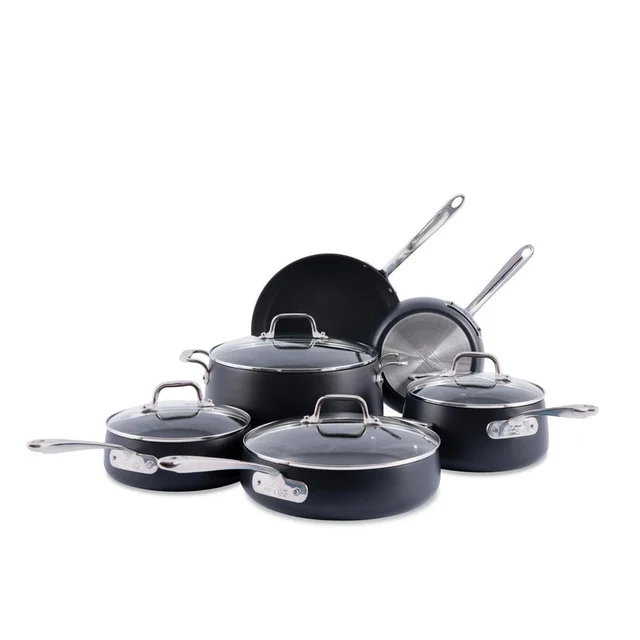
- Buy All-Clad HA1 Expert Nonstick Cookware Set A hard-anodized set with a bonded stainless base that heats evenly, runs on induction, and takes a 500-degree oven. Amazon
- Buy Circulon A1 Series with ScratchDefense Nonstick Cookware Set The most durable coating here, rated for metal utensils, on an induction-ready hard-anodized body. Amazon
- It depends Tramontina Sicilia Aluminum Nonstick Cookware Set A light, genuinely nonstick budget set that is slick when new but stovetop-only and short-lived. Amazon
- Skip Gotham Steel Hammered Copper Nonstick Cookware Set A photogenic hammered-copper bundle whose ceramic coating tends to stop releasing within months. Amazon
What actually matters
- Coating durability is the single biggest factor, because a nonstick pan is only as good as how long it keeps releasing food.
- Body construction and thickness determine whether heat spreads evenly or scorches in hot spots, and whether the pan warps over time.
- Induction compatibility decides whether the set works on your stovetop at all; it requires a magnetic base that lightweight aluminum lacks.
- Oven-safe rating sets how versatile the set is, but only matters if you actually finish dishes under a broiler or in the oven.
- Metal-utensil tolerance protects the coating from the most common cause of failure, so it is worth more than the marketing suggests.
- Handle and lid construction shape daily comfort and safety, and are what owners complain about long after the novelty fades.
- Care requirements such as dishwasher tolerance versus hand-washing quietly determine how fast the coating degrades in real use.
The specs, in plain English
Green flags vs red flags
Green flags
- A thick, hard-anodized or bonded body that feels substantial rather than flimsy
- A magnetic stainless base if you need induction support
- A coating explicitly rated for metal utensils when you know you will use them
- A clearly stated oven-safe temperature for both the pan and its lids
- Secure, riveted handles rather than ones that feel glued or bolted on lightly
Red flags
- A very thin, lightweight body that heats fast and warps easily
- Vague durability claims with no mention of how the coating holds up over time
- Owner feedback reporting sticking or staining within the first few months
- Oversized bundles that pad the piece count with low-value extras
- A warranty that excludes the nonstick performance itself, which is what actually fails
- Induction marketed inconsistently, suggesting the base may not reliably work
Who's who: the brands
- All-Clad - A premium American cookware maker known for even-heating bonded construction and high oven ratings.
- Circulon - Specializes in durable nonstick, including coatings tough enough to tolerate metal utensils.
- Tramontina - A Brazilian brand offering honest, genuinely slick budget sets that are light and affordable.
- Gotham Steel - Markets photogenic hammered-copper ceramic bundles that often prioritize looks over lasting performance.
- T-fal - A widely available value brand best known for PTFE pans with a heat-indicator dot.
- Calphalon - A mainstream maker of hard-anodized nonstick lines positioned between budget and premium.
How to read a listing without getting fooled
Start by decoding the body before the coating. Words like 'hard-anodized' or 'bonded stainless base' signal a pan built to heat evenly and last; 'stamped' or simply 'aluminum' usually means light and thin. Check the oven-safe rating for both the pan and the lids, since glass lids are often capped lower than the pan itself, and treat any 'up to 500 degrees' claim on a thin body with skepticism. Confirm induction compatibility with a plain test: if a magnet does not stick to the base, it will not work on induction regardless of what the listing implies. Read the coating line for whether it is rated for metal utensils, and note the piece count critically, because a large bundle is only a bargain if the pieces you actually use are good. Finally, skim owner feedback for the phrase that matters most: how the set performs after several months, not on day one.
How much should you spend?
Think of price as setting expectations rather than guaranteeing quality. Budget sets are genuinely useful as a first kitchen or a stopgap, and they are not disqualified for being thin or short-lived, only for pretending otherwise; plan to replace them. The value sweet spot sits in the mid-range, where a durable hard-anodized body, a metal-utensil-tolerant coating, and induction support come together without a premium markup. Spending more is worth it when you want the most even heat, the highest oven ceiling, and a set you intend to keep for several years and will treat gently. Spending more is not worth it if you are rough on cookware, since a premium coating scratched by a metal spatula fails just as surely as a cheap one. The costliest mistake is paying for a bundle whose piece count is high but whose coating quits within a season.
Questions, answered
How long should a nonstick set last?
With gentle use, a quality PTFE set lasts roughly three to five years before release fades, and the toughest coatings stretch further. Budget aluminum sets often decline within one to two years, and ceramic tends to wear fastest, sometimes under a year. Hand-washing and soft utensils meaningfully extend any set's life.
Is ceramic or PTFE nonstick better?
They trade off rather than one being clearly better. PTFE releases food more reliably and lasts longer, but some buyers avoid it on principle. Ceramic is free of PTFE and PFAS and handles higher heat, yet it loses slickness sooner and rarely matches PTFE for longevity. Choose based on which priority matters more to you.
Do I need an induction-compatible set?
Only if you cook on an induction cooktop, which requires cookware with a magnetic base. Hard-anodized sets with a bonded stainless base work on induction; lightweight aluminum sets generally do not. The simplest check is whether a magnet sticks to the bottom of the pan. Confirm your stovetop before buying.
What is the fastest way to ruin a nonstick pan?
Scratching it with metal utensils and overheating an empty pan are the two biggest culprits. Unless a coating is specifically rated for metal, use wood, silicone, or nylon tools. Avoid blasting an empty nonstick pan on high heat, and let it cool before washing to slow the coating's wear.
Are nonstick coatings safe to use?
For everyday cooking, yes, when used as directed. Modern PTFE coatings are PFOA-free and stable at normal cooking temperatures; the main caution is not to overheat an empty pan past roughly 500 degrees. Ceramic coatings avoid PTFE entirely. This is general product information, not health advice; consult a professional for specific concerns.
Are more pieces in a set always better?
No. Piece counts are often inflated with lids and low-value extras that pad the number without adding cooking capability. A smaller set of well-made, frequently used pans usually serves you better than a large bundle of thin pieces you rarely reach for. Judge the set by the quality of the pieces you will actually cook with.
Or jump to the head-to-head: All-Clad HA1 Expert Nonstick Cookware Set vs Circulon A1 Series with ScratchDefense Nonstick Cookware Set.