Explained
Meat Grinders, Explained
After reading this you'll understand grinder sizing, motor and gear specs, and be able to pick the right meat grinder for your kitchen without overpaying.
In this guide
A standalone electric meat grinder lets you make your own burger, sausage, and wild-game blends with control over freshness and fat that pre-ground meat can't match. But listings are full of confusing numbers, head sizes like #5, #8, and #22, horsepower and wattage claims, and gear talk, and it's easy to either overbuy a commercial machine or grab a cheap one that fails in a season. This guide decodes those terms so you can match a grinder to how you actually cook.
The 30-second version
- The #8 size class is the home sweet spot. For most households it grinds burger, sausage, and game fast enough without turning into a bulky commercial appliance.
- Metal gears and a metal head are a key durability test. Plastic gears are where cheap grinders strip and fail, so this spec is a strong signal of longevity.
- Right-size the grinder to your batches, not the biggest motor. A commercial machine's throughput is capacity a home cook will realistically never use.
- Be wary of inflated wattage headlines. Marketing watts are often peak, not sustained, so motor design and real-world throughput matter far more than a big number.
- Chilling everything beats extra power. Near-frozen meat and parts grind cleaner and protect the motor more than a few added watts ever will.
The products this guide is about
Our verdict on each, with the full reasoning on the companion review.
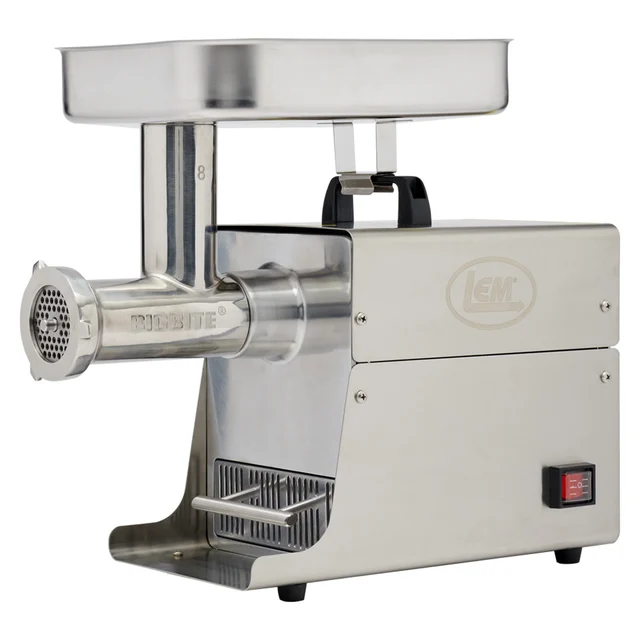
- Buy LEM Big Bite #8 Meat Grinder (0.5 HP) The home-use sweet spot: enough power for game and sausage without turning into a commercial appliance. Amazon
- Buy The Sausage Maker #8 Electric Meat Grinder PRO A semi-commercial #8 grinder with a permanently lubricated motor and a built-in storage drawer, per earlier listings. The Sausage Maker's site no longer lists this model.
- It depends LEM Big Bite #5 Meat Grinder (0.35 HP) The compact, lower-cost entry point that's plenty for small batches but runs out of muscle on bulk work. Amazon
- Skip Pro-Cut #22 Electric Meat Grinder A true commercial workhorse that's wildly over-specced and over-priced for any home kitchen. Amazon
What actually matters
- Grinder head size (the # number) determines throughput and the diameter of meat that fits, and it's the main way grinders are categorized, so getting the size right matters more than any single spec.
- Motor power decides whether the machine powers through connective tissue and semi-frozen cuts or bogs down and stalls on tough or large batches.
- Gear and head material separate grinders that last a decade from ones that strip in a season; metal generally beats plastic.
- Throughput (pounds per minute) tells you how long big sausage or game days will actually take, which matters if you process in volume.
- Cleanup and part count affect whether you'll actually use the grinder, since a machine that takes forever to strip down and wash gets left in the cupboard.
- Footprint and weight matter in real kitchens, because a powerful grinder that won't fit your counter or cabinet is the wrong grinder.
- Included accessories like extra grinding plates and a stuffing tube decide whether you can make coarse and fine grinds and stuff sausage out of the box.
The specs, in plain English
Green flags vs red flags
Green flags
- An all-metal grinding head with steel drive gears, stated explicitly in the listing
- A head size (like #8) that matches your batch sizes rather than the biggest available
- A motor rated for continuous or sustained use, often described as air-cooled or permanently lubricated
- Multiple grinding plates and a stuffing tube included in the box
- A simple, few-part design that strips down for cleaning quickly
- A meaningful consumer warranty, which signals the maker expects the machine to last
Red flags
- Plastic gears or a mostly plastic grinding head, common on the cheapest models
- Headline wattage far out of step with a tiny, lightweight body (often peak, not real, power)
- A commercial-size unit being marketed for home use, meaning capacity and cost you won't use
- No mention of gear or head material anywhere in the description
- Very few or vague accessories, so you can't change grind fineness or stuff sausage
- A price that seems too good for the claimed power, usually hiding cheap internals
Who's who: the brands
- LEM - Popular home and hunting brand known for its 'Big Bite' grinders, which are rated at up to 7 lb per minute for the
- The Sausage Maker - Sausage-focused brand that sells the Pro-Cut commercial grinders and a
- Pro-Cut - Commercial grinder line sold by The Sausage Maker, with stainless bodies and cast-iron headstocks, built for shops rather than home kitchens.
- STX - Value-oriented brand widely sold for home use, aimed at budget and mid-range buyers.
- Weston - Long-running maker of hunting and home food-processing gear, including grinders across several size classes.
How to read a listing without getting fooled
Start with the head size number, since #5 tells you compact and home-scale while #22 and up flag a commercial machine. Next, find the horsepower and treat any headline wattage with suspicion, because those figures are frequently peak rather than sustained; a modest, honestly stated HP paired with an air-cooled or permanently lubricated motor beats a giant watt number on a flimsy body. Then hunt for the words 'all-metal head' and 'steel gears', and if the listing avoids naming the gear material, assume plastic. Finally, check the accessory list for extra plates and a stuffing tube, and read throughput as a time estimate rather than a bragging point, matching it to how much you actually grind at once.
How much should you spend?
Think in tiers rather than dollar figures. The cheapest grinders tend to cut costs exactly where it hurts, using plastic gears and lightweight housings that wear out fast, so a rock-bottom price is usually a false economy. The mid-range is where compact, honest home grinders live, and that's the right level for occasional small-batch cooks with limited space. The premium home tier, the #8-class machines with all-metal heads and steel gears, is where most regular grinders and hunters get the best long-term value, because durability and manageable size are worth paying up for when you'll use the machine for years. Spending into commercial-flagship territory is only worth it if you're processing at small-business volume; for a home kitchen it buys capacity and bulk you'll never use.
Questions, answered
What does the # number on a meat grinder mean?
It's a standardized head size. Bigger numbers mean a larger grinding head, wider openings, and higher throughput. A #5 is compact and home-scale, a #8 is the popular home sweet spot with plenty of power for burger, sausage, and game, and a #22 or larger is commercial-class, far more than a household needs.
How much power does a home meat grinder actually need?
For most homes, a #8-size grinder around 0.5 HP is a good fit. LEM rates its 0.5 HP #8 at up to 7 pounds per minute. A smaller 0.35 HP unit is fine for occasional small batches, while 1 HP commercial motors are more than a home kitchen will ever use.
Do metal gears really matter versus plastic ones?
Generally yes, this is a major durability difference. Owner reports commonly say that all-metal heads with steel drive gears outlast plastic-geared budget grinders, which can strip or crack under load. If a listing won't name the gear material, assume it's plastic.
Is a stand-mixer grinder attachment good enough instead?
For very light, occasional grinding it can work. But it relies on your mixer's motor, tends to be slower, and can strain the mixer on tough or partially frozen cuts. If you grind regularly or in volume, a dedicated standalone grinder is faster, more durable, and less likely to overheat.
Can a meat grinder also stuff sausage?
Most standalone grinders accept a stuffing tube or horn so you can fill casings, and for occasional sausage that works fine. Dedicated sausage makers often prefer a separate stuffer for cleaner, faster filling. Check that the stuffing accessories are included or available before you buy.
Why shouldn't I just buy the cheapest grinder?
Very inexpensive grinders often use plastic gears, inflated wattage claims, and lightweight housings that struggle with real cuts and wear out quickly. Owner reports commonly say they underperform on throughput and longevity, so a mid-range or premium metal-geared grinder is usually the better long-term value even at a higher upfront cost.
Or jump to the head-to-head: LEM Big Bite #8 Meat Grinder (0.5 HP) vs The Sausage Maker #8 Electric Meat Grinder PRO.