Explained
Kids Telescopes, Explained
After reading, you'll understand what telescope specs really promise, which claims come only from the maker, and what to check before you buy for a child.
In this guide
First-time buyers often compare the biggest magnification on the box and skip the figure that matters, which is aperture. Titles lean on words like powerful, beginner and kid-friendly, which are marketing rather than measurements. Age grades, weight and warranty length are only worth trusting when the maker states them on the page. This guide explains the terms so you can compare listings on what they actually say.
The 30-second version
- Aperture beats magnification, because a larger mirror or lens gathers more light.
- Box magnification is a claim, so check whether the maker states a highest useful figure.
- A stable mount matters, since a shaky tripod ruins even a good optic.
- Weight must suit the child, so use only a stated kit weight.
- Sun safety is the maker's job to state, and you should follow it exactly.
The products this guide is about
Our verdict on each, with the full reasoning on the companion review.
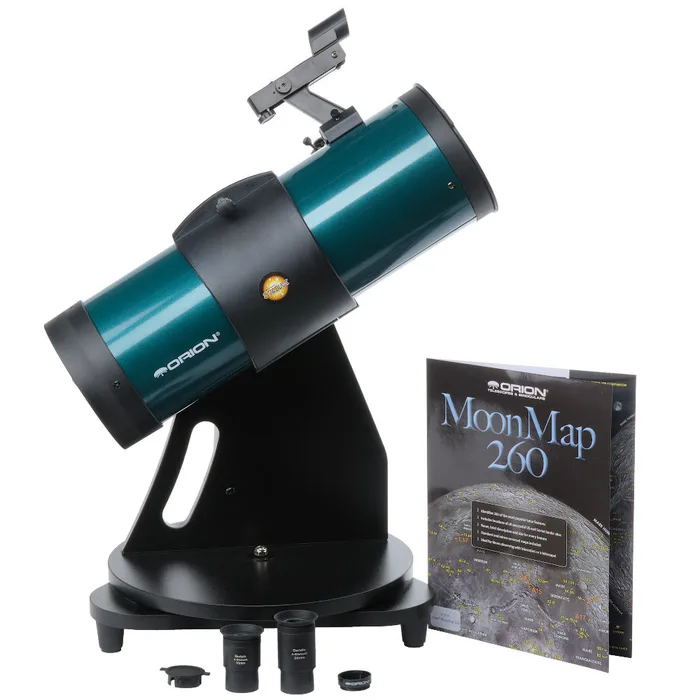
- Buy Orion StarBlast 4.5 Astro Dobsonian A 114 mm tabletop Dobsonian with a 450 mm focal length that is manual, battery-free and 10 lb all-in.
- Buy Celestron National Park Foundation FirstScope A 76 mm tabletop Dobsonian with a 1.4 lb tube and a 4.3 lb total kit weight. Amazon
- Buy National Geographic NT114CF A 114 mm, 500 mm focal length reflector on a full tripod with a panhandle mount and a phone adapter. Amazon
- It depends Sky-Watcher Heritage 150 Tabletop Dobsonian A 150 mm collapsible tabletop Dobsonian at 750 mm focal length, for a family that will keep it. Amazon
- It depends Gskyer 80 Explore (AZ80400) An 80 mm, 400 mm focal length refractor on an altazimuth mount with a phone adapter and Bluetooth remote. Amazon
- Skip Thames & Kosmos Essential STEM Tools Telescope A 40 mm refractor advertised at 20x and 100x, labeled ages 8 and up, with a 1.9 lb tabletop tripod. Amazon
What actually matters
- Aperture - The diameter of the main mirror or lens, in millimeters. It sets how much light is gathered, so a 114 mm scope shows more than a 76 mm one.
- Focal length - The distance the light travels to focus. Divide it by an eyepiece's focal length to get magnification, so 450 mm with a 20 mm eyepiece is about 22x.
- Focal ratio - Focal length divided by aperture, written f/4 or f/5. Lower numbers are faster, with a wider field of view.
- Mount type - A tabletop Dobsonian sits on a table and you push it by hand. An altazimuth mount on a tripod moves up and down and left and right.
- Reflector or refractor - A reflector uses a mirror at the back of the tube. A refractor uses a lens at the front and needs no collimation.
- Eyepieces - Smaller focal lengths give more magnification. A kit with two eyepieces gives two views, and a Barlow lens multiplies them.
- Finder - A red dot or small finderscope helps you aim. Without one, aiming is by eye along the tube.
The specs, in plain English
Green flags vs red flags
Green flags
- The maker lists aperture, focal length and mount type plainly
- A stated kit weight a child can lift
- A finder is included and named
- A stated warranty with a single clear length
- The maker prints a sun warning and an age grade
Red flags
- Magnification is the biggest number in the title
- The listing gives no aperture
- Warranty wording that changes between sections
- Photos that do not match the stated kit contents
- A very small aperture sold on promises of planets and nebulae
Who's who: the brands
- Celestron - A long-established maker with a wide beginner range, including the FirstScope and the Inspire refractors.
- Orion - Known for the StarBlast tabletop Dobsonians and the GoScope travel refractors, with a 2-year warranty.
- Sky-Watcher - Makes collapsible and traditional Dobsonians, from the Heritage tabletops up to large Flextube models.
- National Geographic - Licensed beginner telescopes sold through Explore Scientific, with phone adapters in several kits.
- Thames & Kosmos - A science-toy maker whose kits come with age grades and manuals aimed at young learners.
How to read a listing without getting fooled
Start with aperture, focal length and mount type, then look for a kit weight and a finder. Work out magnification yourself by dividing focal length by eyepiece focal length, and treat any larger figure as a claim. Read the warranty section twice, since some pages state it in more than one place. Finally, read the maker's safety text, including any solar warning, and follow it.
How much should you spend?
Beginner telescopes run from budget to premium tiers, and the tier follows aperture more than anything. The budget tier covers small reflectors and refractor kits, the mid-range adds 114 mm tabletop scopes, and the premium tier covers 150 mm collapsible Dobsonians. Spend on aperture and a stable mount before accessories, and check what is in the box.
Questions, answered
Is a refractor or a reflector better for kids?
Neither wins outright. A reflector gives more aperture for the money but occasionally needs collimation. A refractor uses lenses and needs no collimation, but a given aperture usually costs more. Check what the maker says about setup and care for the model you are considering.
What does f/4 mean on a telescope?
It is the focal ratio, the focal length divided by the aperture. A 450 mm focal length on a 114 mm mirror gives about f/4, and Orion lists f/3.9. Lower numbers give a wider field of view with the same eyepiece.
Do I need a motorized mount for a child's telescope?
No. The scopes in this review are all manual. A manual mount is simpler, and a child learns to find objects. Orion says the StarBlast 4.5 does not find or track objects automatically.
How do I know a magnification claim is realistic?
Look for a highest useful magnification on the maker's page. Orion lists 140x for its 70 mm GoScope III and Celestron lists 241x for its 100 mm Inspire. A claim well beyond that ratio for the aperture, such as 240x on an 80 mm scope, is a marketing number.
Or jump to the head-to-head: Orion StarBlast 4.5 Astro Dobsonian vs Celestron National Park Foundation FirstScope.