

Tech & Gadgets · Head-to-head
Orion StarBlast 4.5 Astro Dobsonian vs Celestron National Park Foundation FirstScope
Which should you buy? Our verdict on both, pulled from our full Kids Telescopes: Which to Buy and Which to Skip comparison.
The StarBlast 4.5 lists a 114 mm mirror on a manual tabletop base weighing 10 lbs in total, the best balance of aperture and simplicity here. The FirstScope lists a 76 mm mirror in a 4.3 lb kit for a lower cost, with a stated solar warning.
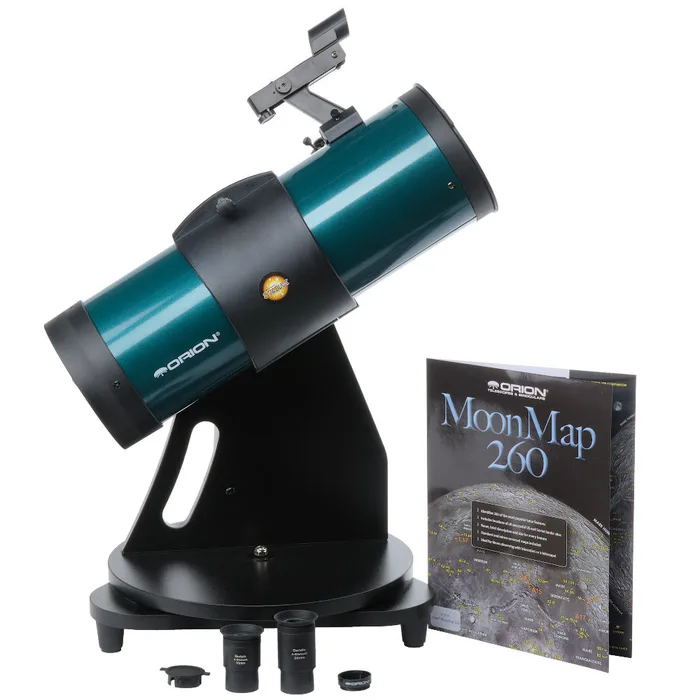
Orion StarBlast 4.5 Astro Dobsonian
Buy itA 114 mm tabletop Dobsonian with a 450 mm focal length that is manual, battery-free and 10 lb all-in.
- Orion lists a 114 mm parabolic primary mirror at f/3.9 and 450 mm focal length, which is a lot of aperture for a scope this small.
- The base is a tabletop Dobsonian with a built-in eyepiece rack, and Orion states the telescope and base weigh 10 lbs together.
- The kit lists 1.25 inch eyepieces for 22x and 45x, a red dot finder, a Moon filter, a collimation cap and a MoonMap 260 lunar map, backed by a 2-year warranty.
- It is fully manual: Orion says it does not find or track objects, so a child has to learn to aim it.
- As a reflector it will occasionally need collimation, which means aligning the mirrors, and the base needs assembly.
- It sits on a table or similar surface, and Orion publishes no age grade for it.
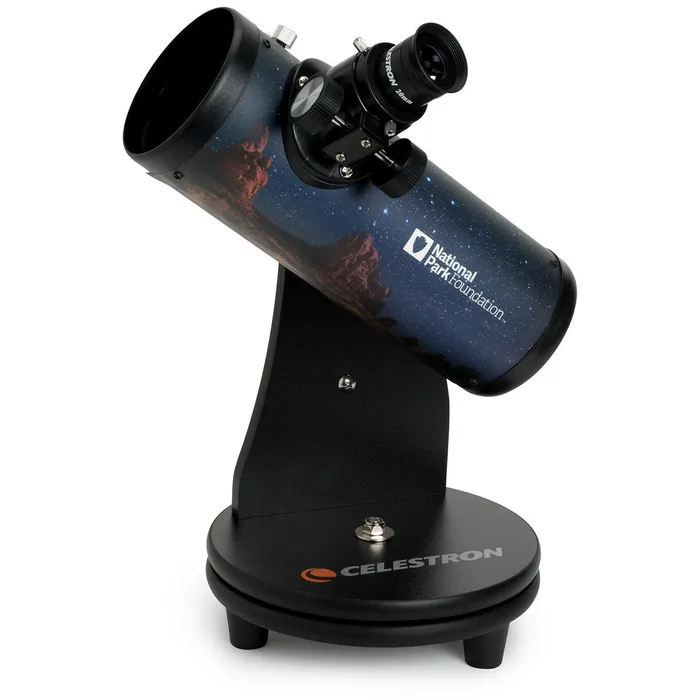
Celestron National Park Foundation FirstScope
Buy itA 76 mm tabletop Dobsonian with a 1.4 lb tube and a 4.3 lb total kit weight.
- Celestron lists a 76 mm Newtonian reflector, 300 mm focal length and f/4, on a manual tabletop Dobsonian mount.
- The tube weighs 1.4 lbs and the whole kit 4.3 lbs, so a child can carry it, and the page calls it a no-tool setup.
- Two eyepieces are included, 20 mm for 15x and 10 mm for 30x, plus a free SkyPortal app and a National Parks guidebook download, with a 2-year warranty shown on the page.
- The page says the finderscope, Barlow lens and star diagonal are not included, so aiming is by eye along the tube.
- The primary mirror is listed as spherical and the optical tube as plastic, which suits a first scope more than a long-term one.
- It is a smaller 76 mm aperture than the 114 mm scopes in this review, and the page gives no age grade.
Side by side
The 8 criteria below are the ones our full comparison judged every product on, narrowed to these two.
| Orion StarBlast 4.5 Astro Dobsonian Our pick | Celestron National Park Foundation FirstScope | |
|---|---|---|
| Our verdict | Buy | Buy |
| Best for | Families who want the most aperture in a simple manual scope that a young teen can carry. | A younger child's first scope, or a gift where the lowest cost and weight matter most. |
| Price tier | $$ · mid-range | $ · budget |
| Aperture | 114 mm | 76 mm |
| Focal length | 450 mm | 300 mm |
| Design | Newtonian reflector | Newtonian reflector |
| Mount type | Manual tabletop Dobsonian | Manual tabletop Dobsonian |
| Included eyepieces | Two 1.25 in (22x, 45x) | 20 mm and 10 mm (15x, 30x) |
| Finder | Red dot finder | Not included |
| Weight as stated | 10 lbs total | 4.3 lbs kit |
| Age grade as stated | Not published | Not published |
Which one is right for you?
Pick the Orion StarBlast 4.5 Astro Dobsonian if
families who want the most aperture in a simple manual scope that a young teen can carry.
Know before buying: it is fully manual: Orion says it does not find or track objects, so a child has to learn to aim it.
Pick the Celestron National Park Foundation FirstScope if
a younger child's first scope, or a gift where the lowest cost and weight matter most.
Know before buying: the page says the finderscope, Barlow lens and star diagonal are not included, so aiming is by eye along the tube.
The bottom line
Our overall pick is the Orion StarBlast 4.5 Astro Dobsonian - A 114 mm tabletop Dobsonian with a 450 mm focal length that is manual, battery-free and 10 lb all-in. Choose the Celestron National Park Foundation FirstScope instead if a younger child's first scope, or a gift where the lowest cost and weight matter most.
Want the full picture, including the other options we compared and the popular one we'd skip? Read the complete Kids Telescopes: Which to Buy and Which to Skip.