Explained
Anemometers, Explained
After reading, you'll understand why an anemometer's CFM reading is only as good as the area you entered, how to tell a useful accuracy spec from a useless one, and which sensor type belongs on which job.
In this guide
Almost everyone buying a first anemometer is buying it to answer a volume question: how much air is coming out of this register, is this fan moving what it claims, is the bathroom exhaust doing anything. The meters are sold on that promise, with CFM printed on the box. But no handheld anemometer measures volume. It measures speed at the sensor, and then multiplies by a number you told it. Once that clicks, the rest of the spec sheet starts to read very differently.
The 30-second version
- The meter reads velocity, and every CFM or CMM figure is that velocity multiplied by a cross sectional area you entered yourself.
- A fixed error term is the tell, because plus or minus 100 fpm looks small next to a 4,900 fpm range and is a third of a 300 fpm reading.
- Hot wire goes in ducts, vanes go on grilles, because a slim probe reaches traverse points and a wide vane averages across an outlet face.
- One centre reading is not the duct average, since wall friction slows the edges, which is why the log-Tchebycheff traverse exists.
- At an air outlet a capture hood is usually the right tool, though it is not an absolute instrument either and a pitot traverse in straight duct remains the reference.
The products this guide is about
Our verdict on each, with the full reasoning on the companion review.
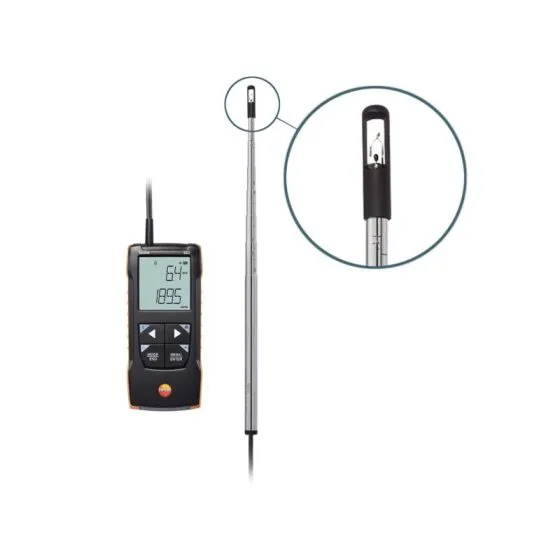
- Buy Testo 425 Digital Hot Wire Anemometer A thermal sensor on a slim 32 inch telescopic probe with the tightest low velocity accuracy spec of the four. Amazon
- Buy Extech AN300 Large Vane CFM/CMM Thermo-Anemometer A 100 mm vane that reads down to 40 fpm, calculates volume flow on the meter, and accepts cone adaptors for outlet work. Amazon
- It depends Kestrel 5200 Professional Environmental Meter A waterproof outdoor environmental meter with a field replaceable calibrated impeller that also does duct volume flow. Amazon
- Skip Fluke 925 Vane Anemometer A well built vane meter whose own manual publishes a flat plus or minus 100 fpm accuracy, which is most of the reading at low velocity. Amazon
What actually matters
- Air velocity - this is the only thing the sensor physically responds to, whether that is a heated wire losing heat to passing air or a vane being spun by it. Everything else on the display is derived from it.
- Volume flow - velocity multiplied by area, in CFM or CMM. Fluke's manual prints the formula and tells you to determine the duct area first and even to ask the duct manufacturer, and Kestrel labels the input as user supplied duct shape and size.
- Free area - the actual open area air passes through at a grille, which is smaller than the grille's outside dimensions and smaller than the duct behind it. Fluke's 925 literally labels its area setting Free Area, which tells you the distinction matters.
- Minimum measurable velocity - the bottom of the stated range. A vane needs enough force to overcome bearing friction before it turns, so vane meters have a floor while thermal sensors are typically specified from zero.
- Accuracy format - percentage of reading, percentage of full scale, or a fixed offset, sometimes all three combined. This one distinction separates a meter you can quote from one you can only wave around.
- Traverse - taking multiple readings across a duct or an outlet face at defined positions and averaging them, because the flow profile is never flat. Good meters have multi point and timed averaging built in for exactly this.
- Calibration traceability - whether the meter ships with any calibration document, whether an NIST traceable version exists, and whether calibration can be restored in the field. The Kestrel is the one here that sells calibrated replacement impellers you fit yourself.
The specs, in plain English
Green flags vs red flags
Green flags
- Accuracy is published as a percentage of reading with a small or absent fixed term, and stated across named velocity bands.
- The stated velocity range starts low, in the tens of fpm rather than above a hundred.
- A slim telescopic probe is offered if duct traverses are part of the plan, with the probe diameter stated.
- Multi point and timed averaging are built into the instrument, not left to you and a notepad.
- A calibration document ships in the box, or an NIST traceable version or service is offered by the maker.
Red flags
- A single bare percentage with no velocity band and no indication of whether it is reading or full scale.
- CFM headlined in the marketing with no mention anywhere that you have to enter the area yourself.
- The maker's web page and the manual state accuracy differently, which usually means the web page dropped the fixed term.
- A vane head presented for duct work when the head is plainly too wide to fit through a test hole.
- No calibration paperwork of any kind mentioned in the manual or data sheet.
Who's who: the brands
- Testo - German instrument maker whose HVAC line runs from app connected smart probes to hot wire anemometers and capture hoods, and which publishes banded accuracy specs and sells NIST calibration certificates as ordering options.
- Extech - Part of Teledyne FLIR, known for broad and affordable test instrument ranges including large vane thermo-anemometers with on meter volume flow and an optional NIST variant.
- Kestrel - US maker of rugged waterproof pocket environmental meters built around a field replaceable impeller that is sold factory calibrated.
- Fluke - Best known for electrical test gear, with a smaller indoor air quality line that includes vane anemometers, micromanometers and pitot tubes for duct traversal.
- TSI and Alnor - Long standing air flow measurement specialists whose capture hoods and thermal anemometers set much of the balancing convention, and whose HVAC handbook documents the traverse procedures.
How to read a listing without getting fooled
Start at the bottom of the spec table rather than the top. Find the velocity range and note where it starts, because that floor decides whether the meter is usable on returns and low velocity ducts at all. Then find the accuracy line and work out what it is a percentage of. If it says percent of reading, multiply it by a number you actually expect to see. If it says percent of full scale, or if there is a fixed term added on, calculate that figure in absolute fpm and compare it with the same expected reading, because that is your real error. Next look for the volume flow row and see how area gets in: on the meter, in an app, or not at all. Finally check whether the probe geometry suits the job, since a vane diameter or a probe length quietly determines whether the instrument can be used where you meant to use it. Anything the maker declines to publish, treat as unspecified rather than assuming it matches a similar model.
How much should you spend?
Budget meters buy you a display and a velocity number, and the honest ones state a range and a rough percentage without much banding. That is enough to confirm air is moving and to compare one register against another on the same day. Mid range is where on meter area entry, multi point averaging and a properly banded accuracy spec appear, and it is where most people should land, especially if outlet and grille work is the main use. Premium buys the hot wire on a slim telescopic probe, tighter low velocity accuracy, calibration paperwork in the box and calibration services from the maker, and it is worth it only if you are genuinely traversing ducts or need a number you can put in a report. A rugged sealed environmental meter also sits at the premium tier, but you are paying for waterproofing, logging and a dozen weather parameters rather than for HVAC precision. Capture hoods sit above all of this and are a different purchase entirely.
Questions, answered
Can I just multiply the register's face velocity by its outside dimensions?
No, and this is the most common mistake. The grille blocks part of the opening, so the area air actually passes through, the free area, is smaller than the outside dimensions of the register. It is also different from the duct area behind it. Diffuser makers used to publish Ak factors to bridge the gap, but Krueger's chief engineer explains that those factors are specific to the exact instrument and probe position used to derive them and are largely no longer published.
Do I need a hot wire if I only ever check registers at home?
Probably not. At an outlet the useful property is averaging across the face, which is what a wide vane does naturally and a single point hot wire does not. A large vane meter with on meter area entry and a multi point average mode will serve you better and cost less. The hot wire earns its place when you need to get a sensor inside a duct through a small hole, or when velocities drop low enough that a vane will not turn.
How much straight duct do I need before a traverse?
The Alnor handbook says to measure at least 7.5 duct diameters downstream and at least 3 duct diameters upstream of any turn or obstruction, and that traversing as close as 2 diameters downstream and 1 upstream is possible but will hurt accuracy. For rectangular ducts, convert to an equivalent diameter first.
Is a calibration certificate worth paying for?
It depends on whether anyone is going to ask. For your own house, no. For work that goes into a commissioning or balancing report, a traceable certificate is often the difference between a number that stands and one that gets queried. Testo ships a calibration protocol with the 425 and sells NIST velocity calibration at three points, Extech offers an AN300-NIST variant, and Kestrel supplies a Certificate of Conformity plus factory calibrated replacement impellers you can fit yourself.
Or jump to the head-to-head: Testo 425 Digital Hot Wire Anemometer vs Extech AN300 Large Vane CFM/CMM Thermo-Anemometer.