

Tech & Gadgets
The Best Anemometers: 4 Compared (and One to Skip)
We compared four handheld anemometers on the things that decide whether a reading is worth anything: the sensor type, the lowest velocity each one will read, how the maker states accuracy, and what happens to a CFM number that is calculated from an area you typed in yourself.
The short version
The Testo 425 is the pick, because it is a hot wire on a 32 inch telescopic probe and Testo publishes accuracy as plus or minus 5.91 fpm plus 4 percent of the reading below 3,937 fpm, which is the only spec here that stays tight at low velocity. The Extech AN300 is the value buy: a 100 mm vane that reads down to 40 fpm, calculates volume flow on the meter itself, and accepts optional cone adaptors that turn it into a small capture hood. The Kestrel 5200 is the depends pick, a rugged IP67 environmental meter whose factory calibrated impeller you can replace in the field, but whose impeller will not turn below 0.6 m/s. The skip is the Fluke 925, and the argument is entirely from Fluke's own manual: accuracy is a flat plus or minus 100 fpm from 80 to 1,965 fpm, so a 300 fpm reading carries a one third error band. Before you trust any CFM number, understand that the meter is doing velocity times an area you supplied, and at an air outlet a capture hood is usually the right tool instead. Best for: anyone checking duct velocity, register airflow, or wind speed who wants a number they can defend.
Our picks at a glance
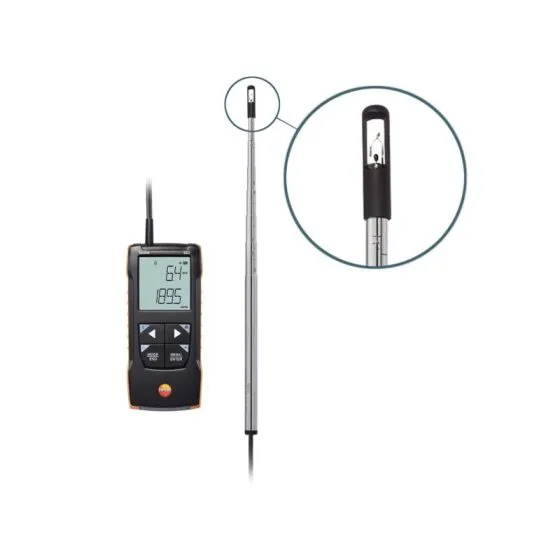
- Testo 425 Digital Hot Wire Anemometer - Buy. A thermal sensor on a slim 32 inch telescopic probe with the tightest low velocity accuracy spec of the four.
- Extech AN300 Large Vane CFM/CMM Thermo-Anemometer - Buy. A 100 mm vane that reads down to 40 fpm, calculates volume flow on the meter, and accepts cone adaptors for outlet work.
- Kestrel 5200 Professional Environmental Meter - It depends. A waterproof outdoor environmental meter with a field replaceable calibrated impeller that also does duct volume flow.
- Fluke 925 Vane Anemometer - Skip. A well built vane meter whose own manual publishes a flat plus or minus 100 fpm accuracy, which is most of the reading at low velocity.
The verdict in 30 seconds
What mattered most
- Sensor type
- Published velocity range
- Published accuracy
- Error band at a 300 fpm reading
- Lowest velocity it will read
- Where duct area is entered
An anemometer does not measure airflow. It measures air velocity at one small spot, and every CFM figure it shows you is that velocity multiplied by a cross sectional area that you entered into the meter. All four instruments here work that way, and all four say so in their own documentation. That single fact reorders the whole category, because a meter with a superb velocity spec still hands you a bad volume figure if the area is wrong, and at a grille or a diffuser the area you want is almost never the one you can measure with a tape.
A thermal sensor on a slim 32 inch telescopic probe with the tightest low velocity accuracy spec of the four.
Best for: Anyone doing real duct traverses or low velocity work where a fixed error term of 100 fpm would swamp the reading.
- Testo publishes accuracy as plus or minus 5.91 fpm plus 4 percent of the measured value from 0 to 3,937 fpm, so the fixed part of the error stays tiny at low speed.
- The cable connected telescopic probe extends to 32 inches and is 0.30 inches in diameter, which is what lets you reach traverse points inside a duct.
- Timed and point mean value calculation is built in, and a calibration protocol ships in the box with NIST velocity calibration offered as an ordering option.
- Accuracy widens sharply above 3,937 fpm, to plus or minus 98 fpm plus 5 percent of the measured value.
- The instrument is rated IP40 and the probe only IP20, so it is an indoor tool and a hot wire element is fragile.
- Duct configuration is presented as an app task in Testo's data sheet, so you are pairing a phone to get the convenient workflow.
- It sits in the premium tier and gains you nothing outdoors that a cheap meter cannot do.
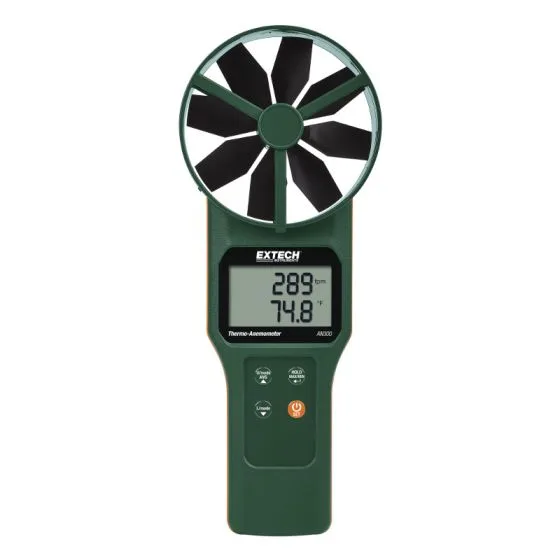
A 100 mm vane that reads down to 40 fpm, calculates volume flow on the meter, and accepts cone adaptors for outlet work.
Best for: Homeowners and technicians checking supply registers, return grilles and open faces, who want the volume maths done on the meter.
- Extech lists plus or minus 1.5 percent accuracy across 40 to 5,900 fpm, and 40 fpm is an unusually low floor for a vane.
- Volume flow in CFM or CMM, up to 99,999, is calculated on the meter, so it works without a phone.
- Multi point and timed averaging modes are built in, which is exactly the operation an equal area grille survey calls for.
- Extech publishes a single percentage with no velocity bands, so the low end of the range is the least certain part of the spec.
- The 100 mm vane head cannot be pushed into a residential duct, so this is an outlet and open face instrument.
- Check the manual for any fixed error term before trusting a reading near the 40 fpm floor, because the product page and data sheet print only the percentage.
- The cone and funnel adaptor kit is a separate order, and the meter has presets for their sizes.
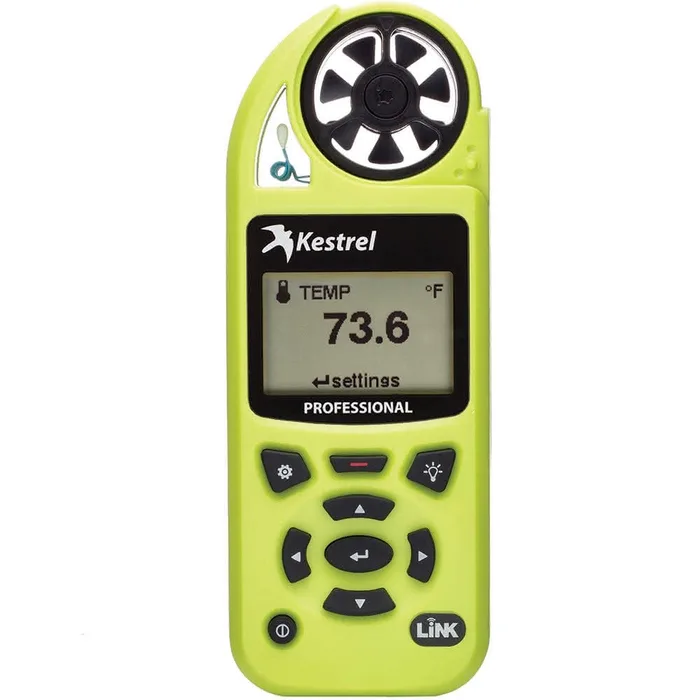
A waterproof outdoor environmental meter with a field replaceable calibrated impeller that also does duct volume flow.
Best for: People whose work is mostly outdoors or in the weather, who want one rugged meter and occasional duct volume flow rather than a dedicated HVAC instrument.
- The impeller replaces without tools, Kestrel sells factory calibrated replacements and suggests changing it every 2 to 3 years depending on use, and a Certificate of Conformity is included.
- Air speed accuracy is the larger of 3 percent of reading, the least significant digit, or 20 ft/min, a much smaller fixed term than the Fluke's flat 100 fpm.
- It is waterproof to IP67 for 1 m over 30 minutes, logs over 10,000 time stamped data sets, and runs up to 400 hours on one AA lithium cell.
- The stated air speed range starts at 0.6 m/s, roughly 118 fpm, so it is the wrong instrument for slow returns and low velocity duct work.
- Kestrel publishes air flow accuracy as 6.71 percent because it stacks the air speed error on top of the duct shape and size you type in.
- Seventeen measurements means you are paying for evaporation rate, density altitude and wet bulb whether or not an HVAC job needs them.
- The small impeller has none of the area averaging that a 100 mm vane gives you across a grille face.
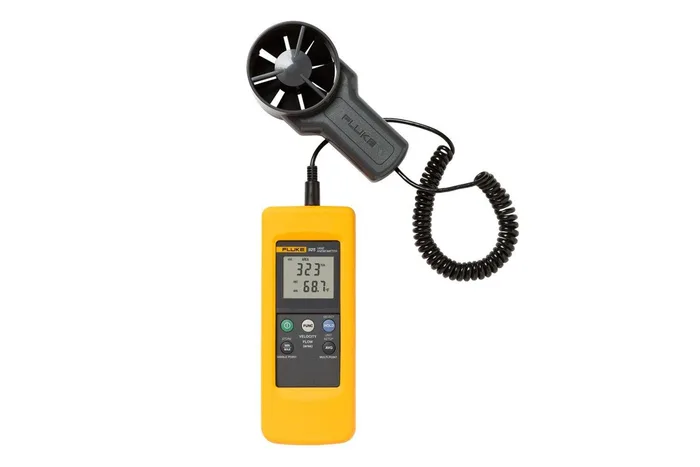
A well built vane meter whose own manual publishes a flat plus or minus 100 fpm accuracy, which is most of the reading at low velocity.
Best for: Rough go or no go checks where you only need to know that air is moving, not how much of it there is.
- The vane head is 70 mm across, small enough to sit in a register face.
- Single point averaging runs up to two hours and multi point averaging stores up to 8 readings.
- Build quality is what you expect from the brand, and 100 hours on a 9 V cell is generous.
- The manual states accuracy as plus or minus 100 ft/min from 80 to 1,965 ft/min and plus or minus 150 ft/min above that, a fixed band rather than a percentage of reading.
- At a 300 fpm reading that flat 100 fpm is a one third error, and the meter will not read below 80 fpm at all.
- The flat accuracy figure sits in the specification table of the user manual, so read it there before you buy.
- Area entry tops out at 9.999 square feet, and the user manual mentions no calibration certificate.
| Criteria | 425 Digital Hot Wire Anemometer Top pick | AN300 Large Vane CFM/CMM Thermo-Anemometer | 5200 Professional Environmental Meter | 925 Vane Anemometer |
|---|---|---|---|---|
| Verdict | Buy it | Buy it | It depends | Skip it |
| Best for | Anyone doing real duct traverses or low velocity work where a fixed error term of 100 fpm would swamp the reading. | Homeowners and technicians checking supply registers, return grilles and open faces, who want the volume maths done on the meter. | People whose work is mostly outdoors or in the weather, who want one rugged meter and occasional duct volume flow rather than a dedicated HVAC instrument. | Rough go or no go checks where you only need to know that air is moving, not how much of it there is. |
| Price tier | $$$ · premium | $$ · mid-range | $$$ · premium | $$ · mid-range |
| Sensor type | Hot wire (thermal) | 100 mm rotating vane | Replaceable impeller (vane) | 70 mm rotating vane on a cord |
| Published velocity range | 0 to 5,905 fpm | 40 to 5,900 fpm | 0.6 to 40.0 m/s, about 118 to 7,874 fpm | 80 to 4,900 fpm |
| Published accuracy | Plus or minus (5.91 fpm + 4% of reading) to 3,937 fpm | Plus or minus 1.5% of reading, no bands published | Larger of 3% of reading, last digit, or 20 fpm | Plus or minus 100 fpm to 1,965 fpm, then 150 fpm |
| Error band at a 300 fpm reading | About plus or minus 18 fpm | Not published | About plus or minus 20 fpm | Plus or minus 100 fpm |
| Lowest velocity it will read | 0 fpm, spec stated to 3,937 fpm | 40 fpm | About 118 fpm | 80 fpm |
| Where duct area is entered | Duct configured in the testo Smart App | Set on the meter, volume up to 99,999 CFM or CMM | On the meter, duct shape and size | On the meter, 0 to 9.999 sq ft |
| Reaches inside a duct | Yes, telescopic probe to 32 in at 0.30 in diameter | No, 100 mm vane head | No, integral impeller | No, 70 mm vane head |
| Calibration paperwork | Calibration protocol in the box, NIST velocity certificate offered | AN300-NIST variant offered | Certificate of Conformity, tool free swap to a factory calibrated impeller | None stated in the user manual |
Which one is right for you?
- Anyone doing real duct traverses or low velocity work where a fixed error term of 100 fpm would swamp the reading. Buy it Testo 425 Digital Hot Wire Anemometer
- Homeowners and technicians checking supply registers, return grilles and open faces, who want the volume maths done on the meter. Buy it Extech AN300 Large Vane CFM/CMM Thermo-Anemometer
- People whose work is mostly outdoors or in the weather, who want one rugged meter and occasional duct volume flow rather than a dedicated HVAC instrument. It depends Kestrel 5200 Professional Environmental Meter
- Rough go or no go checks where you only need to know that air is moving, not how much of it there is. Skip it Fluke 925 Vane Anemometer
How we judged the field
Five things decide whether an anemometer reading is worth writing down. First, the sensor: a hot wire element responds at velocities a vane cannot even start turning at, while a vane head averages velocity across its own face, which is useful at a grille and useless inside a duct. Second, the lowest velocity the maker will commit to, because that floor is where cheap meters quietly stop working. Third, how accuracy is written. A percentage of reading scales down with the reading, but a fixed term, or a percentage of full scale, does not, and at the bottom of the range a fixed term can be most of your number. Fourth, how volume flow is derived, since every one of these meters multiplies velocity by an area you supply. Fifth, whether any calibration paperwork exists and whether you can restore calibration yourself.
The field splits three ways. Hot wire instruments on slim telescopic probes do duct work, and the Testo 425 is the clearest example currently sold. Large vane meters do outlet and open face work, where the vane’s area averaging earns its keep, and the Extech AN300 is the honest version of that. Environmental meters built around a small rugged impeller do weather and site work and treat duct volume as a bonus, which is the Kestrel 5200. We picked one of each, then added the Fluke 925 as the skip because it is a familiar brand selling a vane meter whose own manual publishes a flat plus or minus 100 fpm, which turns out to be a bigger problem than any missing feature.
Testo 425 Digital Hot Wire Anemometer
Buy itThe Testo 425 is a thermal anemometer with a cable connected telescopic probe that extends to 32 inches and measures 0.30 inches across, which is the physical requirement for a duct traverse that nothing else here meets. Testo publishes air velocity from 0 to 5,905 fpm with accuracy of plus or minus 5.91 fpm plus 4 percent of the measured value up to 3,937 fpm, then plus or minus 98 fpm plus 5 percent above that. Read those two lines together and the shape of the instrument becomes obvious: it is built for the low and mid range where duct work happens, and it gets vague at the top where you probably should not be pointing it anyway. It computes timed and point mean values on its own, ships with a calibration protocol and three AA cells, and Testo lists NIST velocity calibration at three standard or three custom points as ordering options. The trade off is that it is an indoor instrument, IP40 on the meter and IP20 on the probe, and hot wire elements do not forgive dust or knocks. Buy it if your work is inside ducts.
Extech AN300 Large Vane CFM/CMM Thermo-Anemometer
Buy itThe Extech AN300 is the meter to buy if your questions are about registers, returns and open faces rather than duct interiors. The 100 mm vane averages velocity across its own face, which is precisely the property the Alnor handbook credits rotating vanes with at supply openings, and Extech lists plus or minus 1.5 percent across a 40 to 5,900 fpm range. That 40 fpm floor is genuinely low for a vane. The catch is that Extech prints only a percentage with no velocity bands, so treat readings near the floor with caution and check the manual for any fixed term. The meter calculates volume flow itself, and multi point and timed averaging are built in, so an equal area survey of a grille face is a two button job. The optional AN300-C cone kit adds a round 8.3 inch and a square 13.6 inch adaptor, and the meter has presets for those two sizes. Buy it for outlet work.
Kestrel 5200 Professional Environmental Meter
It dependsThe Kestrel 5200 is not really an HVAC instrument, and that is the whole point. It is a pocket environmental meter with 17 measurements, waterproof to IP67 for a metre over half an hour, logging more than 10,000 time stamped data sets and running up to 400 hours on a single AA lithium cell. Its air speed accuracy, the larger of 3 percent of reading, the last digit, or 20 ft/min, has a fixed error term of only 20 ft/min, far smaller than the Fluke’s. It will also take a duct shape and size and give you volume flow, and Kestrel is refreshingly straight about what that costs, publishing air flow accuracy as 6.71 percent because the area you type in compounds the velocity error. The catch is the impeller. Kestrel states the range as starting at 0.6 m/s, roughly 118 fpm, and an impeller that will not turn reads nothing at all. Against that, you can fit a new factory calibrated impeller without tools, and Kestrel suggests changing it every 2 to 3 years depending on use. Buy it if you work outdoors.
Fluke 925 Vane Anemometer
Skip itThe Fluke 925 is well made, the 70 mm vane head is small enough for a register face, and the multi point averaging up to 8 readings is the right idea. The problem is one line in Fluke’s own user manual. Accuracy is plus or minus 100 ft/min from 80 to 1,965 ft/min, and plus or minus 150 ft/min above that. Those are fixed bands, not percentages of the reading, so they do not shrink as the number does. At 900 fpm inside a duct that is about 11 percent. At 300 fpm at a register face it is a third of your reading, and below 80 fpm the meter is simply out of range. Area entry also caps at 9.999 square feet, and the user manual mentions no calibration certificate. Skip it and put the money into a meter whose error scales with the reading.
Sources
Specs in this review come from these pages.
- Testo, testo 425 digital hot wire anemometer data sheet (static-int.testo.com)
- Extech Instruments, AN300 Large Vane CFM/CMM Thermo-Anemometer (extech.com)
- Fluke, 925 Vane Anemometer Users Manual (media.fluke.com)
- Kestrel Instruments, Kestrel 5200 Professional Environmental Meter (kestrelinstruments.com)
- Krueger, Diffuser and Grille Area Factors (Dan Int-Hout, Chief Engineer) (krueger-hvac.com)
- TSI Alnor, HVAC Assessment Handbook (tsi.com)
Testo 425 Digital Hot Wire Anemometer vs Extech AN300 Large Vane CFM/CMM Thermo-Anemometer: which should you buy?
The Testo 425 and the Extech AN300 are not really competing for the same job, and choosing between them is mostly a question of where you are going to hold the sensor. If the answer is inside a duct, the AN300 cannot do it: its 100 mm vane head does not fit through a test hole, and the Alnor handbook makes the same point about 4 inch vanes generally. The 425’s 0.30 inch probe on a 32 inch telescope is the only tool here that reaches a log-Tchebycheff traverse point, and its accuracy spec has a fixed term of only 5.91 fpm, small enough to be irrelevant at low velocity. If the answer is at a grille, a register or an open filter face, the AN300 is the better instrument and it is not close, because the vane averages across its own 100 mm face while a hot wire samples a single point in a thin, uneven jet.
The money question is simpler than it looks. If you are balancing a system, buy the 425 and accept that you will still need something else for outlet readings. If you are a homeowner working out why the back bedroom is cold, buy the AN300, enter the grille’s free area rather than its outside dimensions, take readings at the centre of equal areas across the face, and average them. Do not spend on the 425 for that job, because the meter’s own error is not what will limit your answer. The area figure will be, and no meter fixes that.
What to look for
- Read the accuracy line, not the percentage: a spec written as a percentage of reading shrinks with the reading, a fixed term such as the Fluke’s 100 fpm does not, and a percentage of full scale is the worst of the three at the bottom of the range.
- Check the low end of the range: the Kestrel starts at about 118 fpm and the Fluke at 80 fpm, while the Extech reads to 40 fpm and the hot wire Testo is specified from zero, and low flow is exactly where cheap meters fail.
- Ask whether the sensor fits where you need it: a 100 mm vane head cannot enter a residential duct, so if you intend to traverse you need a slim telescopic probe and there is no substitute.
- Treat every CFM figure as velocity times your own area entry: the meter did no volume measurement, and at a grille the free area is not the duct area and is often not published at all.
- Look for the calibration paperwork: Testo ships a calibration protocol and sells NIST velocity calibration, Extech offers an AN300-NIST variant, Kestrel supplies a Certificate of Conformity and sells calibrated replacement impellers, and Fluke’s 925 manual mentions none.
- Match the sensor to the environment: the Alnor handbook warns that rotating vanes cannot survive rough treatment and should not be used in dusty or corrosive air, and hot wire elements are more delicate still, which is why weather work belongs to a sealed impeller meter.
Our final take
Buy the Testo 425 if you traverse ducts, because it is the only instrument here with a probe that fits and an accuracy spec that stays honest below a few hundred fpm. Buy the Extech AN300 for grilles and open faces, where the 100 mm vane’s area averaging is a real advantage and volume flow is calculated on the meter. Take the Kestrel 5200 if you are mostly outdoors and want a sealed meter whose calibrated impeller you can replace yourself. Skip the Fluke 925: a flat plus or minus 100 fpm is a third of a 300 fpm reading. Whatever you buy, the meter only measures velocity. The CFM is arithmetic you supplied the inputs for.
Questions, answered
Does an anemometer actually measure CFM?
No. Every meter here reads air velocity at the sensor and then multiplies it by a cross sectional area that you supply. Fluke's manual for the 925 says the area of the duct under test must first be determined, and even suggests checking with the duct manufacturer. Fluke's manual gives the formula outright, CFM equals air velocity in ft/min times area in square feet. Kestrel is the most candid about the consequence and publishes an air flow accuracy of 6.71 percent because it stacks the velocity error on top of your duct shape and size entry. So the volume number is only ever as good as the area you typed in.
Why is a single reading in the middle of a duct not the answer?
Because velocity is not uniform across a duct. Friction at the wall slows the air near the edges and the centre runs fast, so one centre reading overstates the average. The Alnor handbook says you can take a single centre reading and multiply it by 0.9 to correct for the higher centre velocity, that this might get you within 5 or 10 percent under very good conditions, and that the method is not reliable and should only be used when duct size or access rules out a proper traverse. The recognised practice is a log-Tchebycheff traverse, which puts the points where they account for wall friction rather than spacing them evenly.
How many traverse points do I actually need?
For a rectangular duct the Alnor handbook calls for a minimum of 25 points, with 5 points along each side under 30 inches, 6 points for 30 to 36 inches and 7 points above that. For round ducts the handbook uses concentric equal area circles: 6 points per diameter for ducts of 10 inches and under, 8 points for 10 to 12 inches, and 10 points above 12 inches, taken through three holes drilled at 60 degrees to each other. Position each point using the published multipliers rather than dividing the duct evenly.
Should I be using a capture hood instead of an anemometer at a register?
At a supply diffuser, usually yes. The Alnor handbook calls capture hoods the tool of choice for measuring flow from supply grilles, and notes that ASHRAE recommends a duct traverse to work out whether a correction factor is needed for the hood reading. But a hood is not an absolute instrument either. Krueger's chief engineer writes that with high induction devices such as linear diffusers, differences greater than 20 percent between reported and actual air quantity are not uncommon, and that the most accurate technique remains a pitot traverse in a straight run of duct. A rotating vane is a reasonable alternative when the grille is too small or too large for a hood.
Which sensor should I buy, hot wire or vane?
Hot wire for low velocity and tight spaces. The Alnor handbook puts thermal anemometers at roughly 10 to 10,000 fpm with small probe diameters that fit into small ducts, and lists duct traverses as a core application. Rotating vanes are for supply openings, where the vane's own area averaging is a genuine advantage, but the common 4 inch head generally rules out in duct use and digital vanes are quoted at 50 to 6000 fpm. The handbook also warns that a vane cannot survive rough treatment and should not be used in dusty or corrosive air. For outdoor wind, an impeller or cup meter built for weather is the right family.
Deciding between the top two? See our head-to-head: Testo 425 Digital Hot Wire Anemometer vs Extech AN300 Large Vane CFM/CMM Thermo-Anemometer.
More Tech & Gadgets reviews
 The Best USB Bluetooth Adapters: 4 Compared (and One to Skip)
  The Best Bluetooth Item Trackers (2026): AirTag-Style Finders, Honestly Compared
  The Best Book Lights: 4 Compared (and One to Skip)
  Best Budget 1440p Gaming Monitors (27"): What's Actually Worth It
  The Best Budget Laptops for Everyday Use: 4 Compared (and One to Skip)
  Best Budget Mechanical Keyboards: The 3 Worth Buying and 1 Popular Pick to Skip