

Tech & Gadgets · Head-to-head
Testo 425 Digital Hot Wire Anemometer vs Extech AN300 Large Vane CFM/CMM Thermo-Anemometer
Which should you buy? Our verdict on both, pulled from our full The Best Anemometers: 4 Compared (and One to Skip) comparison.
The 425 is the only one of the four with a hot wire on a slim telescopic probe, which is what a duct traverse actually needs, and its published accuracy holds up where the others fall apart. The AN300 does the grille and register half of the job well, enters duct area on the meter, and takes cone adaptors, which is why it is the one most homeowners should buy.
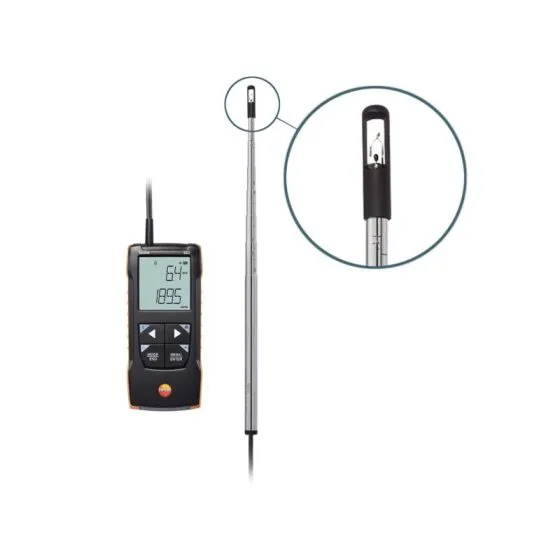
Testo 425 Digital Hot Wire Anemometer
Buy itA thermal sensor on a slim 32 inch telescopic probe with the tightest low velocity accuracy spec of the four.
- Testo publishes accuracy as plus or minus 5.91 fpm plus 4 percent of the measured value from 0 to 3,937 fpm, so the fixed part of the error stays tiny at low speed.
- The cable connected telescopic probe extends to 32 inches and is 0.30 inches in diameter, which is what lets you reach traverse points inside a duct.
- Timed and point mean value calculation is built in, and a calibration protocol ships in the box with NIST velocity calibration offered as an ordering option.
- Accuracy widens sharply above 3,937 fpm, to plus or minus 98 fpm plus 5 percent of the measured value.
- The instrument is rated IP40 and the probe only IP20, so it is an indoor tool and a hot wire element is fragile.
- Duct configuration is presented as an app task in Testo's data sheet, so you are pairing a phone to get the convenient workflow.
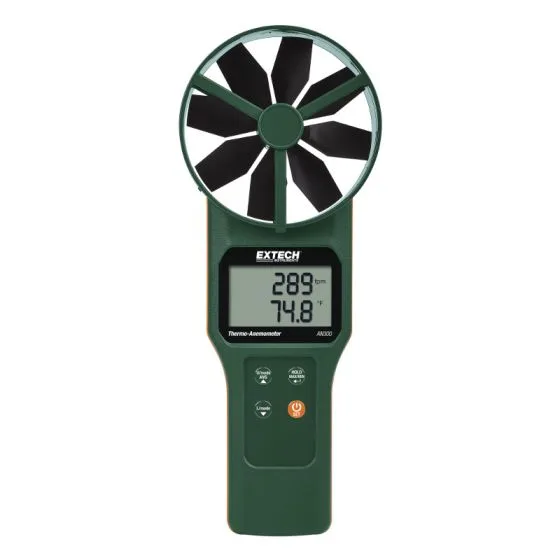
Extech AN300 Large Vane CFM/CMM Thermo-Anemometer
Buy itA 100 mm vane that reads down to 40 fpm, holds a duct area on the meter, and accepts cone adaptors for outlet work.
- The manual states plus or minus 1.5 percent of reading plus 59 fpm across 40 to 5,900 fpm, and 40 fpm is an unusually low floor for a vane.
- Area is entered on the instrument in square inches or square centimetres, anywhere from 0 to 99,999, so volume flow works without a phone.
- Multi point and timed averaging modes are built in, which is exactly the operation an equal area grille survey calls for.
- The 59 fpm fixed term dominates at low speed, so a 300 fpm reading carries roughly a plus or minus 21 percent band.
- The 100 mm vane head cannot be pushed into a residential duct, so this is an outlet and open face instrument.
- Extech's own product page gives accuracy as plus or minus 1.5 percent and leaves the 59 fpm term to the manual.
Side by side
| Testo 425 Digital Hot Wire Anemometer | Extech AN300 Large Vane CFM/CMM Thermo-Anemometer | |
|---|---|---|
| Our verdict | Buy | Buy |
| Best for | Anyone doing real duct traverses or low velocity work where a fixed error term of 100 fpm would swamp the reading. | Homeowners and technicians checking supply registers, return grilles and open faces, who want the volume maths done on the meter. |
| Price tier | $$$ · premium | $$ · mid-range |
The bottom line
Our overall pick is the Testo 425 Digital Hot Wire Anemometer - A thermal sensor on a slim 32 inch telescopic probe with the tightest low velocity accuracy spec of the four. Choose the Extech AN300 Large Vane CFM/CMM Thermo-Anemometer instead if homeowners and technicians checking supply registers, return grilles and open faces, who want the volume maths done on the meter.
Want the full picture, including the other options we compared and the popular one we'd skip? Read the complete The Best Anemometers: 4 Compared (and One to Skip).