Explained
Yoga Blocks, Explained
After reading, you'll understand why block dimensions are more standardised than they look, and how to spot the one that will not pair with anything.
In this guide
Blocks are the prop people buy last and use most, and because they are simple rectangles most buyers pick on colour. The catch is that the dimensions follow an unwritten convention, and a block half an inch outside it will never sit level beside another one. Add the cork-versus-foam question, the fact that almost every block is sold singly, and the habit some makers have of not publishing a weight, and there is more to check than the shape suggests.
The 30-second version
- One block gives three heights, so the dimensions are really a list of the props you are buying.
- 4, 6 and 9 inches is the convention, and a block outside it will not pair with anything else you own.
- Weight is how you judge cork, because density is what keeps a block from sliding under a loaded hand.
- Foam is for support, cork is for load, and plenty of people are better served owning one of each.
- Blocks are sold individually, so budget for two, which is what most sequences assume.
The products this guide is about
Our verdict on each, with the full reasoning on the companion review.
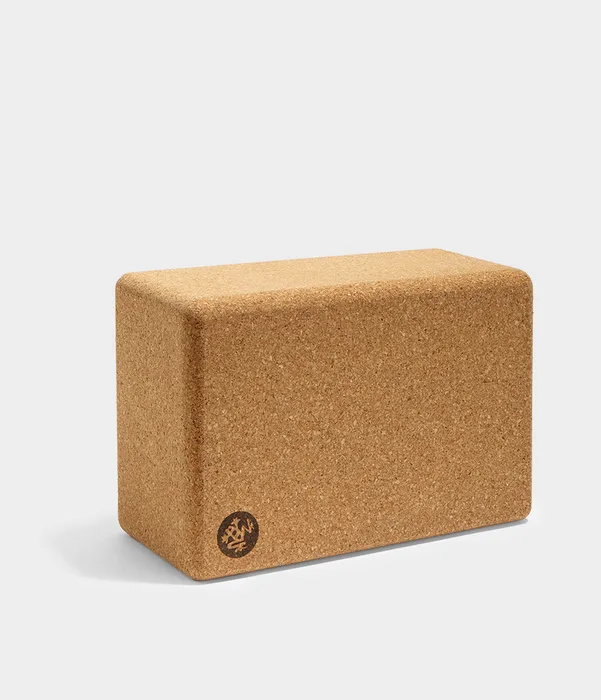
- Buy Manduka Cork Yoga Block A standard-size cork block heavy enough to stay where you put it, with the clearest care instructions in the category.
- Buy Hugger Mugger 4 in. Foam Yoga Block The studio-standard foam block at 0.8 lb, with beveled edges and a stated country of manufacture, which is more than most foam blocks manage.
- It depends JadeYoga Cork Yoga Block The only block here offered in a genuinely small 3 x 4.75 x 9 in size, which is useful for shoulders and wrong as a general-purpose block.
- Skip Yoga Design Lab Cork Yoga Block, Mandala Black Good cork at a normal density, built to a 5.5 in face that quietly breaks the height ladder every other block uses.
What actually matters
- The three faces - stand a block on each of its faces and you get three working heights. Those heights are the product, so check them rather than the overall shape, and confirm they match the convention if you plan to buy a pair.
- Cork density - cork blocks vary a lot in how much material is packed into the same footprint, and the published weight is the only easy proxy. Heavier for the same dimensions means more stable underfoot and slower to wear.
- Foam compression - EVA foam deforms under repeated load and slowly loses its hard edges. That is fine for supported and restorative work and a real limitation if you push hard through your hands.
- Edge treatment - beveled or rounded edges make a block much more comfortable when it is under a shoulder blade or a hip. Sharp cork corners are stable but unforgiving.
- Surface grip when damp - cork keeps its grip when your palms are sweaty; smooth foam can get slick. Textured or printed surfaces change the feel and can wear where you load them.
- Cleaning method - cork should be wiped and never soaked, because water can swell it and change the texture. Foam tolerates a proper wash. A maker who states a method expects the block to last.
- How many are in the box - almost always one. Sequences almost always assume two. This single detail accounts for most of the surprise in this category.
The specs, in plain English
Green flags vs red flags
Green flags
- Dimensions and weight are both published in the specification block.
- The three faces work out to the standard 4, 6 and 9 inches.
- The maker gives a specific cleaning method rather than a general instruction.
- Edges are described as beveled or rounded.
- The material is named precisely, for example EVA foam or cork with a stated origin.
Red flags
- A cork block with no published weight anywhere on the page.
- A middle face that is not 6 inches, which quietly breaks pairing with everything else.
- No cleaning guidance at all, especially on cork, which cannot be soaked.
- Heavy decoration on the face you will be standing or leaning on.
- A listing that shows two blocks in the photograph and prices one.
Who's who: the brands
- Manduka - Best known for dense, standard-size props and unusually specific care and storage instructions.
- Hugger Mugger - A long-standing studio supplier whose foam blocks are the ones stacked in the corner of most classes.
- JadeYoga - Sources cork in Portugal and ties each sale to a stated rainforest preservation commitment.
- Yoga Design Lab - Design-led props with printed cork surfaces, fully specified but not always built to the standard dimensions.
How to read a listing without getting fooled
Start with the dimensions and write out the three heights they give you. If they are 4, 6 and 9 inches, the block will pair with almost anything; if one of them is odd, assume you are buying a block that will only ever work alone. Next look for a weight. On cork, divide it by the volume and compare with another block you are considering, because that ratio is the closest thing to a density figure anyone publishes. Then find the cleaning instructions, which double as a durability hint: a maker who specifies a vinegar dilution and warns against submerging has thought about the material. Finally, check the quantity. The photograph usually shows two blocks and the price is usually for one.
How much should you spend?
Budget buys foam, and foam at this price is genuinely fine for supported and restorative work, especially from a maker who states the material and the edge treatment. The mid-range is where cork lives, and the spread within it is mostly about density and finish rather than quality: a heavier block from a known maker will outlast a lighter one at the same price. Premium pricing in this category usually reflects design, printing or a sustainability programme rather than a functionally better block, which is worth knowing before you pay it. Whatever tier you choose, remember to price two blocks rather than one, because that doubling changes which tier you can actually afford.
Questions, answered
Can I use a book or a cushion instead of a block?
For occasional support, yes, and plenty of people start that way. The reason a block is better is that it gives three consistent, repeatable heights and does not collapse under load, which matters when you are trying to find the same alignment week to week. A cushion compresses differently depending on how you land on it, and a stack of books moves. If you are using an improvised prop more than occasionally, that is the signal to buy the pair.
Do cork blocks smell?
New cork has a mild, woody smell that fades within a few weeks of use and airing. What you should not get is a chemical or adhesive smell, which suggests heavy binder content rather than a well-pressed cork block. Keeping the block out of direct sunlight and away from humidity, as makers generally advise, helps it stay stable. If a block smells strongly of glue out of the box, that is a reasonable reason to return it.
How long should a yoga block last?
A dense cork block used at home should last many years, because the failure mode is slow surface wear rather than collapse. Foam has a shorter life: the corners soften and the faces dent, and once a block no longer holds a flat, square edge it has stopped doing its job. Studio blocks wear faster than home ones simply because of volume of use. The practical test is whether the block still sits level and square when you stand it on each face.
Are printed or patterned blocks a bad idea?
Not automatically, but be clear about where the print is. A pattern on the narrow end face is decoration. A pattern across the broad face is on the surface you push your hands into and rest your back on, and printing adds a layer that can wear, polish or feel different from bare cork. If you like the look, check which faces carry the design and whether the maker states the ink is water-based.
Or jump to the head-to-head: Manduka Cork Yoga Block vs Hugger Mugger 4 in. Foam Yoga Block.