Explained
XLR Microphone Cables, Explained
After reading, you'll understand why a balanced cable rejects hum, what star quad really buys you, which specs are worth comparing, and how to tell a measured claim from a marketing one.
In this guide
XLR is the least mysterious thing in audio and the most mystified. The three-pin connector carries two signal conductors and a shield, and the reason it works is a piece of arithmetic that has not changed in eighty years. What trips up first-time buyers is that the listings do not talk about that arithmetic at all. They talk about crystal structure and directionality and burn-in, none of which come with numbers, while quietly omitting the things that do: shield coverage, capacitance, conductor gauge and whether the connector can be repaired.
The 30-second version
- Balanced wiring is the whole point, because the receiving input subtracts the two signal legs and any interference common to both disappears.
- CMRR belongs to the equipment, not the cable, so the cable's job is to keep the two legs electrically identical and keep radio interference out.
- Star quad is real but situational, delivering big magnetic hum rejection near dimmers and motors and very little in a quiet room.
- Cables die at the connector, so a named connector with a proper strain relief and solder contacts is worth more than exotic copper.
- Unmeasured claims stay unmeasured, and the makers with real engineering behind them publish numbers you can compare instead.
The products this guide is about
Our verdict on each, with the full reasoning on the companion review.
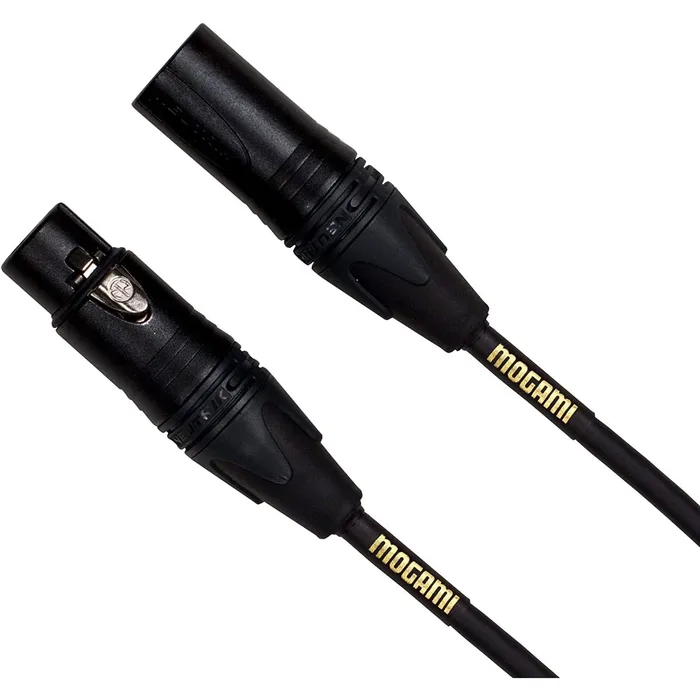
- Buy Mogami Gold Studio A quad-wired studio cable with a lifetime warranty and nine length options, from a maker that publishes real engineering data. Amazon
- Buy Hosa Pro Microphone Cable (HMIC) REAN connectors made by Neutrik AG, 20 AWG oxygen-free copper and a 90 percent braid, at a price that lets you buy eight of them. Amazon
- It depends Belden 1192A Star Quad Microphone Cable The best-documented cable here by a distance, sold as bulk, so it is a great answer only if you own a soldering iron. Amazon
- Skip VOVOX sonorus direct S A premium unshielded microphone cable sold on material-science language, from a maker that openly admits the directionality it markets has no electrical basis.
What actually matters
- Balanced transmission - Two conductors carry the same audio in opposite polarity and the receiving input responds only to the difference between them. Interference couples into both conductors almost equally, so it arrives as a common voltage that the subtraction removes.
- Common-mode rejection ratio - CMRR is the number that says how much of that common voltage actually survives, and it is a property of the receiving input and the driving source, not of the wire. Jensen's application note shows a real interface where a 470 ohm source impedance imbalance drops an active balanced input to just 30 dB of rejection at 60 Hz, while the same input fed through a transformer reaches about 100 dB.
- Shield type and coverage - The shield is a grounded conductive layer that keeps radio frequency interference off the pair, and coverage is the percentage of the cable it actually encloses. Braided shields like Hosa's 90 percent and Belden's 92 percent keep their coverage when the cable is coiled, which matters for a cable that gets wound up every night.
- Star quad geometry - Four conductors are arranged so that diagonally opposite pairs are joined at each end to form two signal legs that occupy nearly identical average positions. Mogami's technical catalogue puts the expected improvement in cancelling electromagnetic coupling at over 26 dB compared with a twisted pair.
- Capacitance per unit length - Every foot of cable adds capacitance between the conductors, and enough of it rolls off high frequencies. Belden publishes 39.2 pF/ft for 1192A, and Mogami openly recommends its two-conductor cable over its quad cables when top end and long runs matter.
- Connector and strain relief - The solder joint at the connector is where microphone cables fail, and the strain relief is what stops the jacket flexing at that joint. Neutrik's NC3MXX uses a chuck-type strain relief for higher pull-out force plus a boot with a polyurethane gland that Neutrik says protects against cable bending stresses.
- Serviceability - A connector assembled with solder contacts can be unscrewed, resoldered and returned to service indefinitely, which is why touring crews carry a soldering iron and not spare cables. A moulded cable is a disposable item the moment one joint cracks.
The specs, in plain English
Green flags vs red flags
Green flags
- The listing names the connector brand, ideally Neutrik, REAN or Switchcraft, rather than saying 'professional connectors'.
- Shield coverage is stated as a percentage and the shield type is named as braid, spiral or foil.
- Conductor gauge is given in AWG and the maker states whether the cable is two conductor or star quad.
- The connector ends unscrew, so the cable can be opened and resoldered instead of thrown away.
- The maker publishes an actual datasheet with capacitance, resistance and temperature range, not just a features list.
Red flags
- Moulded ends that cannot be opened, on a cable you intend to use for years.
- Directional arrows, burn-in instructions or claims about copper crystal structure, none of which come with a published measurement.
- The word 'shielded' with no shield type and no coverage percentage anywhere in the listing.
- Claims that the cable improves 'resolution', 'depth' or 'soundstage' where a capacitance figure would be more useful.
- A price at the top of the market alongside a spec section that contains no numbers at all.
Who's who: the brands
- Mogami - Japanese maker whose Neglex quad cable is a studio default, and one of the few consumer-facing brands that publishes a full technical catalogue with capacitance, inductance and flex-life data.
- Belden - American cable manufacturer whose public datasheets are the reference standard in this category, giving stranding, shield coverage, capacitance, bend radius and intended application for every part number.
- Neutrik - Liechtenstein connector maker whose XLR shells are the benchmark, with published contact resistance, mating-cycle life and a chuck-type strain relief, plus the REAN value line used by other brands.
- Hosa - California brand that covers the budget and mid tiers, and unusually for the price, names its connector brand, conductor gauge and shield coverage on the product page.
- Switchcraft - Long-running American connector manufacturer, used as the termination on Hosa's higher-tier microphone cable line and a common alternative to Neutrik in repair work.
How to read a listing without getting fooled
Read a microphone cable listing from the connector inwards, because that is the order in which things break. First find the connector brand; if it is not named, assume it is generic. Then check whether the ends unscrew, since a moulded cable is a disposable one. Next find the cable construction: how many conductors, what gauge in AWG, what the shield is made of and what percentage it covers. Only then look at the electrical figures, and treat any that are missing as unmeasured rather than unimportant. Finally, separate the specification section from the prose. Everything with a unit attached, whether that is AWG, picofarads per foot, ohms, percent coverage or millimetres of jacket diameter, is a claim the maker can be held to. Everything expressed as an adjective is not, no matter how technical it sounds.
How much should you spend?
Budget-tier XLR cables from a reputable brand already get you the important engineering: oxygen-free copper, a braided shield with a stated coverage figure, and in the best cases a named connector from a Neutrik-family line. That tier is where most people should buy most of their cables. The mid tier is mainly where bulk cable and custom-length assemblies live, and it is genuinely good value if you solder your own, because you pay for cable and connectors rather than for assembly. The premium tier buys you star quad geometry, wider length ranges, better jackets and lifetime warranties, all of which are real, but the actual sonic difference in a quiet room over a normal run is very close to nothing. Above that sits a boutique tier priced on materials language rather than measurements, and there is no engineering case for it in a microphone cable.
Questions, answered
Can I use a microphone cable for DMX lighting?
It will often appear to work and it is not what the standard asks for. DMX is a digital data protocol that expects a data-grade cable with a much higher characteristic impedance than microphone cable, and Belden publishes 40 ohm nominal characteristic impedance for its 1192A microphone cable. The mismatch causes reflections that show up as flickering fixtures or dropped frames, usually on the longest runs or the largest rigs. Buy cable sold as DMX cable for DMX, and keep the microphone cables for microphones.
Do I need gold-plated contacts?
Not particularly, and the industry itself is split. Gold resists oxidation and is a sensible choice on connectors that are rarely unplugged, which is why several cables here use it. Neutrik's reference NC3MXX uses 2 micrometre silver plating instead and publishes a contact resistance of 3 milliohms or less, which is the number that actually matters. VOVOX goes further and argues against gold on frequently swapped plugs on the grounds that repeated insertion already scrapes oxide away. Judge by the published contact resistance, not the colour.
Should the cable shield be connected at both ends?
Yes, for a balanced microphone cable. Rane's long-standing technical note on sound system interconnection states that the method specified by AES48 is to use balanced lines and tie the cable shield to the metal chassis right where it enters the chassis, at both ends of the cable. Lifting the shield at one end is a workaround people reach for when equipment has an internal grounding fault, and it degrades radio interference rejection. Fix the grounding rather than the cable if you can.
Is a thicker cable always better?
No. A heavier conductor gauge lowers resistance, which is useful over very long runs, but microphone signals are tiny and the resistance of a normal run is not the limiting factor. Thickness usually comes with a stiffer jacket that coils badly and puts more leverage on the solder joints when it does. Belden 1192A and Mogami's bulk Neglex 2534 studio quad both use 24 AWG conductors and sit around 6 mm overall diameter, which is a deliberate balance between flexibility and durability rather than an economy.
Or jump to the head-to-head: Mogami Gold Studio vs Hosa Pro Microphone Cable (HMIC).