Explained
Acoustic Panels, Explained
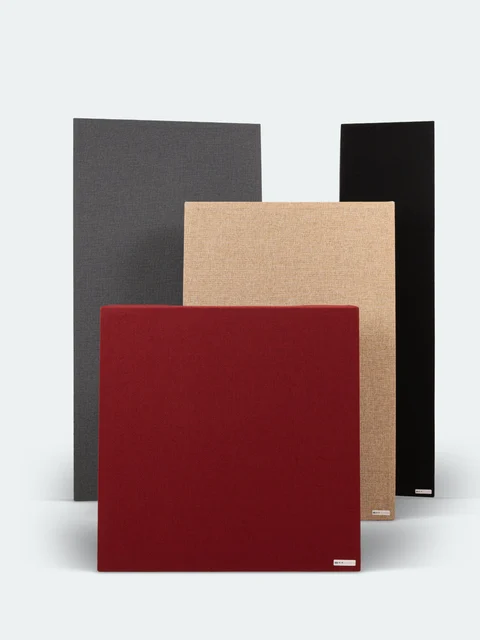
After reading this you will know exactly which room problem you have, how thick a panel needs to be to fix it, and which spec numbers on a listing are meaningful.
In this guide
Acoustic panels absorb sound energy bouncing around inside a room, which makes speech clearer, recordings less boxy and music less harsh. They do not stop sound from leaving or entering the room, and that single misunderstanding is behind most of the disappointed reviews in this category. The second thing that trips people up is thickness: how low a panel keeps working is set almost entirely by how deep the absorber is, so a wall of thin foam tiles leaves the boom exactly where it started.
The 30-second version
- Treatment is not soundproofing. Panels change how your room sounds; blocking sound through a wall needs mass, sealing and decoupling instead, and no fabric-wrapped panel does that job.
- Thickness decides the bass. Roughly 2 inches handles echo and harshness, about 4 inches starts reaching toward 100 Hz, and 6 to 8 inches (or a big air gap) is what genuinely touches low end.
- NRC hides the range you care about. It averages absorption at only 250, 500, 1000 and 2000 Hz, so a headline NRC of 1.0 tells you nothing about whether a panel does anything for boom.
- Placement beats quantity. First reflection points and corners deliver most of the audible change; treating roughly 15 to 25 percent of wall area captures most of the benefit before a room starts sounding dead.
- A documented fire rating matters at scale. Class A per ASTM E84 is a surface burning classification that is commonly required in rented, shared or commercial spaces, and unbranded foam often has no documentation at all.
The products this guide is about
Our verdict on each, with the full reasoning on the companion review.
- Buy GIK Acoustics Classic Bass Trap Panel (4 inch) A genuinely deep absorber that keeps working where thin panels quit, which is the part of the spectrum wrecking most small rooms.
- Buy ATS Acoustics Acoustic Panel with Sona Fabric, 24 x 48 x 2 inch The sensible default panel: mineral wool core, Class A fire rating and enough surface area per panel to actually change a room. Amazon
- It depends Owens Corning 703 Semi-Rigid Fiberglass Board, 2 inch (6 pack) The cheapest route to serious absorption per square foot, as long as you are genuinely willing to build the panels yourself. Amazon
- Skip Auralex Acoustics Studiofoam Wedgies, 2 x 12 x 12 inch (24 pack) Decent foam that still cannot beat physics: tile-sized coverage, little bass absorption and none of the isolation buyers expect. Amazon
What actually matters
- Total absorber depth, including any air gap. This is the single variable that sets how low a panel keeps working. A thin panel held a few inches off the wall behaves like a thicker one, which makes standoff hardware the cheapest upgrade in the category.
- A dense fibrous core. Mineral wool or semi-rigid fiberglass, typically in the 3 to 8 pounds per cubic foot range, outperforms open-cell foam at every thickness and does not yellow or crumble with age.
- Absorption published by frequency, not just a single NRC number. A full coefficient table across 125 Hz to 4000 Hz tells you whether the panel does anything below the mid-range. A lone NRC figure does not.
- Coverage per purchase, measured in square feet. Rooms are changed by treated area, not by how many pieces are in the box. Twenty-four small tiles and three large panels can cover identical wall area with wildly different install times.
- Corner strategy from the start. Bass energy piles up where walls meet walls and ceilings, so thick corner traps produce the biggest single audible change in a small room. Plan them before you buy the thin panels.
- A documented Class A (Class 1) rating per ASTM E84. Essential once you are covering a serious fraction of a wall, especially in a space you do not own. Treat an undocumented product as unrated.
- Mounting that suits the room. Large-format panels mean fewer holes and a faster install; peel-and-stick tiles suit rentals but multiply the number of mounting decisions and rarely hold their edges for years.
The specs, in plain English
Green flags vs red flags
Green flags
- The maker publishes a full absorption table by frequency, starting at 125 Hz, not just a headline NRC
- A mineral wool or semi-rigid fiberglass core inside a real wood frame, with the thickness stated plainly
- A documented Class A or Class 1 rating per ASTM E84, with the test named rather than implied
- The product family includes deeper versions or dedicated corner traps, so you can extend the same system later
- Mounting hardware that allows or includes standoffs for an air gap behind the panel
- Large-format panels sized in square feet, with coverage stated per purchase
Red flags
- Any claim or implication that the panels will soundproof a room, block noise, or quiet your neighbors
- A big NRC number with no frequency table anywhere on the listing
- Thin foam tiles marketed for bass control, or listings that mention bass traps and then ship 1 to 2 inch tiles
- Piece count used as the headline instead of total square footage, which makes small tiles look like a bargain
- No fire rating mentioned at all, or vague wording like fire resistant with no standard cited
- Vacuum-packed foam that arrives compressed, plus reviews mentioning it never recovered its shape or that it yellowed
Who's who: the brands
- GIK Acoustics - Treatment specialist known for deep panels and bass traps in multiple thicknesses, with wide fabric choice; sold direct rather than through marketplaces.
- ATS Acoustics - Mineral wool panels in large formats with published NRC data and a Class A rated Guilford of Maine fabric line (the standard panels are not fire rated), widely regarded as the sensible mid-range default.
- Owens Corning - Insulation manufacturer whose semi-rigid fiberglass board (the 700 series) is the raw core inside a large share of finished panels, and the cheapest route to serious absorption if you build your own.
- Rockwool - Stone wool boards, non-combustible and easier to handle than fiberglass, another common DIY core for panels and corner traps.
- Auralex Acoustics - The best-known acoustic foam maker; genuinely better built than generic tiles and it publishes data, but foam's physics still limit it to mids and highs.
- Primacoustic - Glass wool panels and room kits aimed at project studios and similar rooms.
How to read a listing without getting fooled
Start at the bottom of the spec block, not the top. Find the thickness first, because it caps what the panel can possibly do: 1 to 2 inches is a mid-and-high absorber no matter what the marketing says, and anything sold as a bass trap should be 4 inches or more, or designed to sit well off the wall. Next, look for an absorption table rather than a single NRC value, and read the 125 Hz column specifically; a number near 0.15 there means the panel does essentially nothing for boom, while a number approaching 0.7 or higher means real low-end work. Treat a headline NRC above 1.0 as normal rather than magical, since it comes from how edges are counted in the test chamber. Then convert the listing into square feet: multiply panel dimensions by quantity and compare that number across products, because piece count is the easiest place to be misled. Check that a fire rating names ASTM E84 and a class rather than saying fire resistant. Finally, scan for any language about blocking, isolating or soundproofing; a seller that blurs absorption and isolation is either confused or counting on you being confused, and either way their absorption claims deserve less trust.
How much should you spend?
Cost in this category tracks three things: the depth of the absorber, whether someone else did the framing and fabric work, and how large each panel is. The value sweet spot for most rooms is a mid-range mineral wool panel in a large format, because you get a documented fire rating, a core that will not degrade, and enough coverage per panel that a handful changes the room. Spending more is genuinely worth it when your complaint is boom rather than echo, since depth is the one thing you cannot fake and premium makers are the ones offering 4, 6 and 8 inch versions plus matched corner traps. Spending more is not worth it for fabric colors, brand-name foam, or extra mid-range panels once your reflection points are covered; past roughly a quarter of your wall area you are subtracting high frequencies and buying a duller room. The cheapest serious route is raw semi-rigid board plus your own frames and fabric, which buys far more treated area than any finished panel for the same outlay, but it costs a weekend and some patience with itchy material, so it is only cheap if you will actually build it. The most expensive mistake is a foam multipack bought to fix bass, because it does not, and the money is gone.
Questions, answered
Will acoustic panels soundproof my room or stop my neighbors hearing me?
No, and this is the most common and most expensive misunderstanding in the category. Absorption and isolation are separate problems. Panels soak up sound energy already inside the room, which cuts echo, reverb and harshness so the space sounds clearer. Stopping sound passing through a wall requires mass, sealed air gaps and decoupling: heavier or doubled drywall, sealed doors, treated vents and gaps. A wall full of panels will make your room sound dramatically better and will barely change what anyone outside it hears.
How thick do the panels need to be?
It depends entirely on what you are fixing. Roughly 2 inches handles speech, echo and mid-to-high frequency reflections well. Around 4 inches starts working down toward 100 Hz, which is where small rooms usually go muddy. Six to eight inches, or a thinner panel mounted several inches off the wall, is what it takes to meaningfully affect real bass. The working rule is that an absorber stays effective down to frequencies whose quarter wavelength is close to its total depth including any air gap behind it, which is exactly why thin foam does so little low down.
Where do the first panels go?
Start with the first reflection points: the spots on the side walls where sound bounces from your speakers to your listening seat, plus the ceiling point between them. The mirror trick finds them in a minute, with a helper sliding a mirror along the wall until you can see a speaker from your chair. After that, the wall behind your seat, and then thick absorption or dedicated traps in the corners where bass energy concentrates. If you are buying in stages and the room is small, many people get the biggest single improvement from the corners first.
Is NRC 1.0 better than NRC 0.85?
Slightly, in the range NRC covers, but the number is far less informative than it looks. NRC averages absorption at only 250, 500, 1000 and 2000 Hz, so two panels with identical NRC can behave completely differently at 125 Hz, which is where boom and mud live. A 2 inch panel and a 4 inch panel of the same material can both post NRC 1.0 while only one of them does anything about your bass problem. Always ask for the full frequency table before you let NRC decide the purchase.
Does the fire rating actually matter?
Yes, especially once you are covering a large area. Class A (also written Class 1) per ASTM E84 describes flame spread and smoke development for a surface material, and it is commonly required in commercial, rented or shared buildings. It is a surface burning classification, not a promise the panel is fireproof. Mineral wool and fiberglass cores are non-combustible or close to it, while foam depends on chemical treatment to earn a rating, and cheap unbranded foam often carries no documented rating at all. If you do not own the space, insist on a documented rating.
Can a room have too much treatment?
Yes. Because absorbers work far better on high frequencies than low ones, over-treating strips the top end first and leaves the bass untouched, which is how rooms end up sounding dead, muffled and oddly claustrophobic. Treating roughly 15 to 25 percent of total wall area captures most of the benefit for a typical small room. If you have covered that much and the room still sounds boomy, the answer is more depth in the corners, not more panels on the walls.
Or jump to the head-to-head: GIK Acoustics Classic Bass Trap Panel (4 inch) vs ATS Acoustics Acoustic Panel with Sona Fabric, 24 x 48 x 2 inch.