

Audio & Headphones
The Best Acoustic Panels: 4 Compared (and One to Skip)
We compared four acoustic treatment options on absorption depth, core material, fire rating, coverage for the money and install effort.
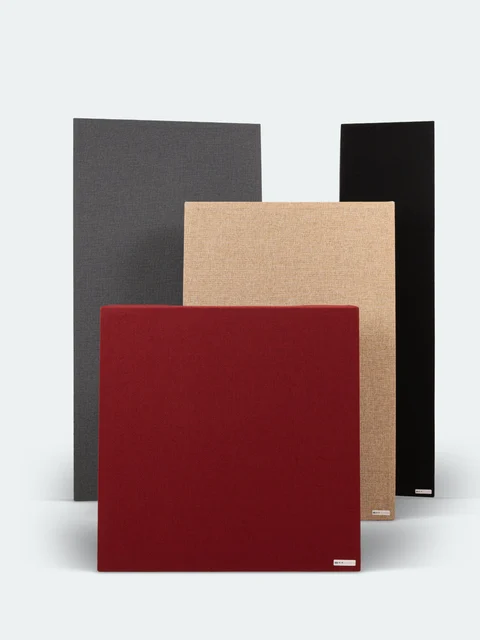
The short version
Acoustic panels change how a room sounds, they do not stop sound getting out, and those two jobs get confused constantly. Absorption below roughly 250 Hz depends on how thick the absorber is and how far it sits off the wall, so 2 inch panels tame echo while 4 inch and deeper panels start touching the low end. GIK's Classic Bass Trap Panel at 4 inches is the strongest single buy: it works down toward 100 Hz and comes in deeper versions for corners. The ATS 24 by 48 by 2 inch panel is the value choice for speech and mid-range reflections, with a Class A fire rating and a mineral wool core. Owens Corning 703 board is the cheapest serious absorption per square foot if you will build the frames yourself. Skip Auralex Studiofoam Wedgies and every other tile-sized foam multipack, because the coverage is small and the bass absorption is low. Best for: anyone who wants their room to sound clearer, not quieter.
Our picks at a glance
- GIK Acoustics Classic Bass Trap Panel (4 inch) - Buy. A genuinely deep absorber that keeps working where thin panels quit, which is the part of the spectrum wrecking most small rooms.
- ATS Acoustics Acoustic Panel with Sona Fabric, 24 x 48 x 2 inch - Buy. The sensible default panel: mineral wool core, Class A fire rating and enough surface area per panel to actually change a room.
- Owens Corning 703 Semi-Rigid Fiberglass Board, 2 inch (6 pack) - It depends. The cheapest route to serious absorption per square foot, as long as you are genuinely willing to build the panels yourself.
- Auralex Acoustics Studiofoam Wedgies, 2 x 12 x 12 inch (24 pack) - Skip. Decent foam that still cannot beat physics: tile-sized coverage, little bass absorption and none of the isolation buyers expect.
The verdict in 30 seconds
What mattered most
- Core material
- Thickness
- Low-frequency reach
- Published absorption
- Fire rating
- Coverage per purchase
Acoustic panels change how a room sounds. They do not stop sound from getting out of it, and no fabric-wrapped panel is soundproofing. The second thing buyers get wrong is depth: absorption below roughly 250 Hz depends almost entirely on how thick the absorber is and how far it sits off the wall, which is why a wall covered in thin foam tiles leaves the boom and mud exactly where it started. We looked at four common paths, from a deep purpose-built trap to the foam multipack that keeps getting bought by mistake.
A genuinely deep absorber that keeps working where thin panels quit, which is the part of the spectrum wrecking most small rooms.
Best for: Studios, mixing rooms and home theaters where low-end control is the actual problem and you want it solved once.
- At 4 inches deep it keeps absorbing down toward roughly 100 Hz, so it treats the low mids that make small rooms sound boomy
- Also sold in 6 inch and 8 inch depths, so you can go deeper in corners without switching brands or fabrics
- Absorbent core in a wood-railed frame with over 20 fabric options, so it survives the living room aesthetic test
- One panel type handles first reflection points and corners, which keeps planning and installation simple
- Costs several times what a foam multipack does, and a room still needs several panels to change
- It is bulky. Four inches plus mounting hardware is very visible on a wall in a small room
- Buying direct from the maker means shipping waits and less casual return convenience than a marketplace order
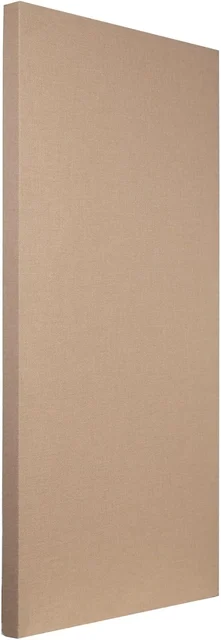
The sensible default panel: mineral wool core, Class A fire rating and enough surface area per panel to actually change a room.
Best for: Home studios, offices, podcast rooms and open living spaces where echo and harshness are the complaint, not rumble.
- Rated NRC 1.0 with a mineral wool core, so it works across speech and music mids and highs rather than only the top octaves
- Fire rated Class A per ASTM E84, which matters when you are covering large wall areas or treating a rented or commercial space
- Wood internal frame and woven Sona fabric hold their shape and edges far better than bare foam
- The 2 by 4 foot format means fewer panels, fewer holes and a faster install than tile-sized products
- At 2 inches its absorption tapers off below roughly 250 Hz, so it thins echo and harshness without fixing genuine bass problems
- Air-gapping it off the wall improves the low end, but the supplied hardware assumes a flush mount
- This 2 by 4 foot size comes only 2 inches thick (the 4 inch versions are smaller formats), so corners and deep bass still need a thicker solution
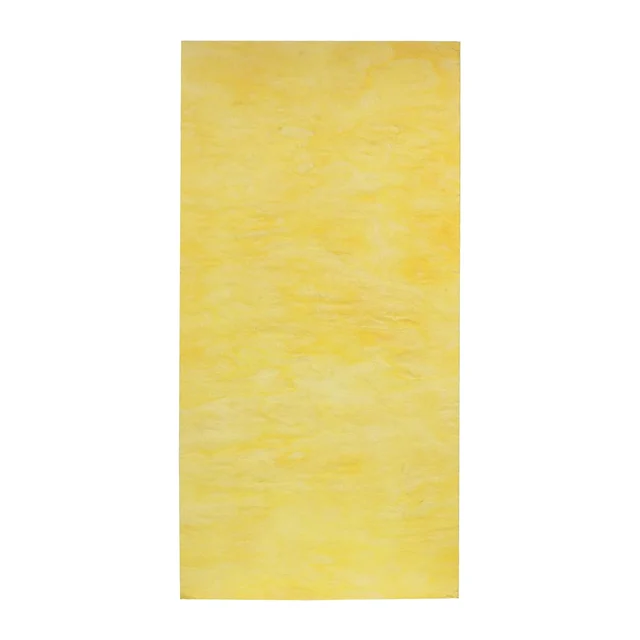
The cheapest route to serious absorption per square foot, as long as you are genuinely willing to build the panels yourself.
Best for: DIY builders treating a whole room on a budget who would rather spend a weekend than several times the money.
- Rated NRC 1.0 and fire rated Class A per ASTM E84, so the core material itself is no compromise
- Costs a fraction of a finished panel per square foot, and stacking two boards or air-gapping them buys real low-frequency depth
- Semi-rigid boards hold their own shape, so a simple wood frame and stapled fabric is the whole build
- Six 2 by 4 foot boards cover a lot of wall, and coverage is where most budget treatment plans run out of money
- This is raw material, not a finished product. Budget a weekend for frames, fabric, staples and cleanup
- Fiberglass is irritating to cut and handle and must stay fully wrapped, so gloves, a mask and long sleeves are not optional
- Bare boards look like insulation, so the finished result depends entirely on your fabric choice and your carpentry
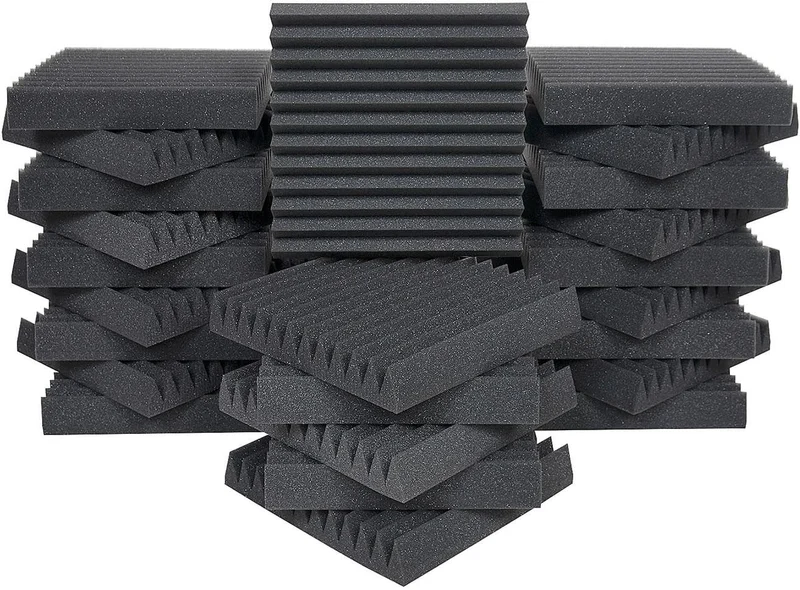
Decent foam that still cannot beat physics: tile-sized coverage, little bass absorption and none of the isolation buyers expect.
Best for: Nobody solving a real room problem. At best a cosmetic patch on one small reflection point.
- Real Auralex foam rather than crumbling no-name tiles, and the maker lists a UL 94 HF-1 flammability rating for Studiofoam
- Light and easy to place, which suits a single vocal corner
- A published NRC figure actually exists for it, which is more than most foam multipacks can claim
- Its NRC of 0.75 only averages 250 to 2000 Hz, and 2 inch foam absorbs little at 125 Hz, so it does close to nothing for boom or rumble
- Twenty-four 12 inch tiles come to about 24 square feet, the same as three 2 by 4 foot panels, but split into 24 pieces and 24 mounting jobs
- Nothing about foam blocks sound transmission, so it will not quiet your neighbors or stop bleed into a microphone
- Foam can discolor and degrade over the years, which fabric-wrapped mineral wool is far less prone to
| Criteria | Classic Bass Trap Panel (4 inch) Top pick | Acoustic Panel with Sona Fabric, 24 x 48 x 2 inch | 703 Semi-Rigid Fiberglass Board, 2 inch (6 pack) | Studiofoam Wedgies, 2 x 12 x 12 inch (24 pack) |
|---|---|---|---|---|
| Verdict | Buy it | Buy it | It depends | Skip it |
| Best for | Studios, mixing rooms and home theaters where low-end control is the actual problem and you want it solved once. | Home studios, offices, podcast rooms and open living spaces where echo and harshness are the complaint, not rumble. | DIY builders treating a whole room on a budget who would rather spend a weekend than several times the money. | Nobody solving a real room problem. At best a cosmetic patch on one small reflection point. |
| Price tier | $$ · premium | $ · mid-range | $ · budget | $ · mid-range |
| Core material | Absorbent core (type not published), fabric wrapped | Mineral wool, fabric wrapped | Semi-rigid fiberglass, unfaced | Open-cell foam |
| Thickness | 4 in (also 6 and 8 in) | 2 in | 2 in, stackable | 2 in |
| Low-frequency reach | Down toward ~100 Hz | Tapers off below ~250 Hz | Like a 2 in panel, better if doubled or gapped | Weak in the low end |
| Published absorption | NRC 1.20 | NRC 1.0 | NRC 1.0 | NRC 0.75 |
| Fire rating | Fire-rated construction, class not published | Class A per ASTM E84 | Class A per ASTM E84 | UL 94 HF-1 listed, no ASTM E84 class published |
| Coverage per purchase | 4 to 8 sq ft per panel, by size | 8 sq ft per panel | 48 sq ft per 6-pack | 24 sq ft per 24-pack |
| Install effort | Mount and done | Mount and done | Build frames, wrap, then mount | Glue or adhesive tabs |
| Price tier | $$ · premium | $ · mid-range | $ · budget | $ · mid-range |
Which one is right for you?
- Studios, mixing rooms and home theaters where low-end control is the actual problem and you want it solved once. Buy it GIK Acoustics Classic Bass Trap Panel (4 inch)
- Home studios, offices, podcast rooms and open living spaces where echo and harshness are the complaint, not rumble. Buy it ATS Acoustics Acoustic Panel with Sona Fabric, 24 x 48 x 2 inch
- DIY builders treating a whole room on a budget who would rather spend a weekend than several times the money. It depends Owens Corning 703 Semi-Rigid Fiberglass Board, 2 inch (6 pack)
- Nobody solving a real room problem. At best a cosmetic patch on one small reflection point. Skip it Auralex Acoustics Studiofoam Wedgies, 2 x 12 x 12 inch (24 pack)
How we judged the field
We do not run an acoustics lab. What we do is read across published absorption data from manufacturers, independent testing of common treatment materials, and the long tail of owner reports from people who bought panels, hung them, and then wrote about whether the room changed. Where those sources disagree, we say so.
Four things ended up deciding the verdicts.
Depth came first. Absorption coefficients published for the same material at different thicknesses tell a consistent story: 2 inches of dense fibrous material absorbs well from the mid-range up, 4 inches keeps going down toward 100 Hz, and 6 to 8 inches, or a panel mounted well off the wall, is what it takes to touch true bass. Thin foam absorbs far less below 500 Hz. That is not a brand problem, it is physics, and it drives most of the disappointment we see in owner reports.
Second, the treatment versus soundproofing confusion. A large share of one-star reviews on every product here are from buyers who expected a quieter room and got a better sounding one instead. Absorption and isolation are separate engineering problems. We weighted products by how well they do the job they can actually do.
Third, coverage for the money. A room is changed by square footage of absorption, not by the number of items in the box. A product that ships 24 tiny tiles and a product that ships three large panels can cover the same wall area, but the large panels install in a fraction of the time and hold their edges for years.
Fourth, fire rating. Class A (Class 1) per ASTM E84 is a surface burning classification for flame spread and smoke development. It is not a fireproof label, but it is a documented test, and it matters enormously once you are covering a serious fraction of a wall in a rented or shared building. Mineral wool and fiberglass cores are non-combustible or nearly so. Foam earns its rating through treatment, and unbranded foam frequently has no documentation whatsoever.
This is the panel that does the thing most buyers actually need and most products cannot do. At 4 inches of absorber in a wood-railed frame, its published performance keeps working down toward roughly 100 Hz rather than falling off a cliff in the low mids. In a small or square room, that low-mid range is where the muddiness lives: the octave or so above the deepest bass, where a wall of 2 inch panels leaves things almost untouched.
The maker publishes an NRC of 1.20 for the panel, which is a figure worth understanding rather than being impressed by. NRC is an average of absorption at 250, 500, 1000 and 2000 Hz, rounded, and a value above 1.0 simply means the panel absorbed more energy than its flat face area would suggest, mostly because the edges are exposed and the mounting adds effective surface. It does not mean the panel absorbs more than 100 percent of anything. It does tell you the panel is doing real work in the range NRC covers, and the deeper build is what extends that work below the NRC window.
The practical strength is the family. The same panel comes in 6 inch and 8 inch depths, reaching toward 80 Hz and 60 Hz respectively, so you can put 4 inch panels at your first reflection points and 6 or 8 inch versions in the corners without mismatched fabric or a second vendor. Fabric options run wide enough that owners report installing them in living rooms and home theaters without a fight about how they look.
The costs are real. This is the most expensive route per square foot here by a distance, it is bulky enough to be a visible design decision in a small room, and buying direct from the maker means shipping timelines and a return process that is less frictionless than a marketplace order. The company does not publish a fire class on the product page, which is worth asking about before you cover a wall in a commercial or rented space. But if the problem you are trying to solve is a boomy, uneven-sounding room, this is the product in this comparison that addresses it directly.
If your complaint is echo, slap, harshness or a room that makes voices sound like they were recorded in a bathroom, this is the sensible default and the better value. A mineral wool core rated NRC 1.0, a solid wood internal frame that keeps the edges from denting, and a woven fabric that is fire rated Class A per ASTM E84. Two feet by four feet means each panel is doing eight square feet of work, so a typical room needs a handful rather than dozens.
Owner reports on panels of this class are consistent and unglamorous in the best way: the room gets clearer, speech gets more intelligible, recordings stop sounding boxy, and the change is obvious immediately after the first two or three panels go up. Nobody reports being surprised by build quality, and the wide color range means they get installed rather than lived with in a garage.
What it will not do is fix bass, and the product is upfront enough about being 2 inches thick that this should not surprise anyone. Published absorption for 2 inch dense fibrous panels holds up well through the mid-range and starts tapering below roughly 250 Hz. If you have a boom in a corner or a note that rings, this panel is not the answer, and adding twelve more of them will subtract high frequencies long before it touches the low end.
The one free upgrade worth knowing: mounting any 2 inch panel a couple of inches off the wall on standoffs or spacers meaningfully extends its low-frequency reach, because the total depth of the absorber system now includes that air gap. The included hardware assumes a flush mount, so this takes a little improvisation, but it costs almost nothing and it is the single best trick in budget treatment.
This is the material inside a large share of the finished panels people buy, sold as raw board at a fraction of the finished price. Rated NRC 1.0 and fire rated Class A per ASTM E84, in 2 by 4 foot boards, six to a pack, which is 48 square feet of absorber in one purchase. Per square foot of treated wall, nothing else here is close.
The reason it is a “depends” rather than a straight buy is that you are buying a project, not a product. You need frames, you need breathable fabric, you need a staple gun, and you need a free weekend. The boards are semi-rigid, which helps a lot: they hold their own shape inside a simple frame rather than sagging the way a soft insulation batt does. Fiberglass is unpleasant to cut and handle, it must stay fully enclosed in fabric once installed, and gloves, long sleeves and a proper mask are non-negotiable rather than cautious advice.
The payoff beyond price is flexibility. Two boards stacked gives you 4 inches of depth for a fraction of what a finished 4 inch panel costs. A single board mounted with a 2 to 4 inch air gap behind it behaves far better in the low mids than the same board mounted flush. You can build straddle traps for corners, oversized ceiling clouds, and panels sized to your actual wall rather than to the maker’s catalog. Owners who go this route almost never regret the acoustics. The regrets, when they show up, are about carpentry: sloppy corners, fabric that sags, frames that do not sit flat against an uneven wall.
Go this way if you want maximum treated area for the money and you enjoy building things. Do not go this way if the realistic outcome is that the boards sit in a garage for a year.
This is the product category that generates more disappointed buyers than anything else in room acoustics, and this is a good version of it, which makes the point cleanly: the problem is not manufacturing quality, it is what foam can do.
Credit where it is due. This is genuine Auralex foam, not the crumbling generic tiles that arrive vacuum-packed and never fully recover their shape. The maker publishes an NRC figure, which most sellers in this category do not, and lists a UL 94 HF-1 flammability rating for Studiofoam rather than an ASTM E84 class. It is light and easy to put up, though the recommended mounting is adhesive, so expect some wall repair if you take it down in a rental.
Now the numbers. The maker publishes an overall NRC of 0.75 for 2 inch Wedgies, and NRC only averages 250 through 2000 Hz. Two inches of foam absorbs little at 125 Hz, and every complaint people have about a small room sounding boomy, uneven or muddy lives at or below that frequency. Covering a wall in these will make the room sound noticeably drier and thinner up top while leaving the actual problem completely intact, which is why owners so often describe the result as “different but not better.”
The coverage math is the second issue. Twenty-four 12 inch tiles is about 24 square feet, no more than three of the large panels above, but split into 24 separate pieces and 24 separate mounting decisions. And it will do nothing at all about sound leaving or entering the room, which is what a large share of buyers were actually hoping for.
If you have one specific high-frequency reflection to kill behind a microphone, a couple of tiles are fine. As a room treatment plan, put the money into mineral wool or fiberglass instead.
Classic Bass Trap Panel (4 inch) vs Acoustic Panel with Sona Fabric, 24 x 48 x 2 inch: which should you buy?
These two are not really competing for the same job, and picking between them starts with diagnosing your room rather than comparing spec sheets.
Clap your hands once in the empty room. If you hear a bright, fluttery ring that decays over a second or so, and voices sound harsh or boxy, your problem is mid and high frequency reflection. The ATS 2 inch panel handles that completely, costs far less per square foot, is a third the depth on the wall, and comes with a documented Class A fire rating. Buy four to eight of them, put them at the first reflection points and behind your listening position, and you are done.
If instead the room sounds thick, boomy or uneven, if bass notes are loud in one chair and vanish in another, if a specific low note rings on after the music stops, no quantity of 2 inch panels will fix it. That is low-frequency behavior, and the only things that touch it are depth, air gap and corner placement. The 4 inch GIK panel is built for that, and its 6 and 8 inch siblings go further.
Most rooms have some of both, which is why the standard professional layout is a mixed one: thinner panels at the reflection points, thick panels or traps in the corners. If you are buying in stages, buy the deep panels first and put them in the corners. Owner reports converge strongly on the same finding, which is that corner traps produce the biggest single audible change in a small room, and that the mid-range panels are the refinement afterwards rather than the foundation.
Budget sharpens the answer. If you can only afford one type, and your room is small, go deep and go in the corners. If your room is a large open living space and the issue is speech clarity, go with the 2 inch panels and buy more of them.
What to look for
- Depth before brand. Total absorber depth, including any air gap behind the panel, sets how low it works. Roughly 2 inches for mids and highs, 4 inches to reach toward 100 Hz, 6 to 8 inches for real bass.
- A dense fibrous core. Mineral wool or rigid fiberglass, typically in the 3 to 8 pounds per cubic foot range. These outperform foam at every thickness and do not degrade with age.
- Published absorption by frequency, not just NRC. NRC averages only 250 through 2000 Hz, so it says nothing about the range where rooms usually go wrong. Ask for the full coefficient table.
- Coverage, not piece count. Compare square feet per purchase. Twenty-four small tiles and three large panels can cover identical wall area with wildly different install time.
- A documented fire rating. Class A or Class 1 per ASTM E84 for anything covering significant wall area, especially in rented or shared buildings. Treat undocumented foam as unrated.
- Mounting hardware that allows an air gap. Standoffs or spacers that hold a panel 2 to 4 inches off the wall extend its low-frequency reach for almost no cost.
- Corners planned from the start. Bass energy concentrates at wall-wall and wall-ceiling junctions. Corner traps deliver the biggest audible change per panel in small rooms.
- A stopping point. Treating roughly 15 to 25 percent of wall area captures most of the benefit. Past that, rooms start sounding dead and unnatural.
Our final take
The two mistakes that cost people money in this category are believing that panels block sound and believing that thickness is a detail. Neither is true, and both lead to the same purchase: a box of thin foam tiles that makes a room sound drier without making it sound better.
GIK’s Classic Bass Trap Panel at 4 inches is the pick because it is the product here that addresses the low-mid range where small rooms genuinely fail, and because its deeper 6 and 8 inch versions let you extend the same system into the corners. It costs the most and it takes up the most wall, and both of those are the price of the physics working.
The ATS 24 by 48 by 2 inch panel is the runner-up and the better buy for a lot of people: NRC 1.0, mineral wool, Class A rated, large format, and priced so that covering the reflection points in a room is a reasonable purchase rather than a project. If the sound you are fighting is echo and harshness, start here.
Owens Corning 703 board is the value answer for anyone who will actually build. Forty-eight square feet of Class A rated, NRC 1.0 absorber for a fraction of finished-panel money, at the cost of a weekend and some patience with fiberglass.
And skip the foam tiles. Not because Auralex makes them badly, but because 2 inches of foam absorbs so little at 125 Hz that no amount of them will fix what most people are trying to fix. Spend the same money on fewer, thicker, denser panels and put them in the corners first.
Questions, answered
Will acoustic panels soundproof my room?
No. Absorption and isolation are different problems with different solutions. Panels soak up sound energy inside the room, which cuts echo, reverb and harshness. Stopping sound passing through a wall needs mass, sealed air gaps and decoupling: heavier drywall, sealed doors, treated vents and gaps. A wall covered in panels will make your room sound much better and will barely change what your neighbors hear.
How thick do acoustic panels need to be?
It depends what you are fixing. Roughly 2 inches handles speech and mid to high frequency reflections well. Around 4 inches starts working down toward 100 Hz. Six to eight inches, or a thinner panel mounted several inches off the wall, is what it takes to meaningfully affect bass. The working rule is that an absorber stays effective down to frequencies whose quarter wavelength is close to its total depth including any air gap behind it, which is exactly why thin foam does so little low down.
Is acoustic foam ever worth buying?
Rarely for a room, sometimes for a spot. Quality foam absorbs mids and highs adequately, so a tile behind a microphone or on one flutter-echo wall is a legitimate use. What it cannot do is control low frequencies or cover enough area to change a room's overall character at a sane price. If your budget is one foam multipack, the same money spent on mineral wool or fiberglass board plus fabric will outperform it by a wide margin.
Does the fire rating actually matter?
Yes, especially at scale. Class A (also written Class 1) per ASTM E84 describes flame spread and smoke development for a surface material, and it is commonly required in commercial, rented or shared buildings. It is a surface burning classification, not a promise the panel is fireproof. Mineral wool and fiberglass cores are non-combustible or close to it, while foam depends on chemical treatment to earn a rating, and cheap unbranded foam often carries no documented rating at all. If you are covering a large wall area or a space you do not own, insist on a documented rating.
How many panels do I need and where do they go?
Start with the first reflection points: the wall spots where sound bounces from your speakers to your listening position, plus the ceiling point between them. Then the wall behind you, and thick absorption or dedicated traps in the corners, where bass energy piles up. For a typical small room, treating roughly 15 to 25 percent of the total wall area gets most of the benefit. Going much past that keeps subtracting high frequencies and can leave the room sounding dead and muffled.
Deciding between the top two? See our head-to-head: GIK Acoustics Classic Bass Trap Panel (4 inch) vs ATS Acoustics Acoustic Panel with Sona Fabric, 24 x 48 x 2 inch.
More Audio & Headphones reviews
 The Best USB Audio Interfaces for Home Recording: 4 Compared (and One to Skip)
  The Best Small Audio Mixers for Podcasting: 4 Compared (and One to Skip)
  The Best AV Receivers: 4 Compared (and One to Skip)
  The Best Bluetooth Audio Transmitters: 4 Compared (and One to Skip)
  The Best Bone-Conduction & Open-Ear Headphones: 4 Compared (and One to Skip)
  The Best Bookshelf Speakers (Passive and Powered), Weighed Against the Hype