Explained
Wheel Cleaners, Explained
After reading this you will be able to look at any wheel cleaner bottle, work out what chemistry is inside, and know within seconds whether it is safe on your particular wheels.
In this guide
Wheel cleaner is one of the few things you can buy at an auto parts store that will permanently ruin a part of your car in under a minute. The whole category comes down to one variable that most labels bury: pH. Get that right for your wheel finish and everything else is preference; get it wrong and you are paying a refinisher, because chemical etching does not polish out.
The 30-second version
- pH is the only spec that can cost you a wheel. Cleaning power, smell, and price are all recoverable mistakes. A cleaner that is too acidic or too alkaline for your finish is not.
- "Non-acid" is not the same claim as "pH-neutral." It only rules out one of the two chemical routes to damage, and strongly alkaline cleaners are technically non-acid while still attacking bare aluminum and anodized layers.
- Identify your wheel finish before you buy anything. Clear-coated painted alloys, which is most factory wheels of the last twenty years, tolerate nearly anything. Polished, bare, machined-face, anodized, magnesium, and pitted chrome do not.
- pH-neutral iron removers are the safe default. They target embedded brake dust, are the lowest risk for most common finishes including ceramic coatings, and usually cost you only a slightly longer dwell time.
- Most reported damage is a process failure, not a product failure. Letting any cleaner dry on a hot wheel in direct sun causes more ruined finishes than picking the wrong bottle does.
The products this guide is about
Our verdict on each, with the full reasoning on the companion review.
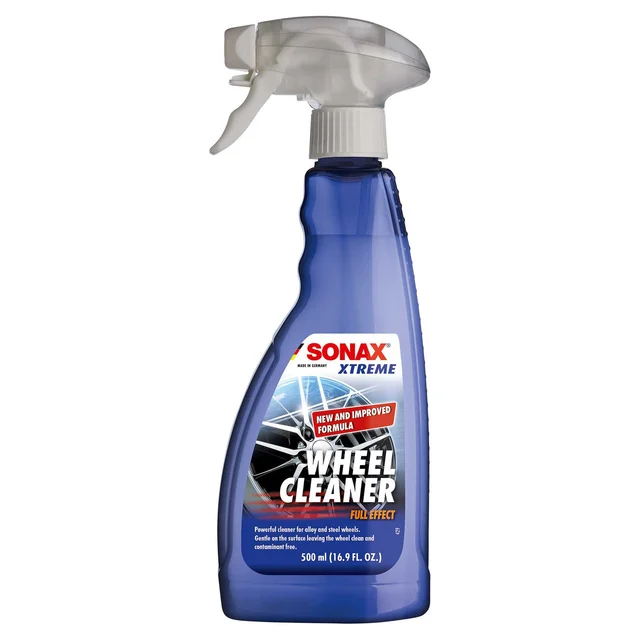
- Buy SONAX Wheel Cleaner Full Effect The pH-neutral iron remover that cleans hardest while staying safe on anodized, and clear-coated wheels. Amazon
- Buy Griot's Garage Heavy-Duty Wheel Cleaner Thick, clinging gel with a color change that stays on spoke faces instead of running to the ground. Amazon
- It depends P&S Professional Detail Products P&S Brake Buster Total Wheel Cleaner The professional workhorse: dirt cheap per wheel and brutally effective, but alkaline enough to stain bare and anodized aluminum. Amazon
- Skip Meguiar's Detailer Wheel Brightener (D140) An ammonium bifluoride acid cleaner that erases brake dust instantly and etches polished, bare, and anodized wheels permanently.
What actually matters
- Chemistry family. Wheel cleaners fall into three buckets: pH-neutral iron removers, caustic alkaline degreasers, and acids. Everything else on the label is downstream of which bucket you are in, so identify it first.
- Finish compatibility list. Read the manufacturer's list of approved surfaces as exhaustive, not illustrative. If polished or anodized is not named, assume it is excluded rather than assuming it was left out for brevity.
- Cleaning power at a realistic dwell. What matters is how much sintered-in brake dust comes off after a short soak and one light pass with a brush, because nobody is scrubbing each wheel for ten minutes.
- Body and cling. Thin liquids creep into lug pockets and tight barrels. Thicker gels stay put on vertical spoke faces and deep-dish lips. The right choice depends on your wheel geometry more than on brand.
- Whether it cleans tires too. Alkaline cleaners strip old tire dressing and sidewall browning. Iron removers are not aimed at rubber, so you may still need a separate tire product.
- Concentrate versus ready-to-use. A dilutable gallon changes the cost-per-wheel math dramatically against a trigger bottle, which matters a lot if you wash weekly and almost not at all if you wash monthly.
- Handling burden. Neutral iron removers need nothing more than gloves if you feel like it. Caustic and acid cleaners realistically demand gloves, eye protection, and ventilation, which is a real cost in a driveway.
The specs, in plain English
Green flags vs red flags
Green flags
- The bottle says pH-neutral or pH-balanced explicitly, not just non-acid or wheel-safe.
- The approved-surface list names polished, bare, anodized, and coated wheels, rather than stopping at clear-coated and painted.
- It identifies itself as an iron or fallout remover with a color-change indicator, which tells you the chemistry is targeted rather than brute-force.
- There is a gallon or concentrate version available, which means you can drop the cost per wheel later without changing products.
- The instructions specify a cool wheel, shade, and a defined dwell time, which is a sign the maker expects you to use it correctly rather than pretending it is foolproof.
Red flags
- "Safe on all wheels" on the front while the directions block or safety sheet quietly excludes polished, bare, or anodized finishes. When two sources on the same bottle disagree, believe the more cautious one.
- The safety data sheet lists sodium or potassium hydroxide, a high pH, or silicates, which means caustic no matter how the front label reads.
- Ammonium bifluoride or hydrofluoric acid anywhere in the ingredients, unless you run a shop with real PPE and nothing but clear-coated wheels.
- The finish list is short and vague, naming only clear-coated and painted wheels. That list is exhaustive, and the omissions are deliberate.
- Instant results with zero agitation advertised as the headline benefit. Speed that dramatic often comes from acid.
- The label is silent on pH entirely, which usually means the number is not a selling point.
Who's who: the brands
- SONAX - German car care house whose Wheel Cleaner Full Effect is described as acid-free and pH neutral, with a listed finish range that includes anodized, clear-coated, chrome and aluminum wheels.
- Griot's Garage - US detailing brand whose Heavy-Duty Wheel Cleaner is a thick, clinging solution sold up to a gallon size.
- P&S Professional Detail Products - Professional-channel supplier whose Brake Buster gel lists a pH of 12.5 on its safety data sheet, so treat it as strongly alkaline.
- Meguiar's - Mass-market brand with a separate professional Detailer line that includes acid wheel cleaners intended for shops, not driveways.
- Chemical Guys - High-visibility consumer detailing brand with a broad range spanning gentle neutral cleaners to aggressive formulas, so the specific product matters more than the badge.
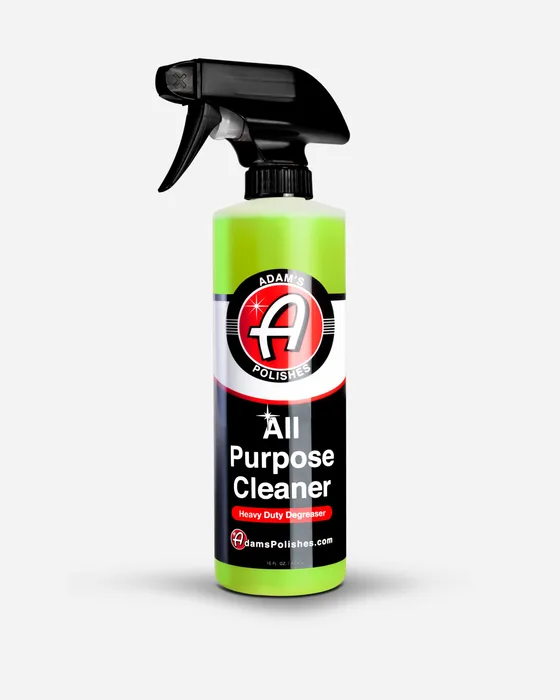
- Adam's Polishes - Enthusiast-focused detailing brand; check each wheel product's pH and finish list rather than assuming.
How to read a listing without getting fooled
Work the label in a fixed order and ignore the marketing until the end. First, hunt for a pH statement. If it says pH-neutral or pH-balanced, you are at low risk on most finishes and can move on to preference, after checking the finish list. If it says only non-acid, wheel-safe, or something similarly warm and imprecise, assume caustic until proven otherwise. Second, find the list of approved surfaces and read it as a closed list. A cleaner rated for clear-coated, painted, and chrome wheels is telling you, in the politest available language, that polished and anodized wheels are not invited. Third, look up the safety data sheet, which manufacturers publish and which is far more candid than the bottle. Sodium or potassium hydroxide means alkaline; ammonium bifluoride means acid. Fourth, check whether the directions block on the back contradicts the front label. This happens more than you would expect, and the cautious version is the one written by someone who has handled warranty claims. Finally, treat the words that sound like chemistry but are not: heavy duty, professional strength, and total wheel cleaner describe intensity or market segment, never pH.
How much should you spend?
This is a category where the cheapest options are the dangerous ones, which inverts the usual advice. Acid concentrates dilute the furthest and cost the least per wheel, and caustic gallons are close behind. pH-neutral iron removers cost the most per wheel because the active ingredient is expensive and most of them ship ready to use. That premium is the price of not being able to ruin a finish, and for anyone with polished lips, anodized wheels, or a ceramic coating it is trivially worth paying. If you wash occasionally, buy a ready-to-use neutral trigger bottle and stop thinking about it; the per-wheel cost is irrelevant at a handful of washes a year. If you wash weekly or have several cars, the single biggest saving available is switching to a gallon refill or concentrate of the same neutral chemistry rather than switching to a harsher chemistry, because dilution moves the cost far more than chemistry class does. Spending more within the neutral tier buys you cling, a clearer color change, and slightly faster action, all of which are conveniences rather than safety. Spending less by dropping to caustic or acid is only rational if every wheel you will ever spray is clear-coated and you are disciplined about dilution, timing, and rinsing.
Questions, answered
Does "non-acid" mean the same thing as pH-neutral?
No, and treating them as interchangeable is how most wheels get damaged. There are two chemical routes to ruining aluminum: acid and strong alkali. Non-acid rules out exactly one of them. A cleaner built on sodium hydroxide is truthfully non-acid and will still dull, whiten, or stain bare and polished aluminum and eat an anodized layer. pH-neutral is the claim that closes both doors. If a label says non-acid but never says neutral, assume caustic.
How do I tell whether my wheels are clear-coated, polished, or anodized?
Most factory alloy wheels from the last twenty years are painted or powder-coated aluminum under a clear coat. They look uniformly glossy with a slightly plastic depth, and the finish continues smoothly into the spoke corners. Polished aluminum looks like a mirror and shows fine swirl marks, usually on an outer lip or a machined face where the metal is cut bright. Anodized wheels turn up on aftermarket, off-road, and motorcycle applications and have a dry, satin metallic look with a colored tint rather than a wet gloss. If you genuinely cannot tell, use a pH-neutral cleaner, which is safe on all three.
Is an acid wheel cleaner ever the right choice?
For a professional shop running clear-coated fleet or rental wheels at volume, with gloves, eye protection, ventilation, and controlled dilution, acid saves real labor time. For one or two cars in a driveway the trade is upside down. A pH-neutral iron remover gets you most of the way there with a slightly longer dwell and one pass of a wheel brush, and it cannot produce an etch you have to pay a refinisher to fix. Acid damage is chemical etching rather than staining, so polishing does not bring the surface back.
Why do iron removers smell like rotten eggs, and does the purple color mean it is working?
Many iron removers use sulfur based chemistry, so the smell is evidence the active ingredient is present rather than a sign of a spoiled bottle. The purple or red bleeding is that active binding to dissolved iron particles. It tells you the reaction is happening and roughly when it has finished. A deeper color only means there was more iron on that wheel, not that one brand is stronger than another.
Will a wheel cleaner strip the wax or ceramic coating on my wheels?
PH-neutral iron removers are generally gentle on coatings and sealants and are a common maintenance product for coated wheels, but check the coating maker's guidance. Strong alkaline cleaners strip wax and most sealants outright and shorten the life of a coating with repeated use. Acid cleaners strip everything and can attack the metal underneath. If your wheels are coated, stay in the neutral tier and you have far less to worry about.
Do I need a separate tire cleaner?
Probably, if you use tire dressing. Iron removers are targeted at metal particles and are not aimed at rubber, so old dressing and brown sidewall blooming survive them. Alkaline wheel-and-tire cleaners handle both surfaces in one pass, which is a genuine convenience, but it comes with the finish restrictions that alkalinity brings. The common compromise is a neutral iron remover on the wheels and a dedicated degreaser on the tires.
Or jump to the head-to-head: SONAX Wheel Cleaner Full Effect vs Griot's Garage Heavy-Duty Wheel Cleaner.