Explained
All Purpose Cleaners, Explained
After reading, you'll understand how to dilute an APC for each surface on a car, and why a degreaser and a cleaner are not the same bottle.
In this guide
All purpose cleaner is the workhorse of a detailing cupboard, used on engine bays, wheel wells, door jambs, carpets, upholstery and trim. It is also the product most likely to damage something, because the same concentrate covers all of those jobs at wildly different strengths and the strength is rarely printed anywhere. Understanding the chemistry type and the dilution is most of what there is to know.
The 30-second version
- Dilution is a safety control, not just a way of making the bottle last longer.
- Degreasers are not cleaners, and a citrus solvent under an all purpose label will dull interior plastics.
- Interiors want a much weaker mix, typically a small fraction of what an engine bay tolerates.
- Dye and fragrance are functional risks, because both stay behind on headliners and in closed cabins.
- Always test somewhere hidden, at the strength and dwell time you actually intend to use.
The products this guide is about
Our verdict on each, with the full reasoning on the companion review.
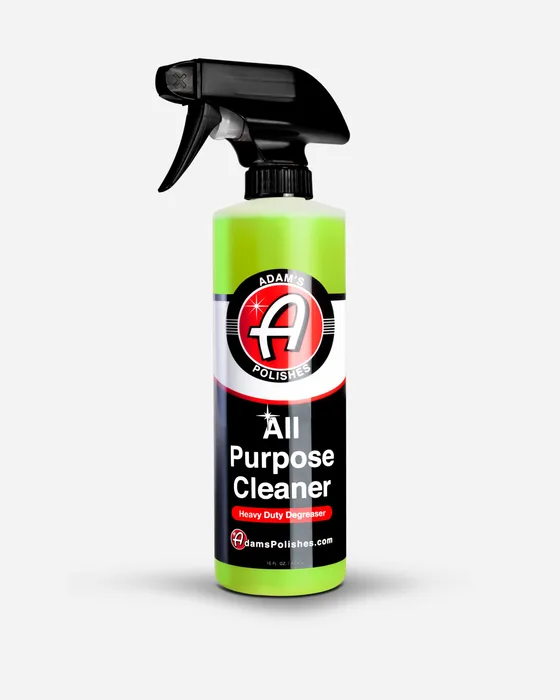
- Buy Adam's Polishes All Purpose Cleaner A bottle that tells you what it does at full strength and what it does diluted, and which surfaces belong to each. Amazon
- Buy P&S Detail Products All Purpose Cleaner The trade bottle, with the longest published surface list here and biodegradable detergents behind it.
- It depends Chemical Guys Nonsense Invisible Super Cleaner Colourless and odourless, which is the whole reason to own it and the reason it is a second bottle rather than a first. Amazon
- Skip Mothers Professional All-Purpose Cleaner Concentrate A trade gallon concentrate with the fullest mix table here, but no pH figure, a dye and perfume, and no word on which side of its ratios is water. Amazon
What actually matters
- Dilution ratio - how much concentrate to how much water, written as 1:10 or 10:1 depending on the brand's convention. It is the single most consequential number on the label and it is frequently absent.
- Chemistry type - detergent-based cleaners lift soil with surfactants and are the safer default; citrus and solvent degreasers dissolve oils and are far more effective on grease and far riskier on trim.
- pH - strongly alkaline cleaners cut grease hardest and are the ones that strip wax, dull aluminium and dry out rubber. Few automotive APCs publish a figure.
- Surface list - the surfaces the brand has cleared. A list that separates interior from exterior is more useful than a blanket safe on everything claim.
- Dye and fragrance - both remain on the surface after cleaning. On light headliners and in closed cabins they are a real drawback rather than a preference.
- Biodegradability - whether the surfactants break down, which matters when rinse water runs off a driveway into a storm drain rather than a treatment plant.
- Dwell behaviour - whether the product is meant to sit and work or be wiped straight off. Products that must not dry need working in small sections.
The specs, in plain English
Green flags vs red flags
Green flags
- A dilution ratio printed for at least one named use.
- Different strengths described for different surfaces, even without numbers.
- The chemistry named, such as citrus, solvent-based or detergent-based.
- A specific surface list that separates interior materials from exterior ones.
- Colourless and unfragranced options offered for interior work.
Red flags
- Concentrated claimed with no ratio anywhere on the page.
- Degreaser and all purpose cleaner used interchangeably in the same product name.
- Safe on any surface as the only guidance given.
- A citrus or solvent formula listing interior plastics and carpets with no dilution advice.
- No mention of what to do if the product dries on a surface.
Who's who: the brands
- Adam's Polishes - Consumer line whose APC page is unusually explicit about how the product behaves at full strength versus diluted.
- P&S Detail Products - Professional supply brand with a detailed surface list and biodegradable detergents, sold only in trade sizes.
- Chemical Guys - Several products under the all purpose label, including a colourless odourless cleaner, so check each page for chemistry and dilution.
- Meguiar's - A long-established consumer line. Check each product page for whether it is a concentrate or ready to use.
- Koch-Chemie - A European professional brand. Check its product pages for dilution guidance and pH data.
How to read a listing without getting fooled
Look for a ratio first, and if there is not one, look for any sentence that connects strength to a surface, because that is the next best thing and few products in the comparison above offer it. Then work out what kind of chemistry you are buying. If the word citrus, degreaser or solvent appears, treat it as an engine bay product regardless of what the label calls it. Read the surface list and be suspicious of anything that says safe on any surface, which is a claim that cannot be true across leather and wheel wells at the same concentration. Check for dye and fragrance if the product is going inside a car. And note whether the page warns about the product drying, since that determines whether you can do a whole panel or must work in sections.
How much should you spend?
Because only two products in this comparison publish a loose ratio or a fuller table, shelf price tells you very little about cost per spray bottle, and the trade gallon is usually far cheaper per use than a consumer bottle even at a higher sticker. The budget end of the category is mostly weaker versions of the same detergent chemistry, which is not dangerous, just slower. The mid-range is where the useful products sit. What is worth paying for is not strength but guidance: a brand that tells you what the product does at each dilution is selling you fewer mistakes. If the interior is the main job, a dedicated interior cleaner already at the right strength is often the better purchase than an APC you have to guess at.
Questions, answered
What dilution should I start with?
When the label does not say, start much weaker than you expect. Something around one part product to twenty parts water is a sensible starting point for interior plastics and upholstery, one to ten for door jambs and carpets, and closer to full strength only for engine bays, wheel wells and tires. Work up from weak rather than down from strong, because the failure is not reversible. If a stronger mix is needed, you will know within a panel.
Can I use an APC on leather?
Heavily diluted, and only if the brand says so. Leather in cars is almost always coated rather than raw, so what you are cleaning is a urethane finish rather than the hide, and an aggressive cleaner attacks the finish and the plasticisers underneath it. One product in the comparison above names leather specifically as a diluted use. A dedicated leather cleaner formulated near neutral is the safer choice and is not expensive.
Why did my dashboard go shiny and then chalky?
That sequence is usually a solvent-based cleaner used too strong. The initial shine is the surface finish being partly dissolved and redistributed, and the chalkiness that follows is what is left after the plasticisers have been pulled out and the surface has dried. It is not reversible by cleaning, and dressings only mask it. The prevention is dilution and using a detergent-based product rather than a citrus one inside the car.
Does an APC replace a wheel cleaner or a degreaser?
Partly. At full strength a good APC handles tires, wheel wells and light engine bay grime perfectly well, and it saves owning a separate bottle. What it will not do is dissolve embedded brake dust, which is bonded iron and needs different chemistry, or shift heavy baked-on grease as efficiently as a dedicated degreaser. The sensible cupboard is an APC for most things, an iron remover for wheels, and a degreaser only if you do engine bays regularly.
Or jump to the head-to-head: Adam's Polishes All Purpose Cleaner vs P&S Detail Products All Purpose Cleaner.