Explained
Battery Tenders, Explained
After reading, you'll understand what separates a real maintainer from a trickle charger, which numbers on a spec sheet actually predict how it will treat your battery, and why chemistry selection is the one setting you cannot get wrong.
In this guide
Almost every unit in this category is sold with the same three words on the box: charger, maintainer, trickle charger. Those words are not used consistently, and one of them describes a device that can slowly destroy the battery you bought it to protect. First-time buyers also tend to shop by amperage, which is the number that matters least for maintenance, and to ignore the Ah range, which is the number that decides whether the unit fits their battery at all. The good news is that the makers worth buying publish enough detail to check all of this in about two minutes.
The 30-second version
- A maintainer regulates, while an unregulated trickle charger keeps pushing current and can drive output voltage past 16 VDC over a long connection.
- Chemistry selection is not optional, because lead-acid float voltage applied continuously to a LiFePO4 pack can damage it, and lithium makers say so directly.
- The Ah range decides fit, so a unit rated 3Ah to 30Ah belongs on a motorcycle and one rated 20Ah to 160Ah belongs on a car.
- Desulfation is oversold, with published results varying enormously between batteries and warnings that indiscriminate pulsing can corrode grids.
- ETL is not a downgrade from UL, because both marks mean the product was tested to the same UL 1236 standard, just by different laboratories.
The products this guide is about
Our verdict on each, with the full reasoning on the companion review.
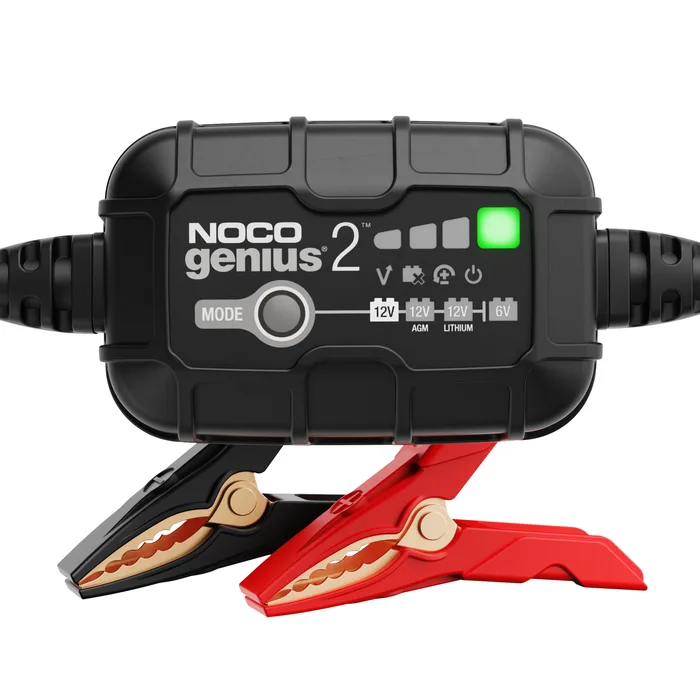
- Buy NOCO GENIUS2 The most flexible small maintainer here, because it covers 6V and 12V, lead-acid and lithium, and NOCO states in writing that it can stay connected indefinitely. Amazon
- Buy Battery Tender Junior Multi-Chemistry 12V 1 Amp Battery Charger and Maintainer A correct answer if the thing you are storing has a lithium powersports battery, thanks to a physical chemistry selector on the case. Amazon
- It depends CTEK CT5 TIME TO GO A premium lead-acid storage charger sized for a real car battery, with published charge voltages and a recondition program, and no lithium mode at all. Amazon
- Skip BatteryMINDer Model 1500 A competent lead-acid maintainer whose headline feature, full-time pulse desulfation, is the part of the pitch with the weakest evidence behind it. Amazon
What actually matters
- Chemistry mode - Flooded, AGM, and LiFePO4 want different absorption voltages and different behavior once full. A unit with a selector or a dedicated lithium mode removes the single most expensive mistake in this category.
- Float voltage - This is the steady voltage the charger holds once the battery is full, and it should sit just above the battery's resting voltage rather than at charging voltage. Deltran describes its float as holding the battery a tenth to half a volt above rest, well under the gassing voltage of lead acid.
- Published Ah range - Every serious maker states the battery capacities the unit is rated for. Ignore this and you will end up with a powersports tender clipped to a car battery, or a car charger oversized for a bike.
- Safety listing - UL 1236 is the standard that covers chargers for engine-starter batteries. An ETL or cETL mark means an independent laboratory tested the product to that same standard, so treat it as equivalent rather than lesser.
- Ingress protection - An IP rating such as IP65 tells you the unit tolerates dust and splashing, which matters if it lives on a garage floor or in a shed for a season. Where no rating is published, keep the unit indoors.
- Back current drain - This is how much the charger pulls back out of the battery when it has no mains power. Figures in the sub-milliamp range mean a power cut will not quietly flatten the battery you are storing.
- What the maker states about indefinite connection - The single most useful sentence on a spec sheet is an explicit statement that the unit can be left connected. If the maker will not say it, do not assume it.
The specs, in plain English
Green flags vs red flags
Green flags
- The maker publishes a charge voltage for each mode rather than describing the charging as smart
- A stated Ah range that actually brackets your battery's capacity
- An explicit sentence saying the unit can be left connected to the battery indefinitely
- A dedicated lithium or LiFePO4 mode, or a physical chemistry selector, if you own lithium
- A published safety listing to UL 1236 by any recognized laboratory, together with an IP rating and reverse-polarity protection
Red flags
- Amperage is the only specification given, with no Ah range and no voltage figures
- The listing uses charger, maintainer, and trickle charger interchangeably without describing a regulated float stage
- Desulfation or battery life multipliers dominate the copy while the maintenance specification is missing
- Lithium is implied by the photography or the vehicle list but never named as a supported chemistry
- No safety listing mark of any kind, and no stated protection against reverse polarity or short circuit
Who's who: the brands
- NOCO - Compact multi-chemistry GENIUS units that publish per-mode charge voltages, cover 6V and 12V, and state that they can be left connected indefinitely.
- Battery Tender (Deltran) - Long-running maintainer brand, with a multi-chemistry Junior that puts a lead-acid or lithium selector on the case.
- CTEK - Swedish charger maker that publishes technical data, including an IP65 rating on the CT5 TIME TO GO.
- BatteryMINDer (VDC Electronics) - Maker of the Model 1500, built around full-time pulse desulfation and multi-battery parallel maintenance, with no lithium mode listed.
- Schumacher - Consumer charger and tester brand. Check each model's page for chemistry support and Ah range.
How to read a listing without getting fooled
Start at the bottom of the listing, not the top. Find the technical data block and look for four things in order: the battery chemistry line, the Ah range, the output voltages, and any statement about leaving the unit connected. If the chemistry line says lead acid and you own a lithium pack, stop there, because no feature further down fixes that. If the Ah range does not include your battery's capacity, stop there too. Then check the output voltages against your battery maker's recommended charge voltage, which is usually printed on the battery or in its data sheet. Only after all of that does it make sense to compare amperage, display features, cable length, or price. Marketing headlines in this category tend to lead with recovery claims and end with the maintenance specification, so read the sheet backwards.
How much should you spend?
Budget units in this class are small single-purpose maintainers, often lead-acid only and 12V only, and at that tier you should still expect a stated float stage, reverse-polarity protection, and a safety listing. The mid-range is where multi-chemistry support, 6V compatibility, ingress ratings, published per-mode voltages, and longer warranties appear, and it is the tier most people should buy from because chemistry support is the feature that prevents an expensive mistake. Premium units add larger battery ranges, higher output for genuine charging, temperature compensation, reconditioning programs, and displays that tell you what is happening. Paying premium money makes sense when the unit covers a battery size the cheaper ones are not rated for, and much less sense when the extra spend buys a recovery claim rather than a specification.
Questions, answered
Does a battery maintainer need to be UL listed?
You want it listed to UL 1236, which is the safety standard for chargers that work on engine-starter batteries, but the mark does not have to say UL. An ETL or cETL mark from an independent laboratory means the product was tested to that same UL standard, so it is equivalent rather than second best. What you should avoid is a unit carrying no recognized listing at all, since this is a device you plug into mains power and leave connected to a battery unattended for months.
Can I leave the maintainer connected while the battery is still in the car?
Yes, and that is how most people use one. Follow the maker's connection order, which typically means clamping the positive lead to the battery terminal and the negative lead to a bare metal part of the chassis or engine block away from the battery, so that any spark happens away from the vent gases. Route the cables clear of hood edges, belts, and fans. Many units also ship with ring terminals you can bolt permanently to the battery and leave hanging behind the bumper or under the seat, which is a much better setup for a vehicle you store every winter.
Why does float voltage matter so much if it is only a fraction of a volt?
Because it is applied continuously for months, so a small error compounds. Hold a lead-acid battery too high and it slowly gasses off electrolyte and corrodes the positive grid. Hold it too low and it sits partially charged, which is the condition that causes sulfation in the first place. Lithium is less forgiving in a different way: it does not want a continuous float at all, which is why lithium modes and lead-acid modes behave differently once the battery is full rather than just charging at a different voltage.
Can one maintainer look after two or three vehicles at once?
Sometimes, but only if the maker says so. Some units, such as the BatteryMINDer 1500, publish the ability to maintain up to four batteries connected in parallel using the maker's own Y-connectors. Most compact tenders do not, and wiring several batteries in parallel to a charger that is not rated for it can leave a weak battery dragging the others down while the charger sees an average it is happy with. If you have several stored vehicles, the safer setup is one inexpensive tender per vehicle with ring terminals permanently fitted, and a switched power strip feeding all of them.
Or jump to the head-to-head: NOCO GENIUS2 vs Battery Tender Junior Multi-Chemistry 12V 1 Amp Battery Charger and Maintainer.