Explained
Car Air Fresheners and Odour Eliminators, Explained
After reading, you'll understand which car air fresheners add fragrance, which remove odour, and how to read a duration claim, an intensity control and an ingredient disclosure before you spend anything.
In this guide
First-time buyers almost always start in the wrong place, because the shelf is organised by scent rather than by mechanism. A hanging tree, a vent clip, a gel cup, a charcoal bag and a single-use fogger sit side by side and share the words air freshener, but two of them add fragrance, one adsorbs, and one treats the cabin. The other thing that trips people up is duration: the number on the pack is usually the best case at the lowest setting. Get those two ideas straight and the category becomes simple.
The 30-second version
- Masking and removal are different jobs, and most products sold as air fresheners only do the first one.
- A smell that appears when the fan starts is in the ductwork, so nothing hanging in the cabin will ever reach it.
- The cabin air filter is the cheapest first move, and in many cars it sits behind the glovebox and comes out without tools.
- Stated durations carry conditions, such as a vent clip's figure being measured on the low dial setting.
- Fragrance-free options exist, and activated or bamboo charcoal is the most common one if you want the car to smell of nothing.
The products this guide is about
Our verdict on each, with the full reasoning on the companion review.
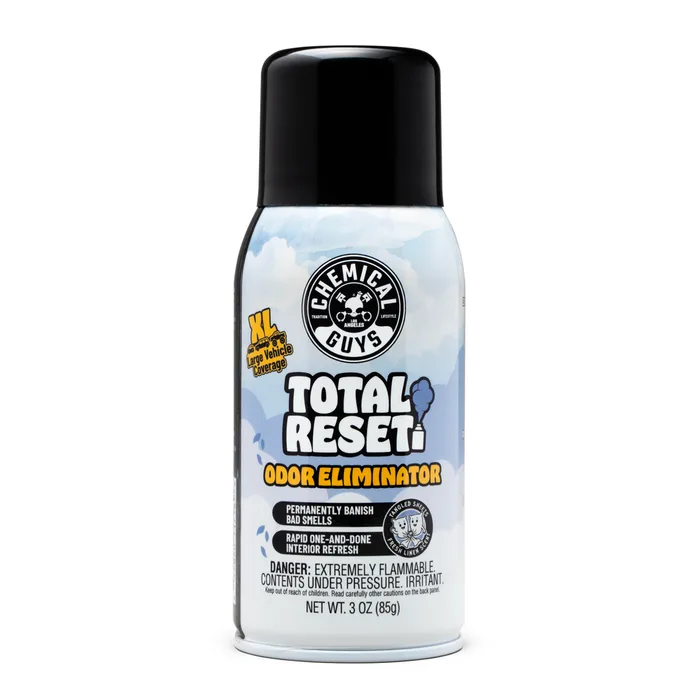
- Buy Chemical Guys Total Reset Odor Eliminator A single-use fogger you set off inside the car with the A/C on recirculate, so the treatment travels through the ductwork instead of just perfuming the air above the seats. Amazon
- Buy Moso Natural Car Air Purifying Bag 300 grams of moso bamboo charcoal in a stitched linen bag that adsorbs airborne compounds without adding any fragrance of its own. Amazon
- It depends Febreze CAR Vent Clip A clip-on fragrance cartridge that sits in the airflow of a vent blade, with a dial on top so you can actually turn the scent down. Amazon
- Skip Little Trees Tree Hanging Air Freshener The scented paper card that has been hanging from mirrors since 1952, and still the purest example of putting fragrance on top of a problem. Amazon
What actually matters
- Mechanism - whether the product adds fragrance, adsorbs compounds, or chemically treats the cabin decides whether it can solve your problem at all. Buying the wrong mechanism is the single most common mistake in this category.
- Source control - a smell that is still being produced, by a damp carpet or something spilled under a seat, will keep coming back. Every product here works better, or only works at all, once the source is gone.
- Cabin air filter - this filter sits in the same airflow as everything you smell from the vents, and a clogged or damp one is a frequent cause of a musty car. Replacing it is usually a cheap, quick job.
- Intensity control - a dial or a staged sleeve lets you match the output to a small sealed space. Without one, you get whatever the manufacturer chose, at full strength, on the hottest day.
- Duration and its conditions - compare like with like by noting the setting a duration was quoted at, and remember a single-use treatment is a one-time event rather than a running scent.
- Ingredient transparency - some makers publish a California ingredient disclosure or a safety data sheet, and some publish nothing. Disclosure is not proof of safety, but it lets you check.
- Contact and leak risk - anything holding fragrance oil near dash plastic or vinyl can leave a mark. Placement matters as much as the product itself.
The specs, in plain English
Green flags vs red flags
Green flags
- The maker says plainly whether the product masks, adsorbs or treats, rather than only listing a scent name.
- The stated duration comes with the condition it was measured under, such as a specific dial setting.
- There is an intensity control you can actually adjust after you install it.
- Ingredients, a California disclosure or a safety data sheet are published and easy to find.
- A fragrance-free version exists in the range, which suggests the maker is not relying on perfume for the effect.
Red flags
- The listing promises to eliminate odours but the product is a scented card, gel or clip with no described mechanism.
- A duration is claimed with no setting, size or condition attached to it.
- The maker publishes no ingredient information at all and no safety data sheet.
- The pitch leans on ozone generation for a car interior, which the US EPA says has little potential to remove indoor contaminants at concentrations that do not exceed public health standards.
- The product is marketed as a substitute for cleaning, rather than as something you use after cleaning.
Who's who: the brands
- Chemical Guys - A detailing brand whose air care range spans sprays, gels, clips and single-use whole-cabin foggers, aimed at people who already wash their own car.
- Moso Natural - Sells fragrance-free bamboo charcoal bags in a range of sizes, including a car-specific version, and builds its whole pitch on adding nothing to the air.
- Febreze - A Procter and Gamble brand whose car range centres on vent clips with an intensity dial, backed by a California ingredient disclosure through SmartLabel.
- Little Trees - The hanging paper tree in production since 1952, now alongside vent wraps, fibre cans and sprays, with over 40 fragrances in the Tree format.
- Meguiar's - A long-established car care brand whose interior line includes odour-eliminating mists sold alongside its cleaners and protectants.
How to read a listing without getting fooled
Start at the format, not the scent. If the listing describes a card, a clip, a gel or a scented spray, you are looking at a fragrance product no matter what the headline says about eliminating odours, so read the duration claim and check whether there is an intensity control. If it describes a charcoal or mineral filler in a bag, look for the weight in grams, the coverage area and the rejuvenation instructions, because those three numbers are what separate a serious bag from a token one. If it describes a single-use aerosol or fogger, read the directions rather than the claims: the useful ones tell you to run the A/C on recirculate and to leave the vehicle empty for a set period, and that instruction is the evidence that it is meant to reach the ductwork. Finally, look for what the maker will not tell you. A page with no ingredient link, no safety data sheet and no measured duration is asking you to trust a scent name.
How much should you spend?
This is a cheap category, which is precisely why people over-buy in it. Budget tier covers hanging cards, vent clips and charcoal bags, and at that level the price difference between products is far smaller than the difference in what they do, so choose on mechanism rather than on cost. Mid-range is where single-use whole-cabin treatments sit, and one can is a one-time purchase for a specific problem rather than a running cost. Premium tier in car air care mostly buys you scent development, packaging and brand rather than a different mechanism, so it is the tier to be most sceptical of. The best value move in the whole category is not a product at all: replacing a clogged cabin air filter usually costs less than a few months of vent clips and fixes the cause instead of the symptom.
Questions, answered
Do charcoal bags really work, or is it marketing?
Activated and bamboo charcoal genuinely adsorb some airborne compounds, so the mechanism is real. What is oversold is the scale: a bag is passive, slow, and limited by how much surface area it has, so it keeps a clean car neutral rather than rescuing a bad one. Makers state coverage areas without publishing a test method, so treat those numbers as guidance. Used as a background measure in a car you have already cleaned, they do a quiet, useful job.
Is fragrance-free automatically the healthier choice?
It reduces one specific thing, which is your exposure to fragrance VOCs in a small enclosed space, and the US EPA does list air fresheners among household VOC sources. What it does not do is make a claim about health outcomes, and we are not going to make one either. If you or a passenger get headaches or irritation from scented products, fragrance-free is a sensible thing to try. If nobody in the car reacts to fragrance, this is a preference rather than a health decision.
What about ozone machines and car odour bombs you rent or buy?
Ozone generators are marketed hard for car odour work, and the US EPA's position is worth reading before you buy one. The agency states that at concentrations which do not exceed public health standards, ozone has little potential to remove indoor air contaminants and is not effective at removing many odour-causing chemicals. It also notes that ozone can be harmful to health and that some studies found generators exceeding health standards even when used per instructions. Chemical treatments run through the A/C are a more sensible starting point for a car.
How often should I change the cabin air filter?
Intervals are set by the vehicle maker, so the owner's manual is the authority rather than any general rule, and dusty or high-pollen driving shortens them. What is worth knowing is that this filter is separate from the engine air filter and sits in the airflow you breathe, which is why a neglected one can make the whole cabin smell musty. In many cars it is behind the glovebox and comes out in a couple of minutes. If your car smells and you have never changed it, start there before buying anything scented.
Or jump to the head-to-head: Chemical Guys Total Reset Odor Eliminator vs Moso Natural Car Air Purifying Bag.