Explained
Car Emergency Kits, Explained
You will be able to look at any roadside kit listing and tell within a minute whether it contains real capability or a pile of adhesive bandages.
In this guide
Roadside emergency kits are sold on a single headline number: the piece count. That number is the least useful thing on the box, because a kit reaches 125 pieces by counting every individual bandage, cotton swab and alcohol wipe. What decides whether the kit helps you at 11pm on a shoulder is four or five items, and none of them are counted separately.
The 30-second version
- Piece count is marketing arithmetic. A 125-piece kit and a 76-piece kit can hold the same six pieces of useful hardware, because consumables inflate the total and hardware does not.
- Cable gauge and length decide whether a jump works. Lower gauge numbers mean thicker wire, and 4 to 6 gauge is the sensible target, yet pre-assembled kits commonly list 8 gauge, which makes length the tiebreaker.
- A 12V air compressor is among the most useful items. A slow leak is at least as common as a dead battery, and a compressor turns a tow into a fifteen minute delay, while a bare pressure gauge only names the problem.
- Most kit flashlights are keychains with ambition. Squeeze-powered and single AAA lights read a label and nothing more, so assume you will add a real flashlight or headlamp to the same bag.
- A lithium jump pack is often the better choice for solo drivers. It starts your car without a second vehicle or a stranger willing to stop, which is the whole reason cables fail people in practice.
The products this guide is about
Our verdict on each, with the full reasoning on the companion review.
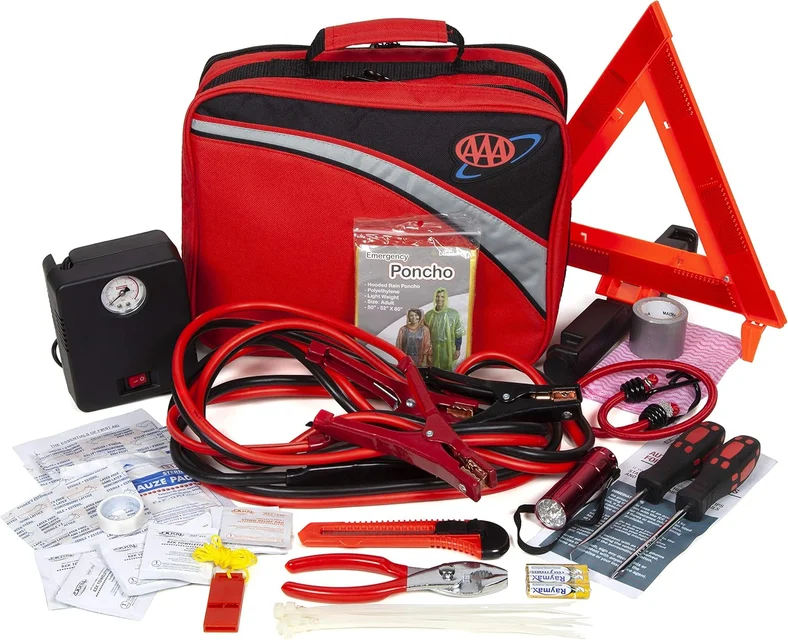
- Buy Lifeline AAA Excursion Road Kit (76-Piece) The rare pre-built kit where the important parts are the good parts: long cables, a real 12V compressor and tools with actual handles. Amazon
- Buy Everlit Survival Road Guardian Roadside Emergency Kit Longest cables in the group, a digital compressor and a 108-piece first aid kit that includes gauze pads. Amazon
- It depends Thrive Roadside Emergency Car Kit (104-Piece) The best hand tools of the group in the tidiest case, but no way to put air in a tire and the shortest cables here.
- Skip Always Prepared 125-Piece Roadside Emergency Kit A textbook example of the piece-count trick: strip out the bandages, swabs and glow sticks and very little capability is left.
What actually matters
- Jumper cable gauge. Gauge measures wire thickness and runs backwards: a lower number is thicker wire carrying more current. Electrical guidance points to 4 to 6 gauge for a normal car, but pre-assembled kits commonly ship 8 gauge. Eight gauge usually starts a mid-size car with a merely tired battery and struggles with a deeply discharged one, a big V8 or a diesel.
- Cable length. Length is the spec kits actually differ on. Eight feet demands cooperative nose-to-nose parking, which you will not always get in a garage, a parallel space or a shoulder. Ten to twelve feet lets you work with wherever the dead car is stuck. Note that longer cable at the same gauge does lose some current, so length is a convenience win, not a power win.
- Tire inflation, not just measurement. A 12V compressor plugs into the socket and reinflates a soft tire well enough to reach a shop. A tire pressure gauge only tells you the pressure. Many kits list a gauge in a way that reads like inflation capability, so check for the word compressor or inflator and a 12V plug.
- First aid substance. Look past the count for gauze pads, tape, gloves, tweezers and a CPR barrier. A first aid section advertised in the dozens or hundreds is usually dozens or hundreds of adhesive strips, which is a scrape kit, not a trauma kit.
- Whether the light is usable. A light you would happily use at home is the bar. Hand crank lights have no batteries to go flat and are not bright. Squeeze-powered mini lights are novelty items. A small AAA flashlight reads a label but will not let you change a wheel comfortably.
- Visibility gear. Reflective triangles are reusable, fold flat and, when built to the federal standard, stay upright in serious wind. Flares burn brighter in rain, snow and fog but burn out in under an hour and are a fire risk near spilled fuel. For a private car, a triangle plus a hi-vis vest is the practical combination, with LED flares as an addition rather than a replacement.
- Case structure. Soft duffels let everything sink to the bottom, so you end up emptying the bag onto the gravel to find the cables. Defined pockets and a case that survives being crushed under a spare wheel are worth more than two dozen extra bandages.
The specs, in plain English
Green flags vs red flags
Green flags
- Cable length stated at ten feet or more, with the gauge stated plainly rather than hidden.
- A 12V compressor listed as a compressor or inflator, ideally with a digital readout and automatic shutoff.
- A first aid section that names gauze, tape, gloves, tweezers or a CPR barrier instead of just quoting a count.
- A modest total piece count where most of the listed items are hardware, which usually signals a maker who did not need the number to sell the kit.
- A structured case with defined pockets, and a reflective panel on the outside of the bag.
- A full size warning triangle that stands on its own, plus a hi-vis vest.
Red flags
- The headline is a piece count and the listing never states cable gauge or length.
- A first aid section quoted in the dozens or hundreds with no contents list, which often means mostly bandages, swabs and wipes.
- Cables under about eight feet, which force parking positions you will not always be able to get.
- A squeeze-powered or novelty light presented as the kit's flashlight.
- Photos where the contents are laid out in dense rows of tiny identical items, the visual signature of a padded count.
- No mention of tire inflation at all, or a pressure gauge described in a way that implies inflation.
Who's who: the brands
- Lifeline - Makes the kits carried under a major motor club's name, and generally specifies better hardware than the category average.
- Everlit Survival - Value-focused kits that tend to lead on the functional specs, notably longer cables and deeper first aid contents.
- Thrive - Known for hand tool quality and tidy structured cases, with narrower scope than full roadside kits.
- Always Prepared - Budget kits sold on large piece counts, where much of the total is wound-care consumables.
- NOCO - Not a kit maker. Widely carried lithium jump starters, which is what many drivers buy instead of relying on the cables in a kit.
- Slime and Viair - Standalone 12V inflators and tire sealant, the usual upgrade path when a kit ships only a pressure gauge.
How to read a listing without getting fooled
Start by covering up the piece count with your thumb, then read the parts list for five things: how thick and how long the jumper cables are, whether there is a compressor or only a gauge, what the first aid pouch actually contains by name, what kind of light is included, and whether the case has structure. If the listing states a piece count but never states cable gauge, that omission is the answer. Watch the photo too: a kit laid out in long rows of identical small items is telling you where the number came from. Treat a first aid count in the dozens or hundreds as a warning rather than a feature unless the contents are itemized. And read the tire section literally, because 'tire pressure gauge' and '12V compressor' sit one line apart in many listings and only one of them fixes anything.
How much should you spend?
The cheapest kits are cheap because the hardware inside them is thin, not because the maker found efficiencies. Moving from the budget tier to the middle of the market buys you the compressor, longer cables and a first aid pouch with real contents, and that step is the one worth paying for. Going from the middle to the premium tier buys better tool quality, a sturdier case and, usually, a recognizable brand behind it, which is a real but smaller upgrade. A useful rule: if you can buy the mid-tier kit and put the difference toward a lithium jump pack and a proper flashlight, that combination beats a premium kit on its own, because the two items you added are the two the kits are weakest on. Spending more rarely buys you thicker cables in this category, since pre-assembled kits commonly list 8 gauge, so if you drive a truck, a diesel or a large SUV, budget separately for heavier cables or a jump pack rather than shopping up the kit tiers.
Questions, answered
Does a higher piece count mean a better kit?
No, and it is worth being blunt about it. Piece counts are built by counting each adhesive bandage, cotton swab, cable tie and alcohol wipe as one piece. A kit can advertise well over a hundred pieces while containing five or six items that matter. Ignore the number and read for cable gauge and length, whether there is an air compressor, what is in the first aid pouch besides bandages, and what kind of light is included.
What jumper cable gauge and length do I actually need?
Aim for 4 to 6 gauge if you are buying cables on their own, since thicker wire carries more current and starts a colder or larger engine. Pre-assembled kits commonly list 8 gauge, which will usually start a mid-size car with a tired battery and struggles with a deeply discharged one or a large engine. Since the gauge is a given, judge kits on length: eight feet forces perfect parking, while ten to twelve feet lets you work with wherever the other car can stop.
Should I just buy a lithium jump pack instead of a kit?
For a solo driver, a jump pack is the more useful single purchase, because it starts your car without needing a second vehicle or a stranger willing to stop, and it usually charges a phone and carries a light as well. It has largely replaced cables as the practical answer to a dead battery. The catch is maintenance: it needs recharging every few months or it will be flat exactly when you need it, while cables have no battery to go flat. Drivers who have actually been stranded tend to end up carrying both, plus a kit for the tire and visibility side.
Triangles or flares?
For a private car, reflective triangles. They fold flat, are reusable, and the ones built to the federal standard stay upright in strong wind, so one purchase covers you for years. Flares cut through heavy rain, snow and fog better than reflective material, but they burn out within a short time and are a bad idea near spilled fuel. LED flares are a good addition for weather, though in commercial-vehicle rules they count as a supplement to triangles rather than a replacement, which is a reasonable way for the rest of us to think about them too.
Should I buy a pre-assembled kit or build my own?
Building your own gets better parts for the same outlay, because you can pick thick cables, a real compressor and a light you would actually use. The argument for a pre-assembled kit is simply that it exists and is already packed, and most people who plan to build one never finish. The middle path most owners land on is to buy a decent kit and then replace its two weakest items, which are often the cables and the flashlight.
What is missing from many kits?
Four things, often: a fire extinguisher, a tire plug kit, drinking water, and a light bright enough to work by. Decide which of those you want before assuming the kit has you covered. One more note on the first aid contents: they are aimed at minor cuts and scrapes, and they are general supplies rather than medical advice. Anything worse than a small wound should go to a professional rather than be handled out of a trunk pouch.
Or jump to the head-to-head: Lifeline AAA Excursion Road Kit (76-Piece) vs Everlit Survival Road Guardian Roadside Emergency Kit.