Explained
Car Seat Covers, Explained
You will know whether your front seats hide a side airbag, what a cover has to do about it, and how to pick a fit and fabric that still looks right a year from now.
In this guide
Seat covers look like the easiest purchase in the car aisle and they are not, because most front seats built in the last two decades hide a side impact airbag inside the outboard bolster of the seat back. A cover fitted over that seat has to be built to let the airbag through, which rules out the entire generic universal category on those seats. Everything else in this guide, fit codes, fabrics, anchoring, is a distant second to that one check.
The 30-second version
- Check for a seat mounted side airbag first. Most modern front seats put the side impact (thorax) airbag in the outboard bolster of the seat back, not in the door or pillar, and a cover over it must have a tear-away seam engineered to rupture when the bag fires. A cover without one can hold the airbag in or send it sideways, which is a genuine hazard rather than a warranty footnote.
- Custom fit is a safety spec, not a luxury. Only a pattern cut for your exact seat can put that tear-away seam where your automaker put the module, which is why universal covers are the wrong tool on any airbag seat regardless of what the packaging claims.
- Buy for the mess you actually make. Canvas and duck weave win on abrasion, grit, and washing; neoprene wins on water and padding but runs hot; leather and leatherette win on looks and wiping down but do nothing extra for protection.
- Your vehicle is not your fitment code. One model year can have separate patterns for bucket versus bench, headrest style, integrated seat belts, armrests, and airbag equipped seats, so the pattern you need is decided by the seat, not the badge.
- A cover sits between you and your seat's electronics. Heated and ventilated seats, lumbar controls, and the front passenger occupant classification sensor can all be affected by a thick padded cover, so thickness has real consequences beyond comfort.
The products this guide is about
Our verdict on each, with the full reasoning on the companion review.
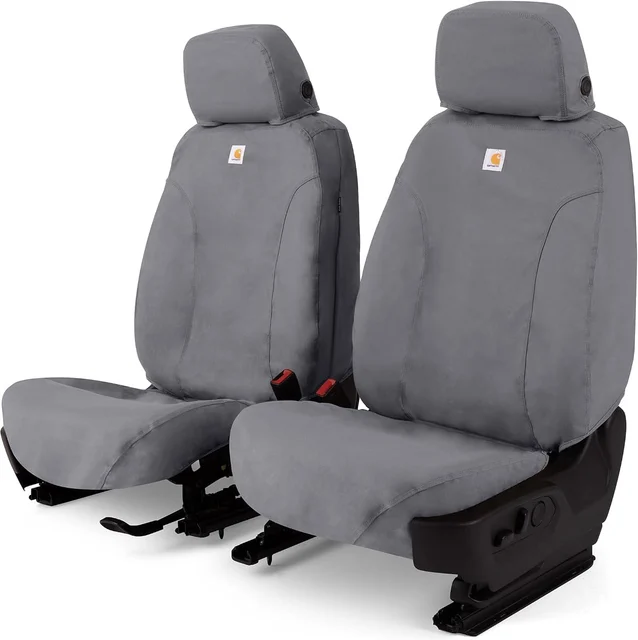
- Buy Covercraft Carhartt SeatSaver Custom Seat Covers Heavy duck weave canvas cut to your exact seat, with the airbag question handled per pattern. Amazon
- Buy Rough Country Neoprene Seat Covers Vehicle specific neoprene that keeps water off the seat without specialist neoprene pricing.
- It depends Clazzio Leather Seat Covers Turns a cloth interior into a convincing leather one, if you can afford it and will do the install properly.
- Skip FH Group Apex90 Superior Faux Leather Car Seat Covers (Front Set) A tidy example of the universal cover category, and the category itself is the problem on any seat with a side airbag.
What actually matters
- Side airbag compatibility. The single decisive criterion. Look for a maker that explicitly states the pattern is engineered for seat mounted side airbags, with a tear-away seam or airbag-rated thread. If a listing is silent on the subject, treat that silence as a no.
- Fitment granularity. How finely the catalogue is cut. A deep catalogue lists distinct patterns for bucket versus bench, adjustable versus recessed headrests, and airbag equipped seats. Granularity is what makes the seam land correctly and what keeps the cover from going slack.
- Material versus your actual mess. Abrasion and grit call for heavy canvas or duck weave; standing water, wet gear, and dogs call for neoprene; a styling upgrade calls for leather or leatherette. Picking on looks alone is the most common mismatch in this category.
- Anchoring method. Straps, hooks under the seat, and crevice tucks are what stop a cover creeping and bunching. Elastic edges alone will go baggy within months.
- What the cover blocks. Seat heating, seat ventilation, side bolster controls, seat back pockets and tables, and on the passenger side the occupant classification sensor that decides how the front airbag deploys.
- Washability. Washable stops being a nice-to-have and becomes the main feature once a cover is a year old and has absorbed a season of coffee, dog, and gravel.
- Install effort. A slip-over set is minutes per row. A tailored leather set is an afternoon of tucking and hooking, and a rushed install leaves wrinkles that never settle out.
The specs, in plain English
Green flags vs red flags
Green flags
- The listing states plainly that the pattern is built for seat mounted side airbags, or specifies airbag deployment thread, rather than gesturing at safety in general terms.
- The fitment tool asks you about your seat, not just your vehicle: bucket or bench, headrest style, armrest, integrated belts, airbag equipped or not.
- Distinct pattern numbers exist for different seat configurations within the same model year, which shows the catalogue was actually cut per seat.
- The cover anchors with straps, under-seat hooks, and crevice tucks rather than relying on elastic edges.
- Care instructions say the cover is washable, or the material wipes clean without special treatment.
- The listing publishes its exclusions, for example power seats or certain cab configurations, instead of implying it fits everything.
Red flags
- A universal or one-size cover sold for a seat that has a side airbag. No generic pattern can place a tear-away seam over your specific module.
- Marketing that says airbag compatible or airbag safe with no mention of which seats, which patterns, or what the seam actually does.
- Fitment described only by vehicle and year, with no question about seat configuration.
- A thick, heavily padded cover intended for the front passenger seat, which is where the occupant classification sensor lives.
- Elastic-only attachment with no straps or hooks, which reads as tidy in photos and baggy after two months.
- Silence on heated or ventilated seat compatibility when your car has either.
Who's who: the brands
- Covercraft - US maker with a broad fitment catalogue, including its Carhartt duck weave SeatSaver line; check each listing for its airbag note.
- Rough Country - Off-road parts brand whose vehicle specific neoprene sets, concentrated on trucks, Jeeps, and popular SUVs.
- Clazzio - Maker of tailored leather sets cut per year, make, model, and trim, aimed at turning a cloth interior into a convincing leather one.
- Coverking - Custom fit house with a wide material range, from ballistic canvas to neoprene to suede, and a per-seat pattern approach.
- WeatherTech - Better known for floor liners, but its seat protectors serve the buyer who wants upholstery protection without wrapping the bolster.
- FH Group - High-volume budget brand typical of the universal cover market, which is exactly the shape of product to avoid on any seat with a side airbag.
How to read a listing without getting fooled
Start at the bottom of the listing, not the top. The hero photo and the material name tell you almost nothing; the fitment section and the exclusions tell you everything. Work through it in order: does the fitment tool ask about your seat configuration, or only your vehicle? Is there a specific line stating the pattern is engineered for seat mounted side airbags, and does it name a tear-away seam or airbag-rated thread? Which pattern number does your seat resolve to, and does the listing note exclusions such as power seats, integrated belts, or particular cab configurations? Then read the attachment description: straps and hooks and crevice tucks are real anchoring, elastic edges are not. Treat the material claims skeptically. Water resistant is not waterproof, faux leather is a plastic coating that will feel like one in summer, and padded is a comfort claim that carries a cost on the passenger seat where the occupant sensor lives. Finally, check the care instructions before you check the reviews, because how a cover cleans is what you will care about in a year. If any of the airbag questions come back vague, stop there and pick a different maker rather than hoping the seam happens to line up.
How much should you spend?
This is one of the rare categories where the cheapest option is not just worse, it is the wrong product. Cost in seat covers is driven by pattern development, which is expensive because the maker has to cut and test a separate pattern for every seat configuration, and by material, where heavy canvas and layered neoprene cost real money to make and thin faux leather does not. The value sweet spot sits at custom or vehicle specific covers in a durable fabric, which is where you get correct airbag seam placement, anchoring that holds, and a cover that survives long enough to be worth the install time. Spending beyond that buys appearance rather than protection: tailored leather sets cost more than a good canvas set and give you a factory-leather look plus extra padding, which is worth it only if the interior upgrade is the actual goal and you will give the install an unhurried afternoon. Spending below that sweet spot is the trap. Budget universal sets look like savings and deliver a cover that creeps out of the seat crease, blocks your seat heater, and cannot guarantee a tear-away seam over your airbag. If the budget genuinely will not stretch to a custom set, buy a simple seat protector or a washable towel style cover instead, which protects the upholstery without wrapping the bolster where the airbag lives.
Questions, answered
How do I find out whether my front seats have a side airbag?
Two quick checks. Look along the outboard edge of the seat back, the side nearest the door, for a small stitched or moulded tag reading SRS, AIRBAG, or SIDE AIRBAG. Then confirm in your owner's manual, which will list side impact or thorax airbags and say where they are mounted. If the manual says the side airbag is in the seat rather than the door or roof pillar, every cover you consider has to be built for it. When you cannot find a clear answer, assume the seat has one and buy accordingly, because that assumption costs you nothing and the reverse mistake can cost a lot.
Is a universal seat cover ever acceptable?
On a seat with no side airbag, a removable headrest, and no integrated seat belt, a universal cover is a reasonable cheap fix. Anywhere else it is the wrong tool. A universal panel is cut to a generic shape, so whatever seam is meant to open sits wherever the pattern put it, not wherever your automaker put the module. Universal covers also have nothing seat specific to anchor to, so they creep, bunch, and pull out of the seat crease. If money is tight and your seat has an airbag, a seat protector or towel style cover protects the upholstery without wrapping the bolster.
Will a seat cover stop my heated or ventilated seats from working?
It can slow them down a lot. A thick padded cover acts as insulation, so a heated seat takes noticeably longer to feel warm, and a ventilated seat can be effectively cancelled because the perforations in the factory upholstery need airflow to do anything. Thinner covers in breathable fabrics fare much better. Some makers list heated seat compatibility per pattern, which is worth checking before ordering. On the front passenger seat there is a second issue: heavy padding can affect the occupant classification sensor that decides how the front airbag deploys.
Canvas or neoprene, which one lasts longer?
They fail in different ways, so the answer depends on what your seats meet. Canvas and duck weave resist abrasion far better, which means tools, claws, belt buckles, and years of sliding in and out, and they wash well. Neoprene blocks water far better but is more prone to tearing and to degrading under UV, and it does not breathe, so summer commutes are unpleasant. Grit and wear point to canvas. Wet gear, dogs, snow, and spills point to neoprene.
How long does installation actually take?
It depends on the type. Slip-over sets are usually a straightforward job per row: pull the headrests, route the straps, hook underneath, and tuck the panels into the seat crevices. Tailored leather sets are a different exercise, with panels that have to be pulled tight and hooked down individually, and a full front and rear set realistically takes an afternoon. Owner reports are consistent that rushing a leather set leaves wrinkles you cannot fix later, so budget the time before you start rather than partway through.
Do seat covers void a warranty or fail an inspection?
Fitting a cover does not by itself void a vehicle warranty in most markets, but damage the cover causes, and any airbag system problem traced to it, is your responsibility rather than the manufacturer's. The real exposure is the safety one: if a cover interferes with an airbag deploying, that is a liability question, not a paperwork one. Keep the cover's fitment documentation, buy a pattern the maker states is engineered for your airbag equipped seat, and remove any cover you are unsure about before it matters.
Or jump to the head-to-head: Covercraft Carhartt SeatSaver Custom Seat Covers vs Rough Country Neoprene Seat Covers.