Explained
Car Wash Soaps, Explained
After reading, you'll understand why pH decides whether your wax survives the wash, and how to read a concentrate that does not always tell you its ratio.
In this guide
Car wash soap looks like the simplest purchase in detailing and hides two decisions inside it. The first is whether the soap is built to maintain existing protection or to remove it, which comes down to pH and is stated in words rather than numbers. The second is how much product a wash actually uses, which comes down to the dilution ratio and is often not stated. Around those sit foam claims, ceramic additives and fragrance, none of which affect how clean the car gets.
The 30-second version
- pH decides whether your wax survives, and a neutral soap cleans through surfactants instead of caustic strength.
- The dilution ratio is the real price, and only some of the soaps compared here publish one.
- Lubricity prevents scratches, because it lets grit release from the mitt rather than be dragged across the clear coat.
- Ceramic soap is a top-up, leaving a layer that lasts a wash or two rather than a season.
- Never use dish detergent, since it is formulated to cut grease aggressively and can strip wax and dry out trim.
The products this guide is about
Our verdict on each, with the full reasoning on the companion review.
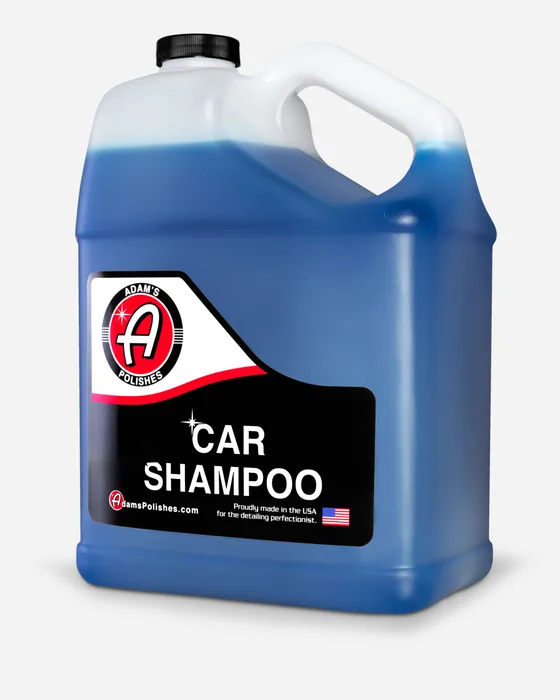
- Buy Adam's Polishes Car Shampoo A pH neutral soap that states in plain terms that it will not strip wax, sealant or a ceramic coating. Amazon
- Buy P&S Detail Products Pearl Auto Shampoo The trade option: pH balanced, biodegradable, and sold in sizes that assume you wash more than one car. Amazon
- It depends Chemical Guys HydroSuds Ceramic Car Wash Soap A ceramic infused soap that leaves a thin layer, which is a top-up rather than protection. Amazon
- Skip Turtle Wax Max Power Car Wash Its own copy says a stronger mix will degrease surfaces, and it is an adjustable cleanser rather than a dedicated maintenance soap.
What actually matters
- pH - how acidic or alkaline the soap is. Near neutral cleans without attacking wax, sealant or coatings. Alkaline soaps clean harder and can strip protection, which is what you want before polishing and not before anything else.
- Dilution ratio - how much concentrate goes into how much water, usually written as something like 1:256 or as ounces per gallon. It sets both the strength in your bucket and the true cost of a wash.
- Lubricity - the slipperiness of the wash solution. It is what lets a trapped grit particle slide off the mitt rather than be dragged across the paint, and it is one of the biggest factors in preventing wash marring.
- Foam - how thick and stable the suds are. Useful for dwell time on vertical panels, largely cosmetic beyond that, and easy to increase with surfactants that do nothing for cleaning.
- SiO2 or ceramic content - ceramic additive so the wash leaves a thin layer. It boosts beading for a short time and does not substitute for a sealant or coating.
- Water spotting behaviour - whether the soap dries clean or leaves mineral residue. Soaps that tolerate sun and hard water save you a second product later.
- Biodegradability - whether the surfactants break down. It matters if you wash on a driveway that drains to a storm sewer rather than a treatment plant.
The specs, in plain English
Green flags vs red flags
Green flags
- The phrase pH neutral used explicitly, ideally with a figure.
- A dilution ratio printed on the label or the product page.
- A clear statement about compatibility with wax, sealant and ceramic coatings.
- Lubricity mentioned as a property rather than only foam volume.
- A size range that includes a quantity matching how often you wash.
Red flags
- Concentrated claimed with no ratio given anywhere.
- Copy describing a stronger mix that degreases, on a product sold as a maintenance soap.
- Foam height as the primary selling point with no chemistry stated.
- A ceramic or SiO2 claim presented as protection rather than as a top-up.
- No pH language of any kind on a soap aimed at coated cars.
Who's who: the brands
- Adam's Polishes - Consumer-facing line whose shampoo page states it will not remove wax, sealants or degrade a ceramic coating.
- P&S Detail Products - A detail supply brand selling in quart to five gallon sizes; its Pearl shampoo page describes proportioning through a dilution device.
- Chemical Guys - A broad consumer range; its HydroSuds page publishes a dilution of 1 to 3 oz per 5 gallon bucket.
- Turtle Wax - A mass-market brand; its Max Power page describes an adjustable cleanser that is gentler diluted and degreases when concentrated.
- Meguiar's - A long-established consumer line; check each wash product's label for wax and sealant compatibility.
How to read a listing without getting fooled
Find the pH language first and read it literally. Neutral is a claim about a number; balanced is a claim about a process. If a soap will be used on a coated car, neutral is the word you want and its absence is meaningful. Next look for a dilution ratio, and note that only two of the four soaps compared here print one, which means the price on the shelf tells you little about the price per wash when it is missing. Then read for lubricity rather than foam, since foam is easy to formulate and lubricity is what protects the paint. Finally, treat any sentence about degreasing or a stronger mix as a warning label: it is the manufacturer telling you the product will strip protection, without telling you when.
How much should you spend?
Where a product does not publish a ratio, comparing on shelf price is unreliable, and the budget tier can cost more per wash than the mid-range. Larger containers of more concentrated product often work out cheapest per wash, while smaller bottles can cost more per wash. If you wash occasionally, buy the smallest bottle of a soap that states pH neutral and stop thinking about it. If you wash weekly, buy a gallon and work the dilution out by trial if the maker does not give one.
Questions, answered
Can I use dish soap to wash my car?
You can, but it is likely to remove your wax along with the dirt. Dish detergent is formulated to cut grease aggressively, which is exactly the property a maintenance car soap avoids. It also has no lubricity worth the name, so grit drags rather than releases. The only sensible use is as a deliberate strip wash before polishing, and even then a purpose-made prep wash is gentler on trim and rubber.
How much soap should I put in the bucket?
Follow the label if it gives a ratio, and if it does not, start at roughly an ounce per gallon of water and adjust by feel. Too little and the solution loses its slip, which is when wash marring happens. Too much wastes product and can leave residue that needs rinsing twice. A useful test is whether the mitt still glides after a few panels; if it starts to grab, the solution is spent or too weak.
Does washing in the sun really matter?
Yes, it matters. Soap drying on hot paint leaves both surfactant residue and the mineral content of your water, which is where water spots come from, and on a hot panel those can etch rather than just sit on top. Some soaps, including Adam's, claim tolerance for sun use. The safer habit is to wash in shade or early, work one panel at a time, and keep the surface wet until you dry it.
Do I need a separate wheel cleaner?
Usually yes, and the reason is chemistry rather than marketing. Brake dust is largely ferrous particulate bonded to the wheel surface, and a pH neutral soap is not designed to dissolve it. Dedicated wheel cleaners and iron removers use chemistry that targets it specifically. Using the same mitt on wheels and paint is also the fastest way to move brake dust onto your clear coat, so at minimum keep separate tools.
Or jump to the head-to-head: Adam's Polishes Car Shampoo vs P&S Detail Products Pearl Auto Shampoo.