Explained
Engine Compression Testers, Explained
After reading, you'll understand which fittings you need, how to run a test whose numbers mean something, and how to tell a ring problem from a valve problem.
In this guide
The tool itself is easy to shop for and easy to misuse. First-time buyers usually get tripped up twice: once on fitment, because they buy an 18 mm kit for a 14 mm engine or a short adapter for a deep plug well, and once on method, because a compression test done with a cold engine, a closed throttle or a tired battery produces numbers that look authoritative and mean nothing. There is a third trap after that, which is treating the absolute reading as the verdict when the useful signal is the difference between cylinders. Get those three right and this is one of the highest-value diagnostics you can do at home.
The 30-second version
- The spread matters more than the number, so compare cylinders against each other before you compare any of them against a target figure.
- Conditions decide validity, meaning a warm engine, every spark plug removed, wide open throttle, a fully charged battery and equal cranking strokes on every cylinder.
- The wet test is the real diagnostic, because a low cylinder that rises with a little oil is leaking past the rings and one that does not is leaking past valves or a gasket.
- A leak-down tester is a different instrument, which pressurises the cylinder instead of measuring it and lets you hear exactly where the air escapes.
- Diesel needs its own tool, since petrol testers here are rated to a 300 psi gauge while diesel testers read to 1000 psi and fit through glow plug or nozzle ports.
The products this guide is about
Our verdict on each, with the full reasoning on the companion review.
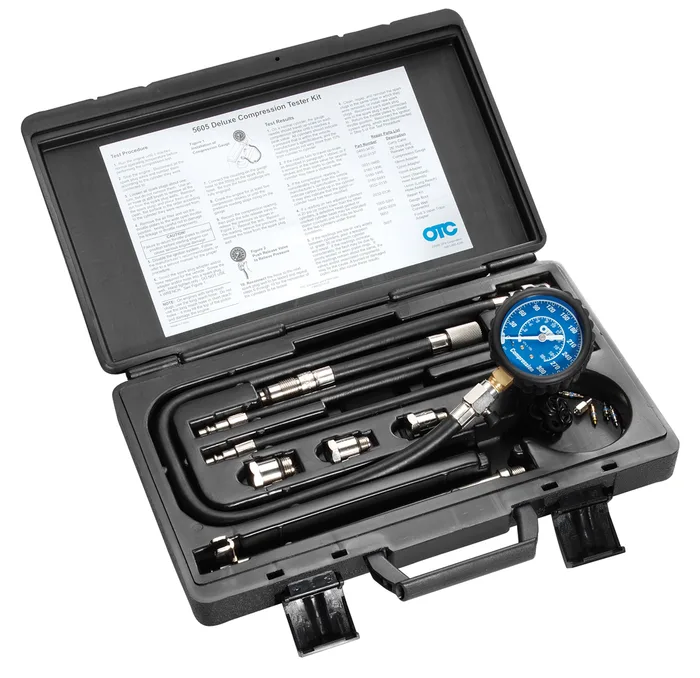
- Buy OTC 5605 Deluxe Compression Tester Kit The kit that already has the adapter for the awkward engine, on a 26 inch hose you can read from outside the bay. Amazon
- Buy Innova 3612 Compression Tester, 4-piece kit The cheap one that does the job properly, with a side release valve and the clearest instructions of the four. Amazon
- It depends Motion Pro 08-0651 Compression Tester with 10 mm, 12 mm and 14 mm adapters A powersports-first tester with a billet manifold and screw-in brass adapters, sized for bike and small-engine plugs rather than car ones.
- Skip Lang Tools TU-20-2PB Jiffee Compression Tester with Gauge Boot A cone-seal tester built for speed in a busy shop, which is exactly the wrong trade for a careful diagnosis.
What actually matters
- Cylinder-to-cylinder spread - this is the number the test exists to produce, because a healthy engine makes similar pressure in every hole. Innova's rule is that the lowest cylinder should be at least 75 percent of the highest, while OTC's sheet says readings should not vary more than 10 percent from cylinder to cylinder.
- Thread size and reach - the adapter has to match your spark plug thread and reach the sealing surface without touching anything. OTC warns that using a long-reach hose in a short-reach hole can hit the top of the piston and damage the engine.
- How the adapter seals - a threaded adapter on an o-ring seats itself the same way every time, which keeps the joint out of your results. A cone pressed into the hole by hand can leak differently on each cylinder, which is the one error the test cannot tolerate.
- Hose length and flexibility - a long flex hose lets you put the gauge where you can read it head on and where it will not sit against something hot. Short hoses force you to read at an angle, which is where small differences get lost.
- Pressure release valve - every cylinder gets tested at least twice, dry and then wet, and a release valve means you reset the gauge without breaking the connection. OTC's kits use a side release valve on the hose and Motion Pro builds one into the manifold.
- Gauge range and rating - the petrol testers here all read 0-300 psi, and Innova explicitly rates its tool for spark-ignited gasoline engines not exceeding 250 psi. Anything beyond that, diesel in particular, needs a higher-range instrument.
- Written interpretation guidance - the instruction sheet that ships with the kit is where the diagnosis rules live, including the wet test, the adjacent-cylinder head gasket signature and the acceptable spread. A tool without one leaves you to find those rules elsewhere.
The specs, in plain English
Green flags vs red flags
Green flags
- Threaded adapters that seal on an o-ring at the spark plug sealing surface rather than a cone you hold in place.
- A hose long enough to put the gauge outside the engine bay, with a quick coupler at the gauge end.
- A pressure release valve on the hose, gauge or manifold so you can retest without unthreading.
- Adapters covering the thread sizes your engines actually use, with a long-reach or deep-well option if your plugs are recessed.
- A printed instruction sheet from the manufacturer that states the pre-test conditions and how to read the results.
Red flags
- A cone or rubber tip you press into the plug hole and hold, offered as the primary sealing method.
- No pressure release valve, which makes the wet test tedious enough that most people skip it.
- A listing that names a gauge range but never states the thread sizes included.
- A petrol-range gauge marketed as suitable for diesel engines despite the pressure difference.
- No mention of long-reach or deep-well adapters in a kit sold for modern overhead cam engines.
Who's who: the brands
- OTC - A long-running professional diagnostic and specialty tool brand whose compression and cylinder leakage kits ship with detailed instruction sheets and unusually broad adapter coverage.
- Innova - Best known for DIY-focused diagnostic tools, and its compression tester kits pair a simple four or six piece package with clearly written operating instructions.
- Motion Pro - A powersports tool specialist whose compression and leak-down testers are sized around motorcycle, ATV and two-stroke fitments rather than car threads.
- Lang Tools - A professional tool maker with a catalogue of compression testers, including cone-seal quick-test designs.
How to read a listing without getting fooled
Read a compression tester listing in this order: thread sizes, reach, seal type, hose, release valve, then gauge. Thread sizes tell you whether the tool fits your engine at all, and a listing that only says 14 mm may still not reach a plug at the bottom of a deep well, so look for the words long reach or deep well if your plugs are recessed. Seal type is usually implied rather than stated, so look for language about threading into the plug hole and an o-ring, and treat rubber cone or hand-held wording as a different kind of tool. Hose length is often buried in the bullet list and is worth finding, since a 26 inch hose and a 15 inch hose give you meaningfully different working positions. A release valve may be called a side release valve, a deflator or a snifter valve depending on the brand. Finally, the gauge: almost every petrol tester reads 0-300 psi with a metric second scale, so a bigger number here is rarely the differentiator it appears to be.
How much should you spend?
Budget kits get you a working gauge, a rubber hose, a release valve and two or three of the most common adapters, and that is genuinely enough if you are testing one familiar engine. Mid-range money buys reach and coverage: a longer flex hose, a hard case, and the deep-well and long-reach adapters that decide whether the tool works at all on a modern overhead cam head. Premium spending in this category is mostly specialisation rather than better measurement, since a powersports tool with a billet manifold and a diesel tester with a much higher range both cost more while doing a narrower job. Two things are worth paying for regardless of tier: screw-in adapters rather than a cone, and a pressure release valve. Two things are not worth stretching for: a marginally larger gauge face and a higher pressure ceiling you will never approach on a petrol engine.
Questions, answered
My dial has psi, kPa and bar on it. Which do I use?
Use whichever unit your engine's service data is written in, so you are not doing arithmetic in a hot engine bay. They describe the same pressure: a 0-300 psi gauge is also marked roughly 0-2100 kPa or 0-21 bar. Dual scale dials exist because service information varies by manufacturer and region. Pick one scale before you start and record every cylinder in it.
Do I need the 10 mm adapter?
Only if you work on small engines or powersports machines, where 10 mm and 12 mm plugs are common. Most cars and light trucks use 14 mm, with 18 mm found mainly on older engines and 12 mm and 16 mm on some specific modern applications such as Ford three-valve heads. Pull one spark plug and measure or check the part number before buying. Adapters are cheap individually, so it is easy to add one later rather than pay for a kit full of sizes you will not use.
Will a car compression tester work on my lawnmower or motorcycle?
It depends entirely on the thread size and reach, not on the gauge. Many small engines and bikes use 10 mm, 12 mm or 14 mm plugs, so a kit that includes those threads can work, and Lang sells a small engine tester specifically for M14 and M18 threads. What often fails is access rather than fitment, since bike plug holes can be deeply recessed or at an angle that a rigid adapter cannot reach. That is why powersports-specific kits use flexible hoses and multiple short adapters.
Can I damage the engine doing this?
You can, which is why the instruction sheets carry warnings. OTC states that using a long-reach hose in a short-reach hole may hit the top of the piston and damage the engine, and that failing to return the throttle plates to the closed position before starting the engine can cause serious damage. Both OTC and Innova say to hand tighten adapters only and never use a wrench, since these threads sit in aluminium heads. Innova also advises waiting about ten minutes before removing plugs from an aluminium head to avoid thread damage. Follow the sequence, disable the ignition, and put everything back the way it was.
Or jump to the head-to-head: OTC 5605 Deluxe Compression Tester Kit vs Innova 3612 Compression Tester, 4-piece kit.