Explained
Detail Brushes, Explained
After reading, you'll know why detail brushes shed, which stiffness suits which job, and how to keep a brush for years.
In this guide
Detail brushes are the cheapest tools in a detailing kit and the ones most likely to be bought badly. They all look similar, they are all described as soft, and the specification that predicts whether one lasts is almost never printed. That specification is not the bristle at all. It is the ferrule and the adhesive behind it, because a brush that sheds is a brush leaving bristles in your paint.
The 30-second version
- Shedding is the failure mode, and how the bristles are anchored decides it, not how soft they feel.
- The ferrule is the scratch risk, and a brush built with no metal in it removes the problem rather than managing it.
- Boar hair is the default, solution-holding, and it needs drying properly or it degrades.
- Three brushes minimum, for wheels, exterior and interior, and they should never swap jobs.
- Dry them bristles-down, so water leaves the ferrule instead of sitting in it and loosening the glue.
The products this guide is about
Our verdict on each, with the full reasoning on the companion review.
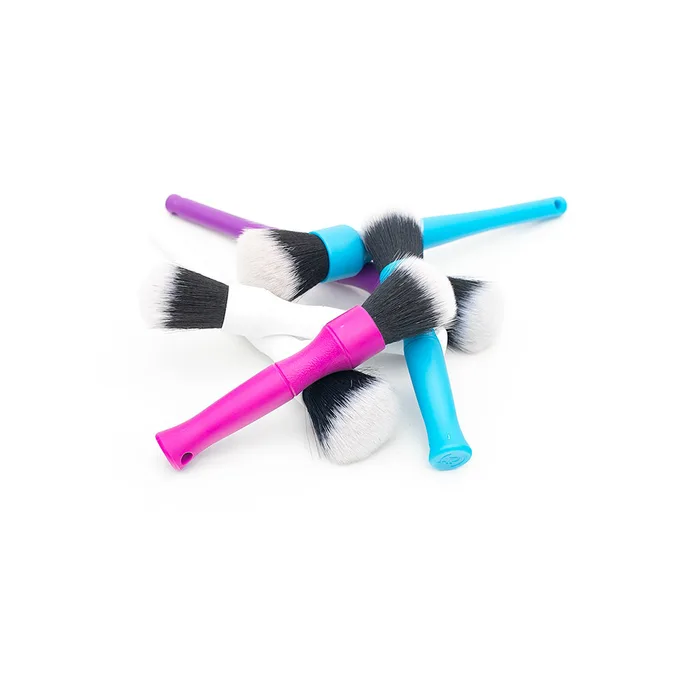
- Buy Detail Factory Synthetic Detailing Brushes Completely metal free, which removes the one part of a detail brush that can actually mark paint. Amazon
- Buy Adam's Polishes Hand Held Boar's Hair Brush A block-style hand brush rather than a round detail brush, and the only page here giving dimensions and anchoring.
- It depends Detail Factory Boar Hair Detailing Brushes A proper boar set across several sizes, with the best handles here and a positioning that is not paint-friendly. Amazon
- Skip Chemical Guys Boar's Hair Detailing Brush The only brush here that lets you choose stiffness, on a page that is one sentence long. Amazon
What actually matters
- Bristle anchoring - how the bristles are set into the ferrule, usually with an adhesive. Epoxy set is the phrase to look for. It determines whether the brush sheds in months or lasts years.
- Ferrule - the band clamping the bristles to the handle. Metal is durable and is the part that can mark paint if the bristles flex aside; some brushes sheath or recess it for that reason.
- Bristle material - boar hair is naturally flagged and holds a lot of solution; synthetics dry faster and resist harsh chemicals better, and some are made ultra soft.
- Head diameter - decides what the brush can reach. A 2 inch head is an interior and badge tool; anything much larger is for wheels, arches and grilles.
- Handle length - a long handle on a small head reaches into clusters and vents without your hand blocking the view. Short handles give more control on wheels.
- Stiffness - soft for interiors and paint-adjacent work, firmer for bonded brake dust and grilles. Very few brands offer a choice within one model.
- Grip - textured or rubberised, because the tool is held with wet hands covered in wheel cleaner. A slick plastic handle is a genuine control problem.
The specs, in plain English
Green flags vs red flags
Green flags
- Metal free construction stated explicitly.
- Bristle anchoring described, especially epoxy set construction.
- Head diameter and handle length published.
- A choice of stiffness within the same model.
- A textured or rubberised grip stated as non-slip when wet.
Red flags
- Softness as the only described property.
- No dimensions of any kind on a tool defined by what it can reach.
- Nothing about the ferrule or how the bristles are held in.
- A one-sentence product description at a mid-range price.
- Marketing about tough jobs on a brush intended to go near paint.
Who's who: the brands
- Adam's Polishes - Publishes brush dimensions and construction, and is unusually willing to say which finishes a brush is not suitable for.
- Detail Factory - Brush line sold through The Rag Company, with metal free boar and synthetic sets and colour-coded handles.
- P&S Detail Products - Professional detailing supply brand; check each product page for dimensions.
- Chemical Guys - Sells a boar's hair detailing brush in soft or normal stiffness, with a very short published description.
- Wheel Woolies - Better known for wheel barrel brushes than for detail brushes.
How to read a listing without getting fooled
Look for anything describing how the bristles are held in, because that is what determines whether the brush sheds and almost nobody says it. Epoxy set is the phrase worth finding. Then look for dimensions, both head diameter and handle length, and match them to the job: a small head on a long handle is an interior tool, a large head is for wheels and grilles. Check whether a stiffness is stated or offered as a choice. Read the handle description, since a grip that works wet is a control feature. And treat any sentence telling you where the brush should not be used as a good sign, because a brand willing to narrow its own claims is usually being accurate about the rest.
How much should you spend?
Detail brushes are cheap enough that buying several is the right instinct, and the real cost of a bad one is not the money but the bristle it leaves in your wet dressing. The budget tier will clean a car perfectly well and tends to shed sooner, which matters more on paint-adjacent work than on wheels. Mid-range buys better handles, better anchoring and colour-coded sets, and a set is usually better value than two singles because the jobs genuinely need different sizes. What is not worth paying for is softness alone, since every brush in this category is soft and the differences that matter are elsewhere.
Questions, answered
Can I use the same brush on wheels and the interior?
No, and it is the most common mistake in the category. Wheels carry bonded brake dust, which is embedded iron, and a brush used on them holds that grit in the bristles no matter how well you rinse. Taking it to a dashboard or a gauge cluster afterwards drags iron particles across soft plastic. Keep separate brushes, colour code them if you can, and treat a brush that has touched a wheel as a wheel brush permanently.
Why has my brush started to smell?
Boar hair is a natural fibre and it has been stored wet. Water sitting in the ferrule breeds bacteria and softens the adhesive at the same time, so a smelly brush is usually a brush about to start shedding. Rinse thoroughly, shake out, and hang it bristles-down so gravity pulls water away from the ferrule rather than into it. Let it dry completely before it goes back in a drawer.
Are synthetic brushes worse?
Different rather than worse. Synthetics dry fast and resist strong wheel chemistry, which makes them a good choice for wheels and engine bays. Boar hair holds more solution, which keeps a surface lubricated while you work, so it is the safer choice near paint. A well-made flagged synthetic is gentler than a cheap boar brush, so construction matters more than material.
How do I stop a brush marking paint?
Use light pressure and keep it rinsed. Bristles do not scratch clear coat; the ferrule can if you press hard enough that the bristles bend fully aside, and trapped grit will if it is not flushed out. Work with the brush wet and full of solution, rinse it constantly, and never use a brush on paint that has been used on a wheel. If the paint is show condition, one brand in the comparison above suggests using a microfibre mitt instead, which is sound advice.
Or jump to the head-to-head: Detail Factory Synthetic Detailing Brushes vs Adam's Polishes Hand Held Boar's Hair Brush.