Explained
Floor Jacks, Explained
After reading, you'll know exactly how much jack you need, why lift height matters as much as capacity, and why a jack lifts a car but must never be trusted to hold it.
In this guide
A floor jack is the tool that raises your car so you can change a tire, swap brake pads, or reach the drain plug — and the spec sheet is full of numbers that sound reassuring but don't all mean what buyers assume. The two things that trip people up most are capacity (a big tonnage number feels safe but isn't the whole story) and the fact that a jack is only ever a lift, never a support. Get the tonnage, the lift range, and the safety habit right and the rest is detail.
The 30-second version
- A jack lifts, stands hold. Once the wheel clears the ground, lower the car onto rated jack stands before any part of you goes underneath — a jack alone can seep, drift, or let go.
- Buy well above the corner load, not the whole car. You lift one corner at a time, so a 3-ton jack carries most cars and many light trucks with comfortable margin — but the margin is the point, not bravado.
- Lift range matters as much as tonnage. A low minimum height slides a jack under a lowered car; a tall maximum lets a truck's wheel clear the ground with room for a stand.
- Metal is a weight-vs-cost trade, not a safety one. Steel is cheaper and robust but heavy; aluminum is far lighter to carry but costs more — seal and build quality decide safety, not the metal.
- Seal quality is the real quality marker. A jack that slowly bleeds down under load is a hazard, not a bargain; trustworthy seals that hold height without drifting separate a good jack from a scary one.
The products this guide is about
Our verdict on each, with the full reasoning on the companion review.
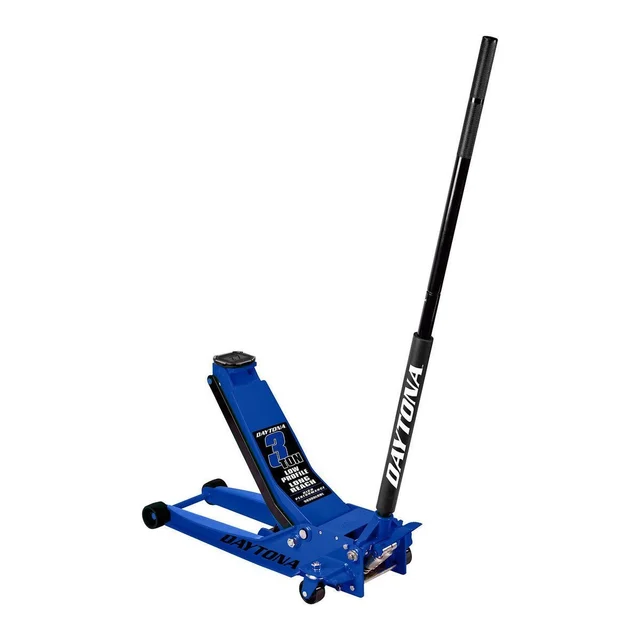
- Buy Daytona 3 Ton Professional Rapid Pump Floor Jack A steel, low-profile, long-reach jack with a dual-piston rapid pump that reaches the car in a couple of strokes — the value benchmark of the group.
- Buy Arcan ALJ3T 3 Ton Aluminum Floor Jack A genuinely light 3-ton aluminum jack with a quick-rise dual pump — the one you will actually move around and take to the track.
- It depends Powerbuilt 640912 All-in-One 3 Ton UniJack A bottle jack that raises itself on its own built-in stand — a lift and a support in one unit, but a narrow tool with a slow pump.
- Skip Torin Big Red 3 Ton Hydraulic Trolley Jack The ubiquitous bargain trolley jack — cheap and fine when it works, but the seal-and-QC lottery is not worth it under a car.
What actually matters
- Rated capacity matched to your vehicle — because you lift one corner at a time, aim for a jack rated well above the corner load (a common rule of thumb is at least about three-quarters of the whole vehicle's weight). A bigger number isn't automatically safer if it comes on a jack too tall or heavy to use.
- Minimum saddle height — how low the nose sits when fully dropped. Low, sporty, or lowered cars need a low-profile nose that slides under the pinch weld; a tall minimum simply won't fit.
- Maximum lift height — how high the saddle rises. Tall trucks and SUVs need a high maximum so the wheel clears the ground with a stand underneath; a short-lifting jack leaves you stranded no matter its tonnage.
- Material (steel vs aluminum) — steel is cheaper per ton and lives happily in one spot; aluminum is dramatically lighter to carry, roll, and store, at a premium price and often slightly less max lift.
- Pump speed (single vs dual piston) — a dual-piston 'rapid pump' or 'quick-rise' design closes the gap to the car in a couple of strokes, then slows for a controlled lift under load, saving real effort over a single-piston jack.
- Saddle size and padding — a wide, padded saddle spreads load on the jacking point and protects the pinch weld; a small bare saddle concentrates force and can slip.
- Jack stands, budgeted as part of the purchase — the jack lifts, the stands hold, and you never substitute one for the other. Plan to buy a rated pair alongside the jack.
The specs, in plain English
Green flags vs red flags
Green flags
- A dual-piston 'rapid pump' or 'quick-rise' spec, so the saddle reaches the car in a couple of strokes
- Both a low minimum height and a stated maximum that suit your specific vehicles
- Owner reports that the jack holds its height without drifting after months of use — the seal-quality tell
- A wide, padded saddle that spreads load on the jacking point
- A longer limited warranty, which signals the maker's own confidence in the seals and build
- Capacity chosen with real margin over your corner load, not right at the edge
Red flags
- Recurring owner reports of hydraulic seepage or a ram that slowly bleeds down under load — the exact failure that makes a cheap jack dangerous
- Build and seal quality that varies noticeably unit to unit (the bargain-bin 'lottery')
- A pump that feels spongy or a lift that stutters instead of rising smoothly
- A minimum height too tall to fit under your car, or a maximum too low to lift your truck clear
- A short warranty and thin support, so a failed seal just means a dead jack
- Marketing that leans entirely on a big tonnage number while saying nothing about lift range or seals
Who's who: the brands
- Daytona - Store-brand steel jacks known for fast dual-piston rapid pumps and low-profile, long-reach frames at a mid-range price — a common value benchmark.
- Arcan - Known for genuinely lightweight aluminum jacks that keep a full tonnage rating in a body you can actually carry, at a premium.
- Powerbuilt - Makes the all-in-one bottle-jack-on-a-stand design that lifts and then supports the load on a fixed cradle — a niche lift-and-support combo for higher-clearance vehicles.
- Torin (Big Red) - The ubiquitous budget trolley jack found at every big-box store — cheap and everywhere, but with common seepage and bleed-down reports that make it a spare-tire backup at best.
How to read a listing without getting fooled
Read a floor-jack listing from the bottom up: capacity first, then lift range, then seals. Treat the tonnage as a minimum with margin — remember you lift one corner, so a rating above your corner load (roughly three-quarters of total weight is the usual guideline) is plenty. Next, hunt for two numbers many listings bury: the minimum saddle height (does the nose slide under your car?) and the maximum lift height (does your truck's wheel clear the ground with a stand under it?). A 'low-profile' or 'long-reach' badge tells you the frame geometry; 'rapid pump' or 'quick-rise' with two pistons tells you it'll reach the car fast. The spec sheet almost never states seal quality, so this is where owner reports do the work — search specifically for whether the jack 'holds' or 'bleeds down' over time, and weight that above the glossy tonnage headline. A long warranty is a proxy for a maker's own confidence in the seals.
How much should you spend?
Spend for seals and lift range, not for a bigger tonnage number. The value sweet spot sits with a mid-range steel jack that pairs a dual-piston rapid pump, a low-profile long-reach frame, and a reputation for holding its load — that combination buys the safety and speed that actually matter under a car. Paying up makes sense in exactly one case: if you'll carry the jack (track days, apartment garages, tossing it in a trunk), aluminum is worth its premium for the weight it saves, even though you often accept slightly less maximum lift. Paying up for capacity alone rarely pays off, since most drivers are covered with margin by a standard 3-ton jack. The place not to economize is the bottom of the market: a bargain jack that seeps fluid or bleeds down isn't a deal, it's a hazard — and whatever you save there, don't skip a rated pair of jack stands, which are a non-negotiable part of the total cost.
Questions, answered
Is it ever safe to work under a car held up by only the floor jack?
No — treat this as the one rule that never bends. A floor jack is a hydraulic lift, and any hydraulic ram can seep, drift, or fail, slowly or suddenly. Once the car is at height, lower it onto a pair of rated jack stands placed on solid jacking points, chock the wheels still on the ground, and only then go underneath. The jack raises the car; the stands are what keep it off you. A jack lifts but never supports.
How much capacity do I actually need, and is a bigger number safer?
Match the rating to your vehicle, not to bravado. Because you lift one corner at a time, a common guideline is to pick a jack rated for at least about three-quarters of the whole vehicle's weight — a 3-ton jack covers most cars and many light trucks with margin. A higher rating isn't automatically safer if it means a taller, heavier jack that won't fit your car. The right capacity plus the right lift height beats the biggest number on the box.
Why does maximum lift height matter as much as capacity?
Because a jack that can't reach your jacking point is useless no matter how much it can lift. Low, wide cars need a low minimum — a low-profile nose that slides under the pinch weld — while tall trucks and SUVs need a high maximum so the wheel clears the ground with room for a stand. Check both the minimum and the maximum against your specific vehicle before buying.
Steel or aluminum — which should I choose?
It's a trade-off between weight and cost, not safety. Steel is heavier but cheaper for a given capacity and easy to build robustly, which suits a jack that lives in one spot. Aluminum is markedly lighter for the same rating, so it's far easier to carry, roll, and store — but you pay a premium and often accept a slightly lower maximum lift. Neither metal is inherently safer; seal and build quality matter more.
What does a bad or failing jack actually look like?
Watch for hydraulic fluid seeping around the ram, a saddle that slowly sinks or 'bleeds down' while holding a load, a pump that feels spongy, or a lift that stutters instead of rising smoothly. Any of these means the jack can't be trusted to hold — which is exactly why a bargain jack with seal problems is dangerous rather than a deal. Retire a jack that seeps or drifts, and never rely on it to hold weight even briefly.
Is a single-piston jack fine, or do I need a dual-piston 'rapid pump'?
A single-piston jack works, it's just slower — it takes many more handle strokes to raise the empty saddle up to the car before it even starts lifting. A dual-piston rapid-pump (or 'quick-rise') design closes that gap in roughly two or three strokes, then slows down for a controlled lift under load. It's a convenience and effort feature, not a safety one, but it's the difference most owners notice first.
Or jump to the head-to-head: Daytona 3 Ton Professional Rapid Pump Floor Jack vs Arcan ALJ3T 3 Ton Aluminum Floor Jack.