Explained
Glass Towels, Explained
After reading, you'll understand why your glass streaks, and which weave and density actually suit the job.
In this guide
Microfibre buyers learn one rule quickly, that higher GSM is better, and glass is where that rule breaks. A drying towel is built to absorb, and absorption is exactly the wrong property against a windscreen, where a saturated pile pushes residue around instead of lifting it. Glass towels are thin, low-nap and textured, and the two-towel method matters more than any single product choice.
The 30-second version
- Low GSM is right here, because deep pile holds residue and lays it back down as a film.
- Texture lifts, nap buffs, which is why the job wants two surfaces and one towel rarely does both.
- Streaks come from the towel, usually one that is saturated or has previously touched a wax or dressing.
- Keep interior and exterior sets apart, since interior glass carries an oily film that ruins an exterior towel.
- Borderless matters next to the glass, on screens, clusters and gloss black trim rather than on the window itself.
The products this guide is about
Our verdict on each, with the full reasoning on the companion review.
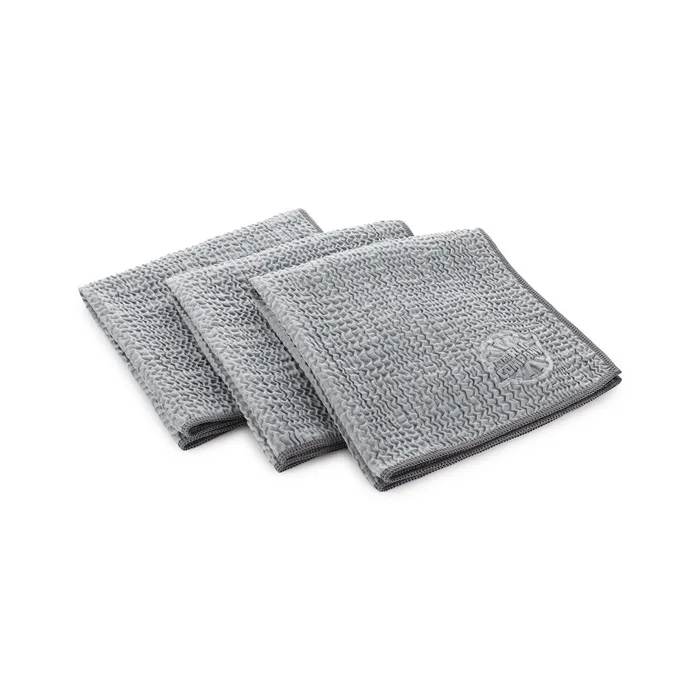
- Buy The Rag Company Wrinkle Glass Towel 500 GSM at 16 by 16 inches, dual sided, with the blend published as 70 percent polyester and 30 percent polyamide. Amazon
- Buy The Rag Company Diamond Weave Glass & Window Towel A diamond-scale texture that sits between waffle and herringbone, in two sizes and proper multipacks. Amazon
- It depends Adam's Polishes MicroSilk Glass Towels Borderless and silk-textured, aimed at screens and gauge clusters as much as at windows. Amazon
- Skip Chemical Guys Waffle Weave Glass and Window Microfiber Towel A normal waffle towel sold with a stated 24 by 16 inch size but no GSM, no blend ratio, and an instruction to conquer your windows. Amazon
What actually matters
- GSM - grams per square metre. On glass, lower is better, with the two glass towels in the review that publish a figure listing 280 and 500, against much higher figures for drying towels.
- Weave - waffle, wrinkle, diamond and herringbone textures all create pockets or ridges that mechanically lift film. A flat short nap does the buffing rather than the lifting.
- Nap height - how far the fibres stand off the backing. Short is right for glass, since long pile absorbs cleaner and redistributes it.
- Size - determines how many clean folded faces you get. A 16 by 24 towel folds into more usable surfaces than a 16 by 16, which matters on a windscreen.
- Edge - stitched polyester borders are harmless on glass and are the hardest part of a towel on soft plastics. Borderless matters if the towel touches screens or gloss trim.
- Dual sided - a towel carrying a texture on one face and a short nap on the other does both stages of the job without a second towel.
- Pack quantity - the job needs a damp towel and a dry towel at minimum, so buying singles is buying half a set.
The specs, in plain English
Green flags vs red flags
Green flags
- A GSM figure in the low hundreds, published on the page.
- Dimensions stated, so folded faces can be worked out.
- The weave named specifically rather than described as premium.
- Dual-sided construction, or a clear statement of which stage the towel is for.
- Multipacks, matching the fact that the job needs at least two towels.
Red flags
- No GSM and no dimensions anywhere on the page.
- A high GSM presented as a benefit on a glass towel.
- Marketing verbs standing in for every specification.
- A stitched border on a towel sold for screens and delicate surfaces.
- Sold as a single, on a job that needs a wet towel and a dry one.
Who's who: the brands
- The Rag Company - A microfibre specialist that publishes GSM, size and blend ratio on its glass towel pages.
- Adam's Polishes - Focuses on borderless, silk-textured towels aimed at screens and delicate interior surfaces as much as at glass.
- Chemical Guys - Wide consumer range of waffle weave glass towels, sold with colour options and a stated size but no published GSM or blend ratio.
- Meguiar's - Sells glass towels aimed at the mainstream retail buyer.
- Autofiber - Another microfibre-first brand worth checking for published weave, GSM and blend.
How to read a listing without getting fooled
Check the GSM and expect it to be low, because this is the one microfibre category where a small number is the good one. If it is not published, look for the weave, and prefer a named texture such as waffle, wrinkle or diamond over a description like premium or ultra-soft. Find the dimensions, since size determines how many clean folded faces you get and a windscreen needs several. Look at whether the towel is dual sided, which tells you whether it does both the lifting and the buffing or needs a partner. Finally check whether it is sold in a pack, because a single glass towel cannot complete the job it was bought for.
How much should you spend?
Glass towels are cheap and the temptation is to buy one, which is the mistake. The budget tier is generally fine on weave and silent on specification, and the towels work; you just cannot compare them. Mid-range buys published densities, better edge finishing and multipacks, and that is where the useful products sit. What is genuinely worth spending on is quantity and discipline: two sets, one for interior and one for exterior, kept away from every other towel in the cupboard. A cheap towel that has only ever touched glass will outperform an expensive one that once wiped a dressing.
Questions, answered
Can I use a drying towel on glass?
You can, and it is why most people think glass is hard. A drying towel is high GSM with a deep pile designed to absorb, so on glass it holds cleaner and moisture and redistributes them as a film. Use a dedicated low-nap glass towel instead. If you only have a drying towel to hand, use the driest part of it and follow immediately with a second dry pass, and expect to work harder for a worse result.
Why is the inside of my windscreen always hazy?
Cabin plastics off-gas over time, and the residue condenses on the coldest surface in the car, which is the inside of the glass. It is worst in hot weather and on newer cars. It needs a textured towel and usually two passes, one with a cleaner to break the film and one dry to buff. Any towel used on it will pick up that oily residue, so keep interior glass towels separate from everything else.
Does the glass cleaner matter more than the towel?
Less than people expect. Most streaking comes from a saturated or contaminated towel rather than from the chemistry, which is why the same cleaner can give perfect results in one person's hands and a smeared mess in another's. Use less product than feels right, use a clean towel that has never touched a wax or dressing, and finish with a dry towel. Fix the towel first and then judge the cleaner.
How do I wash glass towels?
Separately from everything else, in warm water with a plain detergent, no fabric softener and no bleach. Softener coats the fibres and destroys their ability to lift film, which shows up on glass faster than anywhere else. Never wash them with towels that have been used for wax, dressings or quick detailers, because the residue transfers in the machine and the next window you clean will streak.
Or jump to the head-to-head: The Rag Company Wrinkle Glass Towel vs The Rag Company Diamond Weave Glass & Window Towel.