Explained
Jack Stands, Explained
After reading, you'll understand what the locking mechanism is doing, whether the tonnage on the box applies to one stand or two, and which claims on a listing are worth anything.
In this guide
Jack stands look like the simplest thing in the garage, which is exactly why people buy them badly. The number printed on the side does not mean the same thing from one brand to the next. The word ratchet covers two designs with very different failure behaviour. And the safety standard that governs them in the United States is voluntary, so its absence from a listing tells you as much as its presence. None of this is complicated once someone lays it out.
The 30-second version
- The mechanism is the product, and a pin passed through drilled holes has fewer ways to go wrong than a spring loaded pawl resting on teeth.
- The tonnage may not be per stand, because some makers state it across the pair and at least one manual caps a pair at the rating of a single stand.
- ASME PASE is voluntary in the US, so a maker that names the edition it complies with is volunteering information a silent maker is not.
- Base area decides what floors you can use, and a small footprint means level concrete or nothing at all.
- Chocks and a level surface are not optional extras, they appear in the safety markings of the manuals themselves, alongside the load rating.
The products this guide is about
Our verdict on each, with the full reasoning on the companion review.
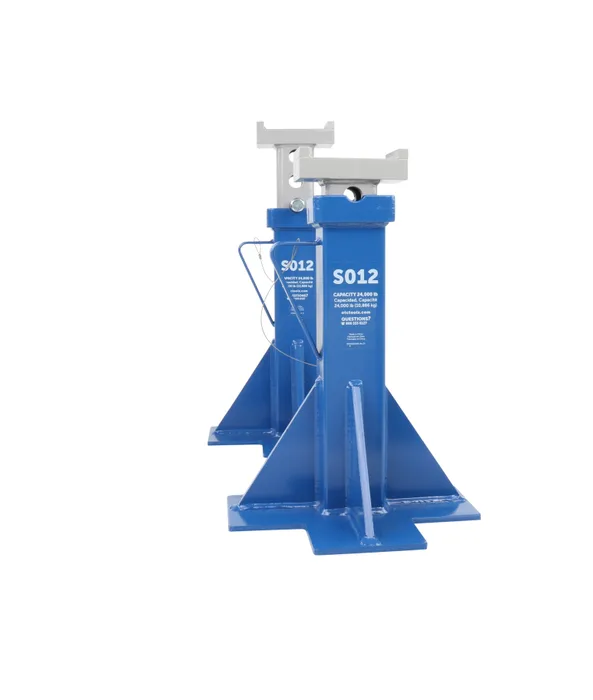
- Buy OTC 12-Ton Jack Stands (S012) A pin type stand with no ratchet pawl anywhere in the load path, a broad welded base, and a printed ASME PASE-2019 statement. Amazon
- Buy Torin BIG RED Double Locking Jack Stands, 2 Ton (T42002A) The cheap ratchet stand done properly: a separate locking pin sits behind the pawl so one failure mode does not become a collapse. Amazon
- It depends Sunex Tools 1210 10 Ton Low Height Pin Type Jack Stands (Pair) Pin locking in a low profile package, held back by a modest maximum height and a listing that does not state its standard. Amazon
- Skip Torin BIG RED Jack Stands, 2 Ton (AT42002R) The same stand as the double locking version with the second lock deleted, which is the one part worth paying for. Amazon
What actually matters
- Locking mechanism - This is the one specification that decides whether the stand can fail progressively or catastrophically. A pin has to be either in a hole or out of it, while a pawl can rest on the tip of a tooth and look engaged.
- Rated capacity and how it is stated - The number alone is meaningless until you know whether it applies to one stand or to the pair. Two brands can print the same tonnage and mean loads that differ by a factor of two.
- Base footprint - The base spreads the load into the floor and resists tipping when you lean on a stuck bolt. A wide welded base is the difference between a stand that tolerates a slightly uneven slab and one that does not.
- Height range - A stand that will not fit under your vehicle is worse than useless, because it encourages improvisation. Check the minimum height against your actual lift point, not against a photograph.
- Saddle shape - A V notch or horseshoe cradles an axle or frame rail, while a smaller notched saddle suits a unibody pinch weld. The wrong saddle concentrates load in the wrong place.
- Stated standard compliance - ASME PASE-2019 or PASE-2024 printed on a listing means the maker is claiming a specific, checkable design and testing framework. Silence means you are trusting the brand alone.
- Construction and weight - Formed and welded steel, ductile iron columns and robotic welding all appear in listings for a reason, and per stand weight is a decent proxy for how much metal is actually there.
The specs, in plain English
Green flags vs red flags
Green flags
- The listing names a specific standard edition, such as ASME PASE-2019 or PASE-2024, rather than a vague claim about safety testing.
- The mechanism is pin type, or it is a ratchet with an independent secondary locking pin.
- Capacity is stated with a pound figure and with the words each or per pair, so there is nothing to guess.
- Base dimensions and per stand weight are both published, which suggests the maker expects you to compare them.
- The manual is downloadable from the product page and includes surface, slope and chocking instructions.
Red flags
- No standard is named anywhere on the listing or the packaging.
- The tonnage appears with no pound equivalent and no indication of whether it covers one stand or two.
- The description contradicts itself, for example calling the same stand both self locking ratchet and pin design.
- No base dimension is given, which usually means the footprint is not a selling point.
- The saddle, base or column is described only as heavy duty, with no measurements attached to it.
Who's who: the brands
- OTC - A professional line whose S012 stand prints its PASE edition, publishes its height range and base size and carries a lifetime warranty.
- Sunex Tools - Professional lifting equipment that leans heavily on pin type stands, and a brand that describes its PASE certification process as voluntary.
- Torin, sold as BIG RED - A consumer brand that sells double locking stands in the budget tier and states capacity per stand on its BIG RED line.
- ESCO - A heavy equipment specialist whose stands are aimed at commercial trucks and heavy equipment rather than driveways.
- Hein-Werner and Omega - Two brands that sell both shop and consumer grade ratchet and pin stands.
How to read a listing without getting fooled
Start at the bottom of the listing, not the top. Find the pound figure and the word each or pair, and if only a tonnage appears, assume the worst until the stamped rating on the stand itself tells you otherwise. Next find the mechanism: the words pin, pawl, ratchet or double locking will all be in there somewhere, and if the description uses two of them for the same stand, that is a copywriting failure that should make you wonder what else is wrong. Then look for base dimensions and a per stand weight. A maker that publishes both is inviting comparison; a maker that publishes neither is not. Finally, search the page for ASME or PASE. In the United States that compliance is voluntary, so its presence is a claim you can check and its absence is a gap you have to fill with trust.
How much should you spend?
Budget stands cover most consumer ratchet designs, including the double locking versions, and the step from a plain pawl stand to a double locking one inside that tier is small enough that there is no good reason to take the cheaper one. Mid-range buys you pin type mechanisms, larger bases and better saddles, which is where most people working on a car regularly should end up. Premium is professional shop equipment: heavier columns, wider welded bases, higher capacities, published dimensions for everything and, in OTC's case, a lifetime warranty. The jump from budget to mid-range buys real engineering. The jump from mid-range to premium mostly buys capacity, durability and paperwork, which matters if the stands live in a shop and less if they come out four times a year.
Questions, answered
Are jack stands regulated by the government in the United States?
Not directly for consumers. ASME PASE is a voluntary consensus standard, which is why Sunex describes its certification process as voluntary. In workplaces, OSHA 1910.244 covers jacks and requires that a raised load be cribbed, blocked or otherwise secured at once. Recalls on jack stands go through NHTSA rather than the Consumer Product Safety Commission, because they are treated as motor vehicle equipment.
How many stands do I need?
Use them as a matched pair, and manufacturers are firm that a pair supports one end of the vehicle only. Torin's manual states that stands are not to be used to simultaneously support both ends of a vehicle. OTC's manual repeats the same restriction. If you need the whole car in the air, that is a job for four stands of the right type placed in a single lift, or for a proper lift.
Do jack stands wear out?
They can, and both manuals we read tell you to inspect before every use. Look for cracked welds, a bent or gouged column, a pawl that does not snap back cleanly, missing pins or chains, and rust at the base seam. One of the 2020 Harbor Freight recalls was for a base seam weld that could fail, so the welds are not a theoretical concern. Anything damaged or worn should be removed from service rather than nursed along.
Can I use jack stands on a trailer, an RV or a lawn tractor?
Torin's manual says no on all three counts. It lists lawn mowers and lawn tractors as a never, and states that foundations, homes, mobile homes, trailers, RVs, campers and fifth wheels are not recommended for support on this equipment. Those loads are either too light to sit stably on an automotive saddle or too poorly distributed for a stand designed around a car's lift points. Use equipment made for the job.
Or jump to the head-to-head: OTC 12-Ton Jack Stands (S012) vs Torin BIG RED Double Locking Jack Stands, 2 Ton (T42002A).