Explained
Leather Conditioners, Explained
After reading, you'll understand why most leather conditioner marketing describes furniture rather than cars, and what to buy instead.
In this guide
Leather care for cars is sold with the vocabulary of leather care for boots and furniture: feeding, nourishing, moisturising, restoring suppleness. Almost none of it applies. Automotive leather is finished with a pigmented polyurethane coating that gives it the colour, the durability and often the grain, and that coating is a barrier between anything you apply and the hide underneath. Once you know that, the category becomes much easier to shop.
The 30-second version
- Car leather is coated, so products sit on a urethane film rather than soaking into a hide.
- The coating fails before the hide does, which is why UV protection is the property worth paying for.
- Cleaning matters more than conditioning, since body oils and dye transfer are what actually build up on the surface.
- Shine is a defect here, because factory coated leather is matte and a glossy seat is a slippery one.
- Nourishment claims are furniture language, carried over to a product that cannot reach what it claims to feed.
The products this guide is about
Our verdict on each, with the full reasoning on the companion review.
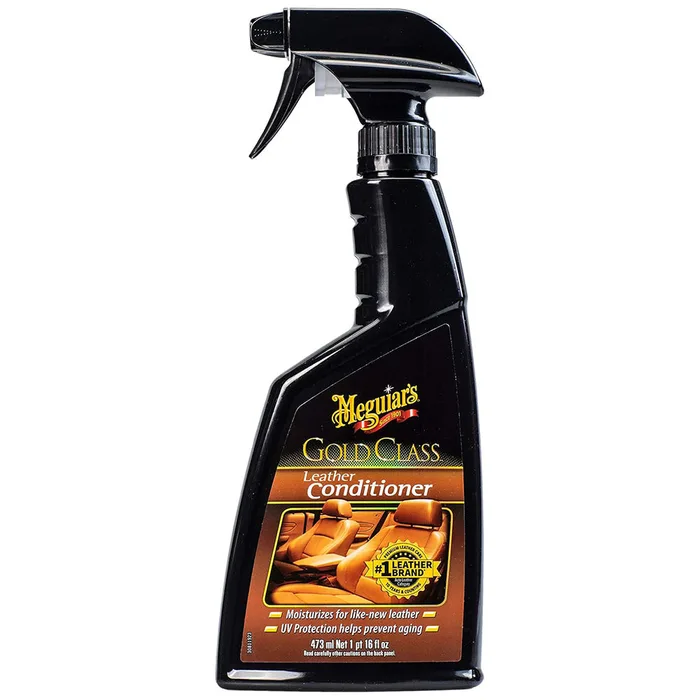
- Buy Meguiar's Gold Class Leather Conditioner, 16 oz The only leather-only product here with a UV claim, and it promises no buildup or artificial gloss. Amazon
- Buy Turtle Wax Luxe Leather Cleaner & Conditioner, 16 fl oz Says sealed leather, is pH-balanced, and its page imagery covers leather, vinyl and rubber, so it is the one-bottle option. Amazon
- It depends Chemical Guys Leather Conditioner Restores a matte finish, which is the correct look for a car interior and not what every conditioner leaves. Amazon
- Skip Torque Detail Leather Restore Ceramic Conditioner, 16 oz Leads on Vitamin E nourishing the leather, on a surface that cannot be nourished.
What actually matters
- Coated versus uncoated - almost all car leather is coated. Uncoated aniline and nubuck appear on some luxury models and do absorb products, which is why the wrong product ruins them.
- UV protection - the mechanism that actually preserves car leather, because ultraviolet light degrades the urethane topcoat and that is what cracks.
- pH - whether repeated cleaning attacks the coating. A pH-balanced product is gentler on the film over years of use, and most pages make no claim either way.
- Finish - matte is correct for factory leather. A glossy result means excess product sitting on the surface, which looks wrong, attracts dust and makes a steering wheel slippery.
- Cleaning power - removing body oils, sunscreen and dye transfer from denim. This is the job that visibly changes a seat, particularly on pale leather.
- Application format - sprays cover a seat evenly and cream needs an applicator. Perforated and ventilated seats need product on a towel rather than sprayed directly.
- Surfaces claimed - a product cleared for leather, vinyl and plastic is a general interior dressing, which means it is not optimised for the coating on your seats.
The specs, in plain English
Green flags vs red flags
Green flags
- The words sealed or coated leather used on the product page.
- A UV protection claim tied to preventing fading or cracking.
- A pH-balanced statement.
- An explicit promise of a matte, non-greasy, non-slippery finish.
- Clear positioning as either a cleaner, a conditioner, or both.
Red flags
- Nourishing, feeding or moisturising the leather as the primary mechanism.
- Vitamins or botanical oils leading the ingredient story.
- One product claimed for leather, vinyl, plastic and trim alike.
- No pH claim on a product used repeatedly on a coated surface.
- Before and after imagery showing a high gloss finish on a seat.
Who's who: the brands
- Turtle Wax - Unusually accurate labelling for the mass market, naming sealed leather and pH balance rather than nourishment.
- Meguiar's - Splits cleaning and conditioning into separate products and leads its conditioner on UV protection and finish quality.
- Chemical Guys - Broad interior range, with a conditioner that correctly targets a matte finish and very short product descriptions.
- Torque Detail - Direct-to-consumer brand leaning on ingredient stories, with products spanning leather, vinyl and plastic trim.
- Leatherique - A specialist brand with products for uncoated and vintage leather, where penetration is possible and relevant.
How to read a listing without getting fooled
Look for the word sealed or coated first, because a page that uses it is describing your car and a page that talks about nourishing the hide is describing a sofa. Then find the UV claim, since the topcoat is what degrades and ultraviolet exposure is what degrades it. Check for a pH statement, which tells you whether repeated use will be kind to that coating. Read what finish the product promises and prefer matte and non-greasy stated explicitly, especially if the product will touch a steering wheel. Then decide whether you want a combined cleaner and conditioner or a dedicated pair, and treat a product claimed equally for leather, vinyl and plastic as a general dressing rather than a leather product.
How much should you spend?
This is a category where price and accuracy are not related, and one of the budget products in our comparison had the most accurate page. Budget products are perfectly capable of cleaning surface oils and leaving a matte finish, which is most of the job on coated leather. What is worth paying a little more for is a UV claim with a mechanism behind it, since that is the property that actually extends the life of the topcoat. What is not worth paying for is ingredient romance: aloe, vitamins and botanical oils cost money to put on a label and cannot reach the hide through a coating. Spend the difference on a dedicated cleaner instead.
Questions, answered
How do I tell if my leather is coated or uncoated?
Put a small drop of water on an inconspicuous area. On coated leather it beads and sits on the surface; on uncoated aniline it darkens and soaks in within seconds. Most mainstream cars will bead. If it soaks in, stop and look up what your specific interior is, because products designed for coated leather can stain uncoated hide permanently.
Can I use a household leather cream on car seats?
It will not usually damage a coated seat, and it will not do what it was designed to do either. Furniture and boot creams are formulated with waxes and oils meant to penetrate uncoated leather, so on a car seat they sit on the coating, leave a shine, attract dust and can make a steering wheel slippery. A product made for automotive coated leather is designed around the surface you actually have.
What causes the shiny patches on my driver's seat?
Two things, usually together. Body oils transferred from skin and clothing build up and polish the coating where you sit and slide, and previous greasy products add to it. The fix is cleaning rather than more conditioner: a dedicated leather cleaner with a soft brush lifts the film, and a matte-finish conditioner afterwards restores the correct look. Adding more product to a shiny seat makes it shinier.
Does leather in a car actually need conditioning at all?
Less than the industry suggests, and it is not nothing. On a coated seat you are maintaining a plastic film, so cleaning and UV protection do the real work. A conditioner still helps by restoring the surface feel, keeping the finish matte and adding a protective layer that takes the abrasion instead of the coating. Doing it two to four times a year is plenty, and doing it monthly mostly builds up product.
Or jump to the head-to-head: Meguiar's Gold Class Leather Conditioner, 16 oz vs Turtle Wax Luxe Leather Cleaner & Conditioner, 16 fl oz.