

Automotive
The Best Leather Conditioners: 4 Compared (and One to Skip)
We compared four leather conditioners and found three selling oils that nourish the hide, on car seats sealed under a urethane coating those oils cannot reach.
The short version
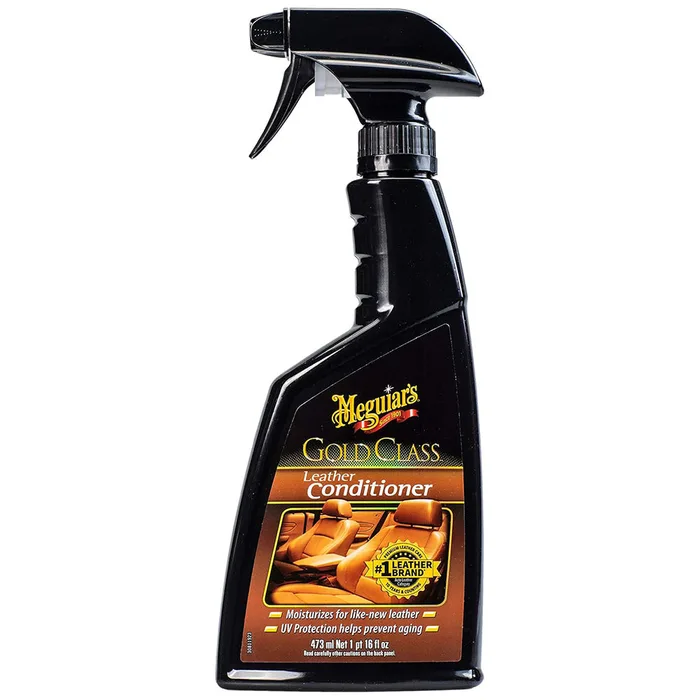
Meguiar's Gold Class Leather Conditioner is the pick: it is leather-only, it claims UV protection to prevent ageing and fading, and it explicitly leaves no buildup, white residue or artificial gloss. Turtle Wax Luxe Leather is the value buy and the practical one-bottle choice, pH-balanced and non-greasy, correctly describing the surface as sealed leather, with a label covering vinyl and rubber as well. Chemical Guys Leather Conditioner is the depends pick because it restores a matte finish, which is the correct look for a car interior and not what every product delivers. Skip Torque Detail Leather Restore: it leads on Vitamin E nourishing the leather, which is the claim that makes least sense on a coated surface. Best for: anyone whose seats are getting shiny, cracking at the bolster, or feel sticky after a hot week.
Our picks at a glance
- Meguiar's Gold Class Leather Conditioner, 16 oz - Buy. The only leather-only product here with a UV claim, and it promises no buildup or artificial gloss.
- Turtle Wax Luxe Leather Cleaner & Conditioner, 16 fl oz - Buy. Says sealed leather, is pH-balanced, and its page imagery covers leather, vinyl and rubber, so it is the one-bottle option.
- Chemical Guys Leather Conditioner - It depends. Restores a matte finish, which is the correct look for a car interior and not what every conditioner leaves.
- Torque Detail Leather Restore Ceramic Conditioner, 16 oz - Skip. Leads on Vitamin E nourishing the leather, on a surface that cannot be nourished.
The verdict in 30 seconds
What mattered most
- Describes leather as sealed or coated
- pH claim
- UV protection
- Stated mechanism
- Finish left
- Cleans as well as conditions
Almost all automotive leather is coated. What you touch on a modern car seat is a pigmented urethane film applied over the hide, which is why it survives sun, sweat and jeans dye. That single fact undermines most of what this category sells, because oils and moisturisers marketed as feeding the leather are sitting on a plastic layer instead. Of four current products, one says sealed leather out loud, and the rest talk about nourishing.
The only leather-only product here with a UV claim, and it promises no buildup or artificial gloss.
Best for: Coated leather on a car parked outside, where UV protection is the property that actually extends the life of the finish.
- UV protection stated as helping prevent ageing and fading, which is the real degradation mechanism on coated leather.
- Explicitly leaves no buildup, no white residue and no artificial gloss, which is the failure mode of cheap conditioners.
- Marketed for leather surfaces rather than as a multi-surface product.
- Spray bottle application, which makes even coverage on a seat far easier than a cream.
- Sells aloe and moisturising oils as the mechanism, which cannot reach the hide through a urethane topcoat.
- No pH claim.
- Positioned as the step after a separate leather cleaner, so it is half a routine.
- Single 16 ounce size.
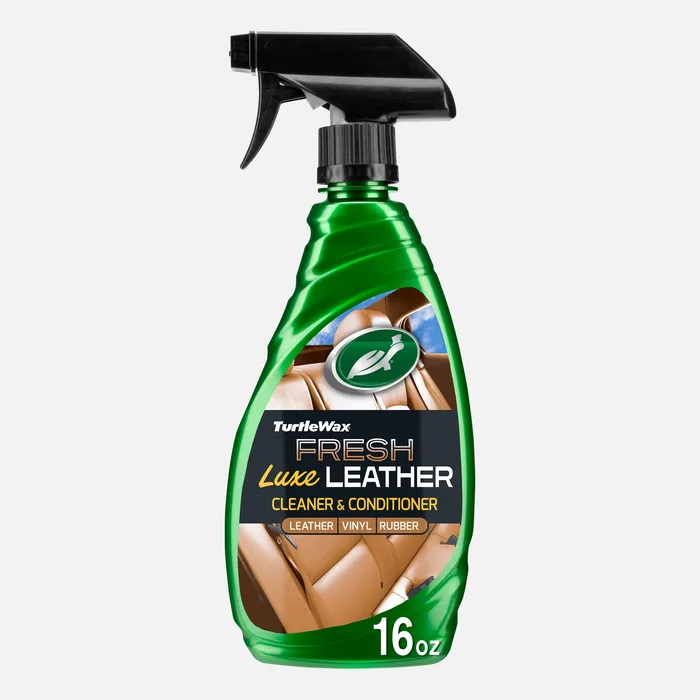
Says sealed leather, is pH-balanced, and its page imagery covers leather, vinyl and rubber, so it is the one-bottle option.
Best for: Anyone who wants one bottle for a whole interior of leather, vinyl and rubber, and who values the pH claim and the non-slippery finish.
- Explicitly stated for all sealed leather seats, door panels, dashboards and steering wheels, which describes coated automotive leather correctly.
- pH-balanced, the only pH claim in this comparison and the property that protects a urethane topcoat.
- Non-greasy and non-slippery, which matters most on a steering wheel.
- Image text on the page covers leather, vinyl and rubber, so one bottle may handle seats, door cards and trim.
- Being cleared for vinyl and rubber as well as leather makes it a multi-surface product rather than a leather specialist.
- A combined cleaner and conditioner is a compromise on heavily soiled leather.
- Its UV protection claim is a feature badge with no detail or mechanism given.
- Single 16 ounce size, and the emollients are named without being described.
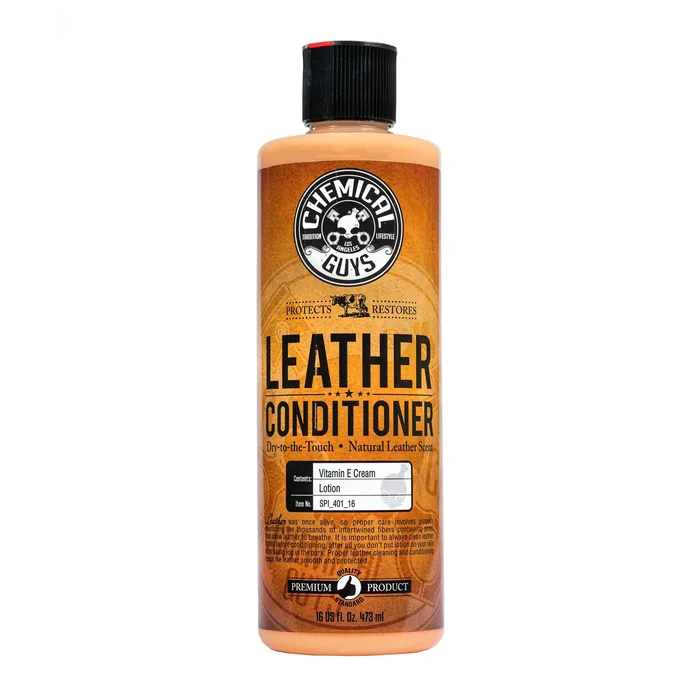
Restores a matte finish, which is the correct look for a car interior and not what every conditioner leaves.
Best for: Anyone whose seats have gone shiny from a previous greasy product and who wants the matte factory look back.
- States that it restores a matte finish, which is what factory coated leather should look like.
- Claims protection against fading from daily use and harsh elements.
- A single-purpose conditioner rather than a combined product, so it does one job.
- Sixteen ounce bottle.
- Hydrates and nourishes is the stated mechanism, which does not describe what happens on a coated surface.
- No explicit UV protection claim, only protection against fading, with no mechanism given.
- No pH claim.
- The page is a single sentence, so there is very little to evaluate.
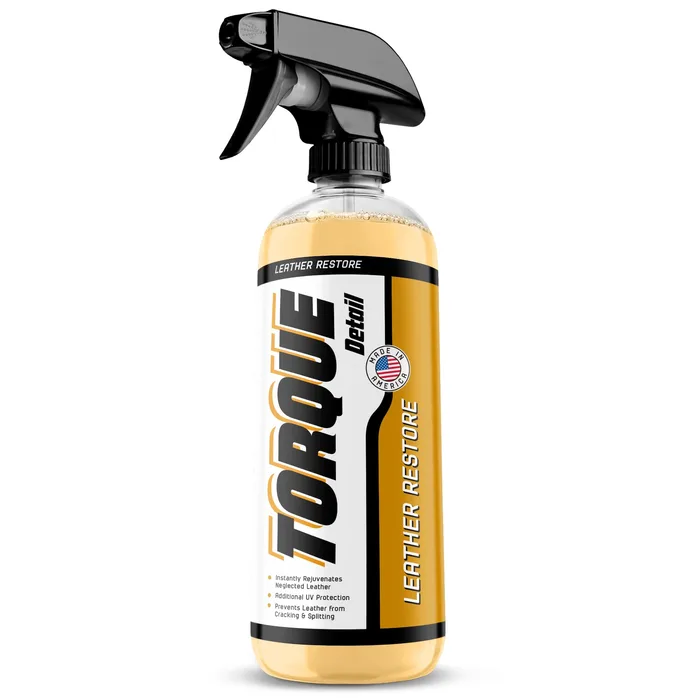
Leads on Vitamin E nourishing the leather, on a surface that cannot be nourished.
Best for: Almost nobody as a leather product. As a general non-greasy interior dressing it is competent, which is what other products here also are.
- Non-greasy spray-on formula, which is the right format and the right finish.
- Added UV protection claimed against future cracking and splitting.
- Also works on plastic trim and door panels, so one bottle covers several interior surfaces.
- Formulated with Vitamin E to nourish leather, on a surface where a urethane coating stands between the product and the hide.
- Premium price tier, against a budget product that makes a pH claim and a mid-range one that makes a UV claim.
- No pH claim and no mention anywhere of coated or sealed leather.
- Sold for all types of leather as well as plastic trim, with nothing said about the difference between coated and uncoated hide.
| Criteria | Gold Class Leather Conditioner, 16 oz Top pick Buy it Buy | Luxe Leather Cleaner & Conditioner, 16 fl oz Buy it Buy | Leather Conditioner It depends Buy | Leather Restore Ceramic Conditioner, 16 oz Skip it Buy |
|---|---|---|---|---|
| Best for | Coated leather on a car parked outside, where UV protection is the property that actually extends the life of the finish. | Anyone who wants one bottle for a whole interior of leather, vinyl and rubber, and who values the pH claim and the non-slippery finish. | Anyone whose seats have gone shiny from a previous greasy product and who wants the matte factory look back. | Almost nobody as a leather product. As a general non-greasy interior dressing it is competent, which is what other products here also are. |
| Price tier | $$ · mid-range | $ · budget | $$ · mid-range | $$$ · premium |
| Describes leather as sealed or coated | No | Yes, all sealed leather | No | No |
| pH claim | None | pH-balanced | None | None |
| UV protection | Yes, prevents ageing and fading | Ultimate UV protection badge, no detail | Fading protection, no mechanism | Yes, against cracking and splitting |
| Stated mechanism | Aloe and moisturising oils | Emollients and conditioners | Hydrates and nourishes | Vitamin E nourishment |
| Finish left | No buildup, residue or artificial gloss | Non-greasy, non-slippery | Matte | Non-greasy |
| Cleans as well as conditions | No, use after a cleaner | Yes, one application | No | Described as cleaner and conditioner |
| Other surfaces claimed | Leather only | Leather, vinyl and rubber in page imagery | Leather only | Plastic trim and door panels |
| Size | 16 oz | 16 fl oz | 16 oz | 16 oz |
Which one is right for you?
- Coated leather on a car parked outside, where UV protection is the property that actually extends the life of the finish. Buy it Meguiar's Gold Class Leather Conditioner, 16 oz
- Anyone who wants one bottle for a whole interior of leather, vinyl and rubber, and who values the pH claim and the non-slippery finish. Buy it Turtle Wax Luxe Leather Cleaner & Conditioner, 16 fl oz
- Anyone whose seats have gone shiny from a previous greasy product and who wants the matte factory look back. It depends Chemical Guys Leather Conditioner
- Almost nobody as a leather product. As a general non-greasy interior dressing it is competent, which is what other products here also are. Skip it Torque Detail Leather Restore Ceramic Conditioner, 16 oz
How we judged the field
Five things decide a leather product for a car, and the first is whether the brand understands what it is selling onto. Automotive leather is coated, so the useful properties are surface properties: pH that will not attack a urethane film, UV protection that slows the film degrading, a finish that is matte rather than glossy, and cleaning power for the body oils that build up. Ingredient stories about nourishment describe furniture leather, not car seats. Second is whether the product cleans as well as conditions, since a combined product suits maintenance and a dedicated pair suits neglected leather. Third is the finish, because shine on a seat is both wrong-looking and slippery. Fourth is what else the product claims to cover. Fifth is application format, since spraying a seat evenly is easier than spreading a cream.
The field divides between products that describe a surface and products that describe an ingredient. We took two of each. What emerged is that one of the budget products is the one whose page most accurately describes the material it will be used on, and the Vitamin E product is the one leaning hardest on a mechanism that a coated seat makes impossible.
Meguiar’s Gold Class Leather Conditioner, 16 oz
Buy itMeguiar’s Gold Class is the better product for anyone who has already dealt with the cleaning. It states UV protection to help prevent ageing and fading, and on a coated seat that is the one property with a real mechanism behind it, since ultraviolet light degrading the urethane film is what actually destroys car leather. The page also makes a promise most conditioners quietly break: no buildup, no white residue and no artificial gloss. White residue in the grain and a plasticky shine are the two visible signs of a bad leather product, and naming them is a small act of confidence. The spray bottle makes even coverage straightforward. Where it is doing marketing rather than chemistry is the aloe and moisturising oils, which are described as creating a premium conditioner and cannot reach the hide through the coating. It also assumes you own a separate cleaner, which makes it half a routine rather than a whole one.
Turtle Wax Luxe Leather Cleaner & Conditioner, 16 fl oz
Buy itTurtle Wax Luxe Leather is the pick for an unglamorous reason: it is the only page here that describes the surface correctly. It is stated for all sealed leather seats, door panels, dashboards and steering wheels, and sealed is the accurate word for what a modern car interior actually is. From that follow the two claims that matter. It is pH-balanced, which is the only pH statement in this comparison and the property that determines whether a cleaner attacks the urethane topcoat over time. And it is non-greasy and non-slippery, which is a specification rather than a boast when the product will end up on a steering wheel. It cleans and conditions in one application, removing surface oils while leaving emollients behind. The page imagery also lists leather, vinyl and rubber, which makes it a genuine multi-surface interior product rather than a leather specialist, and that is a convenience if you want one bottle and a compromise if you want the best thing for your seats. The trade-offs are what you would expect from a combined product: on heavily soiled leather a dedicated cleaner does more, the UV claim is a badge with no detail, and the emollients are not named.
Chemical Guys Leather Conditioner
It dependsChemical Guys Leather Conditioner is the one worth considering for a specific problem, and its useful claim is easy to miss. It says it restores a like-new look and matte finish, and matte is the correct appearance for factory coated leather. A great many interiors have been ruined by greasy dressings that leave seats looking wet and feeling slippery, and a product that explicitly brings the finish back down is solving a real and common complaint. It also claims protection against fading from daily use and harsh elements, and it is a single-purpose conditioner rather than a combined cleaner, which keeps the roles distinct. Against that, the stated mechanism is that it hydrates and nourishes the leather, which on a sealed surface is not what happens. There is no pH claim and no UV claim with a mechanism attached, and the entire product description is one sentence, which leaves very little to weigh.
Torque Detail Leather Restore Ceramic Conditioner, 16 oz
Skip itTorque Detail Leather Restore is the one to skip, and the reason is that its headline claim is the least applicable one in the category. It is formulated with Vitamin E to nourish leather, and on a seat sealed under pigmented urethane there is no route for a nutrient to reach the hide. That would be a marketing quibble on its own, but the page compounds it: the product is sold for all types of leather and also works on plastic trim, door panels and other interior surfaces, which describes a general interior dressing rather than a leather-specific product. If it is formulated to be safe across leather, vinyl and hard plastic, it is by definition not optimised for any of them. There are genuine positives. It is a non-greasy spray-on formula, which is the right format and finish, and it claims added UV protection against future cracking and splitting, which is the correct mechanism. With no pH claim and no mention of coated leather, it is the weakest proposition here.
Sources
Specs in this review come from these pages.
- Turtle Wax Luxe Leather Cleaner & Conditioner product page (turtlewax.com)
- Meguiar's Gold Class Leather Conditioner product page (meguiarsdirect.com)
- Chemical Guys Leather Conditioner product page (chemicalguys.com)
- Torque Detail Leather Restore product page (torquedetail.com)
- US EPA, UV radiation (epa.gov)
Meguiar’s Gold Class Leather Conditioner, 16 oz vs Turtle Wax Luxe Leather Cleaner & Conditioner, 16 fl oz: which should you buy?
Meguiar’s Gold Class and the Turtle Wax are the two to choose between, and it comes down to whether you want a specialist or one bottle. Meguiar’s is leather-only, which means the formulation has not been compromised to also suit vinyl and rubber, and it is the only leather-dedicated product here claiming UV protection. Since the urethane topcoat is what actually fails on a car seat, and ultraviolet light is what breaks it down, that is the claim with a mechanism behind it. Its explicit promise of no buildup, white residue or artificial gloss addresses the most common way these products go wrong.
Turtle Wax is the only one that describes the surface accurately as sealed leather, and it is pH-balanced and non-greasy, which are the right properties for a coated finish. Its page imagery covers leather, vinyl and rubber, so one bottle handles seats, door cards and trim in a pass. Buy the Meguiar’s if the car lives outside and the seats are the thing you care about. Buy the Turtle Wax if you would rather do the whole interior with one product and can accept that it is not specialised for any part of it.
What to look for
- The word sealed or coated: it tells you the brand knows what automotive leather is, and only one product here uses it.
- Whether it is leather-only: two of these four also cover vinyl, rubber or plastic in their marketing, which makes them interior dressings with leather on the label.
- A UV protection claim: the urethane topcoat is what degrades, and UV is what degrades it, so this is the property with a real mechanism.
- pH balance: it determines whether repeated use attacks the coating, and three of these four make no pH claim at all.
- A matte, non-greasy finish stated explicitly: shine on a seat is both wrong-looking and slippery, and on a steering wheel it is a safety issue.
- Whether it cleans too: a combined product suits maintenance, and neglected leather needs a dedicated cleaner first.
Our final take
The premise of this category is mostly wrong for cars. Automotive leather is sealed under a pigmented urethane coating, so the oils, aloe and Vitamin E that three of these four lead with are being applied to a plastic film rather than to a hide. What actually helps is cleaning off body oils, adding UV protection to slow the coating’s failure, and leaving a matte, non-slippery finish. Meguiar’s Gold Class is the pick because it stays leather-only, claims the UV protection that matters, and promises none of the buildup and artificial gloss that ruin seats. Turtle Wax is the budget pick, says sealed leather, is pH-balanced, and covers vinyl and rubber too, which makes it the sensible one-bottle answer. Chemical Guys is worth having if a previous product left your seats shiny. Torque Detail leads with the claim that applies least.
Questions, answered
Is car leather actually coated?
Almost always, yes. Modern automotive leather carries a pigmented polyurethane topcoat that provides the colour, the grain texture in many cases, and the resistance to sunlight, sweat and dye transfer from clothing. That coating is why car leather survives conditions that would destroy furniture leather. It also means anything you apply sits on plastic rather than soaking into hide, which is why one product here referring to sealed leather is more accurate than three referring to nourishment.
So do conditioners do anything at all?
Yes, just not what the marketing describes. On a coated seat the useful jobs are cleaning the film of body oils and dye transfer off the surface, adding UV protection to slow the coating's degradation, and leaving a matte, non-slippery finish rather than a greasy shine. Those are real benefits. What does not happen is oil penetrating to feed the hide, because the coating is a barrier by design. Judge products on UV claims, pH and finish rather than on ingredient romance.
Why does my leather crack if it is coated?
Because the coating fails before the hide does. Ultraviolet light and heat break down the urethane film, and constant flexing at the seat bolster where you slide in and out concentrates the stress. What looks like dry cracked leather is usually a cracked coating with the hide intact underneath. That is also why UV protection is the property worth paying for, and why no amount of oil applied afterwards repairs it once the film has split.
What about perforated or ventilated seats?
Use less product and never spray directly onto the perforations. Liquid that runs into the holes ends up in the foam, where it cannot dry, and on a ventilated seat it can reach the fan. Spray onto an applicator or a microfibre towel and work it across the surface, then buff off promptly. The same applies to any seat with visible stitching, since thread wicks liquid and stays damp long after the panel looks dry.
How often should I condition car leather?
Two to four times a year for most cars, and more often for a convertible or anything parked outside in strong sun. The trigger to watch is not dryness but grip: coated leather that starts to feel slick or tacky is carrying a film of body oils and previous product, which is a cleaning job rather than a conditioning one. Over-application is a real problem, since layers of unbuffed product attract dust and turn the seat shiny.
Deciding between the top two? See our head-to-head: Meguiar's Gold Class Leather Conditioner, 16 oz vs Turtle Wax Luxe Leather Cleaner & Conditioner, 16 fl oz.
More in Automotive
Leather Conditioners, Explained Plain-English guide → Meguiar's Gold Class Leather Conditioner, 16 oz vs Turtle Wax Luxe Leather Cleaner & Conditioner, 16 fl oz Head-to-head →  The Best LED Headlight Bulbs: 4 Compared (and One to Skip)
  The Best Mechanic Creepers: 4 Compared (and One to Skip)
  The Best Metal Polishes: 4 Compared (and One to Skip)
  The Best OBD2 Scanners: 4 Compared (and One to Skip)