Explained
Oil Drain Pans, Explained
After reading, you'll understand how to size a drain pan to your engine, how to check it will fit under your car, and what separates an open pan from a sealed drain-and-store container.
In this guide
First-time buyers usually get tripped up in the same three places. They buy a pan sized to the number in the owner's manual and then watch it overflow, because the manual number is the fill capacity and not the total that comes out. They buy a container with plenty of capacity and discover it is too tall to slide under the car on jack stands. And they buy an open tray with no cap, then realize the oil has to live somewhere until they can drive it to a collection site. None of those are hard problems once you know which numbers to look at.
The 30-second version
- Size up, always, because the sump figure ignores residual oil, the contents of the old filter, and whatever misses the pan.
- Height is the deal-breaker, so measure your clearance with the car supported the way you plan to work on it, then buy under that number.
- Caps decide the errand, since only a sealed container can ride in a car to a collection site without a towel and a prayer.
- A screen is a real feature, not marketing, because retrieving a drain plug from hot oil with a magnet is a bad ten minutes.
- Pouring is half the job, and a pan with no spout is the usual reason a driveway ends up stained.
The products this guide is about
Our verdict on each, with the full reasoning on the companion review.
- Buy Zeeline by Milton ZE700 15-Quart Drain Pan with Filter Drain Screen A 15 quart sealed drain pan whose catch screen keeps your drain plug out of the oil. Amazon
- Buy Performance Tool W4077 16 qt. Oil Drain Container Sixteen quarts, tethered gasketed caps, and every dimension published so you can check clearance first. Amazon
- It depends FloTool 42003MI Super Duty 16 Qt. Drain Container The lowest-profile 16 quart container here at a retailer-listed 6.25 inches tall, sold on a capacity number and not much else. Amazon
- Skip Performance Tool W4070 7 qt. Plastic Drain Pan A 7 quart open pan that a modern V8 oil change will simply overflow. Amazon
What actually matters
- Stated capacity - the volume the maker says the pan or container holds, usually in quarts and sometimes in liters. Treat it as a ceiling you should not approach, because a pan filled to its rated line is one you cannot slide or carry without slopping.
- Overall height - the tallest point of the pan, which has to clear the lowest thing between your drain plug and the ground. This is a common reason a drain pan gets returned, and some makers still do not publish it.
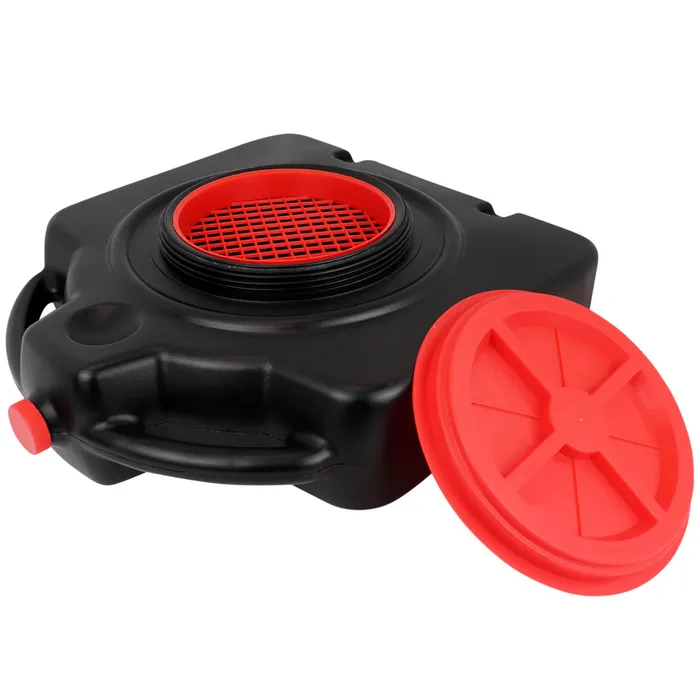
- Sealing caps - the screw or push caps that close the catch opening and the pour spout. Gaskets or O-rings are what make the difference between leak-proof marketing copy and a container that survives a car journey lying on its side.
- Drain opening size - the diameter of the hole the oil actually falls into. A wider opening, like the 8 inch one Milton specifies on the ZE700, is more forgiving of an oil stream that arcs sideways when the plug first comes out.
- Catch screen or filter shelf - a mesh or grate under the opening that stops plugs, gaskets and filters sinking, and gives the old filter a place to drip dry before it goes in the bin or the recycling bin.
- Material - polyethylene and polypropylene are the two normal choices, both chemical resistant. What matters more is wall thickness, since a thin-walled pan flexes and sloshes when you drag it, and hot oil makes that worse.
- Pour spout and handles - the geometry that gets oil back out. Look for a recessed corner spout or a capped spout and handles placed so you can control the tip, rather than a plain tray you have to bear-hug over a funnel.
The specs, in plain English
Green flags vs red flags
Green flags
- The maker publishes overall height, width and depth, not just capacity.
- Capacity comfortably exceeds your engine's with-filter oil capacity, with several quarts of headroom.
- Sealing caps are described with a gasket or O-ring, and ideally tethered to the body.
- There is a catch screen or filter shelf so dropped hardware stays retrievable.
- A defined pour spout, preferably capped, plus handles positioned for controlled tipping.
Red flags
- Capacity roughly equal to a typical sump, with no allowance for filter contents and residual.
- No published height anywhere, on the maker's page or the retailer's spec sheet.
- Leak-proof claimed but no cap or seal described.
- A wide open tray with no spout, sold as a general-purpose pan for oil changes.
- Vague material language with no mention of wall thickness or behavior with hot oil.
Who's who: the brands
- FloTool (Hopkins Manufacturing) - Hopkins' automotive fluid-handling line, widely stocked in home improvement and general retail, strong on capacity and low profile but light on published specification.
- Performance Tool (Wilmar LLC) - A broad automotive tool brand whose drain range runs from 2.8 quart low-profile trays up to 24 quart sealed containers, with dimensions and UPCs published for each.
- Zeeline by Milton - Milton Industries' line, whose ZE700 is designed with professionals and do-it-yourself mechanics in mind and carries a catch screen and an O-ring cap.
- Lisle - A long-running US specialty automotive tool maker.
- Capri Tools - A shop tool brand that also sells drain pans; check the listing for height and caps before buying.
How to read a listing without getting fooled
Read a drain pan listing in this order: capacity, height, caps, spout, screen, material. Capacity tells you whether it can hold your oil change, and you want the number well above the with-filter figure in your owner's manual. Height tells you whether it will physically go under the car, and if the listing does not give it, treat that as missing information rather than a minor omission. Caps tell you whether it is a pan or a container, and the useful listings name the gasket or O-ring rather than just saying leak-proof. Spout and screen are the quality-of-life features that separate a well-designed pan from a molded tub. Material comes last because almost everything is polyethylene or polypropylene and the meaningful differences show up in wall thickness and rigidity language, not in the polymer name.
How much should you spend?
This is a category where the budget tier is genuinely usable. A plain open pan or a basic sealed container sits at the $ · budget end, and the sealed containers there already include gasketed caps and published dimensions, which is most of what you need. Moving to $$ · mid-range buys the features that reduce hassle rather than raw capacity: a catch screen, an O-ring on the main cap, a wider drain opening, better handle geometry. Above that you are into shop equipment, meaning rolling low-profile drains with pumps and hoses and multi-gallon waste tanks, which only make sense if you are servicing several vehicles or working on a lift. For one or two cars in a home garage, a budget or mid-range sealed container is the whole answer, and the money is better spent on ramps or stands than on a fancier pan.
Questions, answered
Can I use the same pan for coolant and oil?
Physically yes, and Milton lists the ZE700 for use with motor oils, transmission fluids and coolants. Practically, keep them separate. Collection sites take used oil on the basis that it has not been mixed with other fluids, and coolant or solvent contamination can get a load rejected. If you only own one pan, wash it out thoroughly between different fluids and never store mixed fluids in it.
How hot is the oil when it comes out?
Hot enough to burn you if the engine has just been running, which is also why makers talk about heavy wall construction staying rigid when draining hot engine oil. Warm oil drains faster and carries more suspended dirt out with it, so a short run before the change is worth doing. Let the engine sit for several minutes before you pull the plug, and wear gloves. None of these consumer pans publishes a maximum temperature rating.
How long can I keep used oil in the container?
There is no fixed clock, but keep it capped, keep it out of the sun and away from heat, and label it so nobody mistakes it for anything else. A sealed drain-and-store container is designed for exactly this, which is the main argument for buying one over an open pan. Check your local rules, since states and municipalities set their own storage and quantity limits for households.
Do I still need a funnel?
Only if your pan has no usable spout. A container with a capped pour spout, or a pan with a recessed corner spout, pours into a collection tank or a jug without one. If you are decanting into narrow-necked bottles, a funnel still helps. What you should not do is tip a wide open tray freehand, because that is the single most reliable way to put used oil on concrete.
Or jump to the head-to-head: Zeeline by Milton ZE700 15-Quart Drain Pan with Filter Drain Screen vs Performance Tool W4077 16 qt. Oil Drain Container.