Explained
Paint Sealants, Explained
After reading, you'll understand where a sealant sits between wax and ceramic, and what actually determines how long yours lasts.
In this guide
Paint protection comes in three tiers that overlap in price and blur in marketing: wax measured in weeks, sealant measured in months, and ceramic coating measured in years. A sealant is the middle option and the one most people should own, because it lasts through a season without the preparation and permanence a coating demands. The catch is that durability, the only reason the tier exists, is rarely printed where you shop online.
The 30-second version
- Durability is the whole point, and the figure may be printed on the bottle rather than on the website you are buying from.
- Preparation decides the result, because a sealant bonds to clear coat and cannot bond through old wax or contamination.
- Sealant goes under wax, since the durable synthetic layer needs contact with the paint to work.
- UV blocking beats water beading, as beading is the visible sign and UV damage is the thing that actually ages paint.
- Spray sealants trade life for speed, laying down a thinner layer than a cream applied by hand or machine.
The products this guide is about
Our verdict on each, with the full reasoning on the companion review.
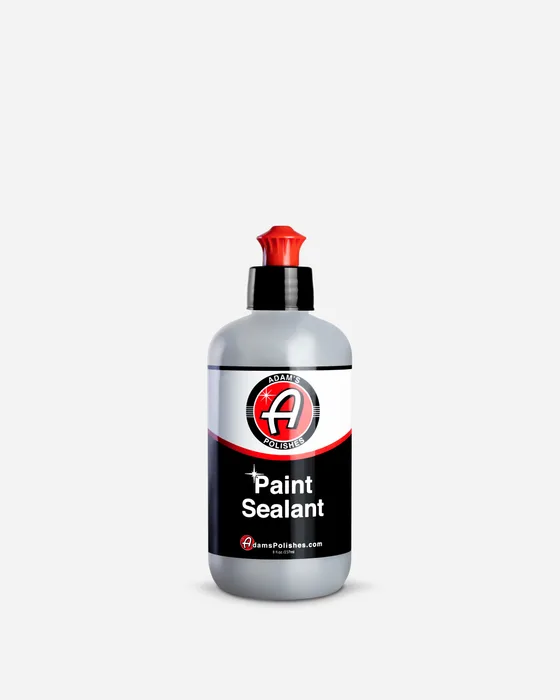
- Buy Adam's Polishes Paint Sealant The only sealant here that states how long it lasts on its product page, and it tells you where it goes in the layering order. Amazon
- Buy Chemical Guys Jet Seal Sealant & Paint Protectant Claims up to 12 months and advanced UV protection, both printed on the bottle and neither on the web page. Amazon
- It depends Adam's Polishes Proline SHIELD Spray Sealant A professional spray sealant whose page says SiO2 ceramic and whose bottle says polymer based.
- Skip P&S Detail Products Ultracoat Paint Sealant Its own description opens by calling it the longest lasting wax we make, then uses three different product names for it.
What actually matters
- Durability - how many months the protection is expected to last. It varies with climate and washing, which is why a range is the honest way to state it, and silence is not.
- Chemistry - polymer, resin, urethane or SiO2. Each bonds and ages differently, and a named chemistry lets you compare products where a brand term does not.
- Format - creams and liquids applied by hand or machine lay down the most material; sprays are faster and thinner. The choice is a trade between time and months of life.
- Layering position - where the product sits in a stack. A sealant belongs directly on clean bare paint, with wax or a glaze over it if you want more depth.
- UV protection - whether the product includes UV blockers. Beading is what you see; UV absorption is what stops the clear coat oxidising over years.
- Cure time - how long before the sealant can meet water. Rarely published and genuinely important, since rain on an uncured sealant can leave marks.
- Preparation requirement - how clean the paint has to be. Sealants are less demanding than coatings and far more demanding than wax, and this is where most disappointment originates.
The specs, in plain English
Green flags vs red flags
Green flags
- A durability figure or range, stated on the page rather than only on the label.
- The chemistry named as polymer, urethane, resin or SiO2 rather than as a trademarked word.
- Layering guidance saying where the product sits relative to wax and glaze.
- A UV protection claim tied to the formulation.
- Preparation guidance, since that is what determines whether the claim is achievable.
Red flags
- Longest lasting as an opening claim with no figure anywhere on the page.
- A label and a product page that name different chemistries for the same product.
- The word wax used to describe a product sold as a sealant.
- Multiple different product names used for the same item in one description.
- Adjustable dilution with no ratio published.
Who's who: the brands
- Adam's Polishes - One of the few brands publishing a durability window on a paint sealant, along with UV claims and layering order.
- Chemical Guys - Jet Seal is a long-established polymer sealant with a named chemistry and an aviation origin story, with up to 12 months printed on the bottle but not on its product page.
- P&S Detail Products - Professional supply, with sealant chemistry described in detail and product naming that varies within a single page.
- Gtechniq - A coatings-first brand whose sealant and coating products are usually sold with stated durability in months or years.
- Meguiar's - A long-established consumer line whose synthetic sealants are among the most widely available entry points to the category.
How to read a listing without getting fooled
Find the durability claim first, and look for it on the bottle as well as on the page, because two products in the comparison above print a duration on the label and nothing in their descriptions. Then note whether the claim is a number, a range, or an adjective. A range in months is the honest form; longest lasting with no figure is a claim you cannot check or hold anyone to. Then look at the chemistry and require an actual word: polymer, urethane, resin or SiO2 all tell you something, where a capitalised brand term tells you nothing. Look for layering guidance, since a sealant that is meant to go under wax should say so and most do not. Check for a UV claim, which separates products that protect from products that only bead. And read the page for internal consistency, because a description that calls a sealant a wax and uses four names for one product has not been checked by anyone.
How much should you spend?
Sealant pricing overlaps heavily with both wax and entry-level ceramic, so the tier boundaries are set by chemistry rather than by cost. A mid-range polymer sealant applied properly onto decontaminated paint will outlast an expensive wax by months, which makes it the best value in paint protection for most people. Spray sealants cost less per application and last less time, so they suit topping up rather than as the main layer. What is genuinely worth paying for is not the bottle but the preparation: an iron remover, a clay bar and a panel prep wipe do more for how long whatever you apply will last than a pricier bottle does.
Questions, answered
How do I know when to reapply?
Watch how water behaves. A working sealant makes water bead tightly and sheet off quickly; as it wears, the beads flatten out and water starts to sit in sheets that dry in place. That change usually appears well before the protection is fully gone, which makes it a useful early warning. If your product publishes a window, as one in the comparison above does, use it as the schedule and the water as the confirmation.
Can I apply a sealant over an existing coating?
Yes, and SiO2 sprays are sold specifically for it, described as coating toppers. What you should not do is apply a traditional cream sealant expecting it to bond to the paint, because it will be bonding to the coating instead and will behave more like a temporary layer. If you have a ceramic coating, use a topper on the same chemistry. If you want to start fresh with a sealant, the coating has to be polished off first.
Does a sealant work on wheels and trim?
On painted wheels, yes, and one product in the comparison above names wheels explicitly. Wheels are a good use for a sealant because the surface is painted clear-coated metal, and a slick surface makes brake dust much easier to remove. Unpainted plastic trim is a different problem and wants a dedicated trim product, since a paint sealant will not restore pigment and can look patchy on textured surfaces.
Is it worth polishing before sealing?
If the paint has swirls, yes, because a sealant is transparent and will lock in whatever is underneath for its whole life. Polishing removes the defects; the sealant then protects the corrected finish. If the paint is already in good condition, a wash, a chemical decontamination, a clay if needed and a panel prep wipe is enough. The prep is what determines whether you get the top or the bottom of the stated durability range.
Or jump to the head-to-head: Adam's Polishes Paint Sealant vs Chemical Guys Jet Seal Sealant & Paint Protectant.