Explained
Rinseless Washes, Explained
After reading, you'll understand how rinseless chemistry protects paint, and when the car is too dirty for it.
In this guide
Washing a car without a hose sounds like a compromise and mostly is not, provided you understand what the chemistry is doing. A rinseless wash uses polymers that wrap each particle of dirt so it releases into a towel instead of scraping across the clear coat. That mechanism has a hard limit, which is how much dirt the solution can hold, and a soft one, which is how disciplined you are with towels. Neither is printed on the bottle.
The 30-second version
- Encapsulation is the mechanism, with polymers wrapping each particle so it lifts into the towel rather than dragging.
- Towels decide the outcome, and going back to a used face is what actually marks the paint.
- Rinseless and waterless are different, one a bucket concentrate for a dirty car and one a spray for dust.
- Dilution changes the product, since the same concentrate can be a bucket wash or a spray depending on how thin you mix it.
- There is a dirt ceiling, and visible grit or salt crust needs rinsing off before any of this starts.
The products this guide is about
Our verdict on each, with the full reasoning on the companion review.
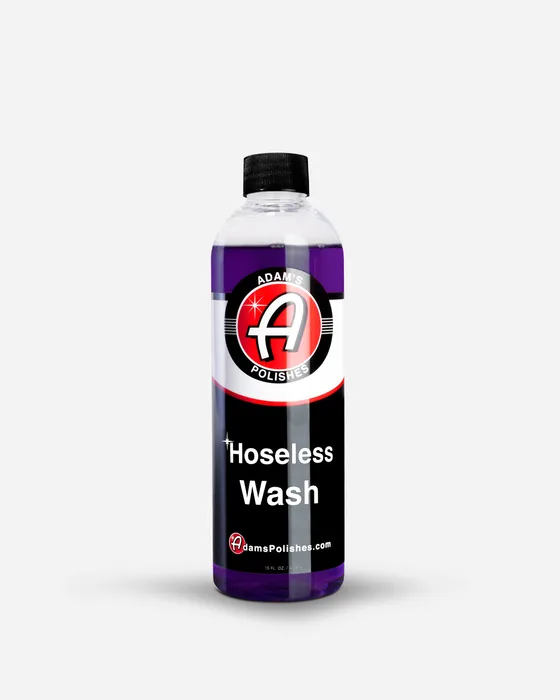
- Buy Adam's Polishes Hoseless Wash The fullest dilution chart here: one concentrate for the bucket, a waterless spray, a detail spray and a two-bucket wash booster. Amazon
- Buy Armour Detail Supply HERO Rinseless Wash Silica for slickness with nothing left behind, stated plainly, which is a distinction almost nobody draws. Amazon
- It depends P&S Detail Products Absolute Rinseless Wash A professional concentrate that describes its mechanism properly and tells you nothing about quantity. Amazon
- Skip Chemical Guys HydroGlide Ceramic Waterless Wash A waterless wash rather than a rinseless one, which is a lighter job and a different product.
What actually matters
- Encapsulation - polymers surrounding each dirt particle so it releases into the towel. It is the whole safety mechanism and the reason the method works at all.
- Lubricity - how slippery the solution is. It buys margin when a particle does not get fully encapsulated, and silica is sometimes added purely for this rather than for protection.
- Dilution - the ratio of concentrate to water, which changes the product's job. Thicker for a bucket wash, much thinner for a spray-bottle waterless application.
- Whether it deposits anything - some formulas leave a protective layer, others deliberately leave nothing. On a coated car the second is usually what you want.
- Towel count and type - plush, high-GSM towels used one face per section. This is the single biggest factor in whether a rinseless wash marks the paint.
- Dirt load - how much soil the solution can carry. Road film and dust are fine; caked mud, sand and salt crust are not, and need a pre-rinse.
- Runoff - a rinseless wash produces almost none, which is the practical reason it is often allowed where hose washing is restricted.
The specs, in plain English
Green flags vs red flags
Green flags
- The word rinseless used specifically, rather than waterless or no-rinse used interchangeably.
- Encapsulation or emulsification described as the mechanism.
- A figure for how many washes a bottle makes, or a dilution ratio.
- A clear statement about whether the product leaves protection behind.
- More than one size, so a concentrate can be bought at concentrate economics.
Red flags
- Rinseless and waterless used as if they meant the same thing.
- Concentrated claimed with no ratio and no usage figure.
- Silica mentioned with no indication of whether it deposits or just lubricates.
- No guidance on how dirty a car the product will handle.
- A ready-to-use spray priced and positioned as a full wash solution.
Who's who: the brands
- Adam's Polishes - Its Hoseless Wash prints the fullest dilution chart in this comparison, with one concentrate covering bucket, waterless spray and detail spray.
- Armour Detail Supply - A chemical-focused brand distributed through The Rag Company, and unusually precise about what its silica does and does not deposit.
- P&S Detail Products - Professional supply, describing the encapsulation mechanism accurately and selling only in trade sizes.
- Chemical Guys - Broad range of wash products, with ceramic-depositing waterless sprays prominent in the line.
- Optimum - Maker of No Rinse, a long-established rinseless wash that many others are compared against.
How to read a listing without getting fooled
Check first whether the product is rinseless or waterless, because the words are used loosely and the two do different jobs. Then look for the mechanism: encapsulation or emulsification named on the page tells you the brand is describing how the product protects paint rather than how glossy it looks. Look for any quantity figure, whether that is a dilution ratio or a number of washes per bottle, and note that many brands publish neither. If silica or SiO2 appears, find out whether it is depositing protection or only adding slickness, because those are opposite intentions. Finally read the size options, since these are concentrates and buying the small bottle is usually the expensive way to do it.
How much should you spend?
Because many products in this category publish no dilution ratio, shelf price is a poor guide, and a product that states washes per bottle or a clear ratio is the one you can actually cost out. As a rule the trade sizes from professional brands usually work out cheaper per wash, and the small consumer bottles are best treated as a trial rather than a purchase. The real budget item is towels: a rinseless wash needs a large stack of good plush microfibre, and skimping there both costs more over time and is the thing most likely to damage your paint. Buy the mid-range chemical and spend the difference on towels.
Questions, answered
Can I use a rinseless wash in winter?
It is one of the best uses for it, since a hose is often impossible and salt needs removing regularly. The caution is the salt crust itself: if there is visible build-up, get it off with a pre-soak or a bucket rinse before you touch the paint with a towel. Work in a garage if you can, because the solution needs to stay liquid long enough to encapsulate, and it will not do that on a frozen panel.
Do I need special towels?
Plush, high-GSM microfibre, and a lot of them. Unlike glass, where low nap is right, rinseless washing wants deep pile so encapsulated dirt has somewhere to go away from the paint. Cheap thin towels hold the grit against the surface. Most people use either a large stack of small towels, one face per section, or a few very large towels folded into eighths and rotated relentlessly.
Is a pump sprayer worth it?
It is the accessory that most extends what a rinseless wash can handle. Filling a pump sprayer with the same diluted solution lets you pre-soak a panel and give the polymers time to work before any towel arrives, which is the difference between a rinseless wash being safe on a moderately dirty car and being marginal. It also lets one bottle of concentrate cover both the bucket and the pre-soak.
Will it clean the wheels too?
Poorly, and you should not want it to. Brake dust is embedded ferrous particulate that needs dedicated chemistry, and wheels carry the heaviest grit on the car. Using the same solution and towels on wheels and then on paint is how you move that grit onto your clear coat. Do the wheels first with a proper wheel cleaner and separate tools, then start the rinseless wash on the paint.
Or jump to the head-to-head: Adam's Polishes Hoseless Wash vs Armour Detail Supply HERO Rinseless Wash.