Explained
Tire Inflators, Explained
After reading this you will know which tire-inflator numbers describe real speed and accuracy, so you buy one that tops up a tire in a couple of minutes and stops at the pressure you set.
In this guide
A portable tire inflator is one of the highest-value tools you can keep in a car: it turns a slow leak or a low-pressure warning into a two-minute fix instead of a tow. But listings lead with max PSI, which tells you almost nothing about how fast it fills or how accurately it stops. This guide sorts the specs that matter from the ones that just sound good.
The 30-second version
- Max PSI is a ceiling, not a speed. A high maximum pressure says the pump won't stall on your tires, but it says nothing about how quickly it gets there. Fill rate is the spec that matters.
- Power source shapes the whole experience. Cordless is convenient and portable; 12-volt is tireless and steady; wall-corded is for the garage. Pick for where you'll actually use it.
- Auto-shutoff turns guesswork into a set-and-forget. Dial in a target pressure and a good inflator stops there on its own, so you don't over- or under-inflate while distracted.
- Accuracy is worth checking. A built-in gauge that reads a few PSI off defeats the purpose. The best inflators hold close to a trusted gauge and let you fine-tune.
- Small details decide daily usability. A backlit screen, a long hose, a good valve connector and a built-in light separate a tool you'll use from one that stays in the box.
The products this guide is about
Our verdict on each, with the full reasoning on the companion review.
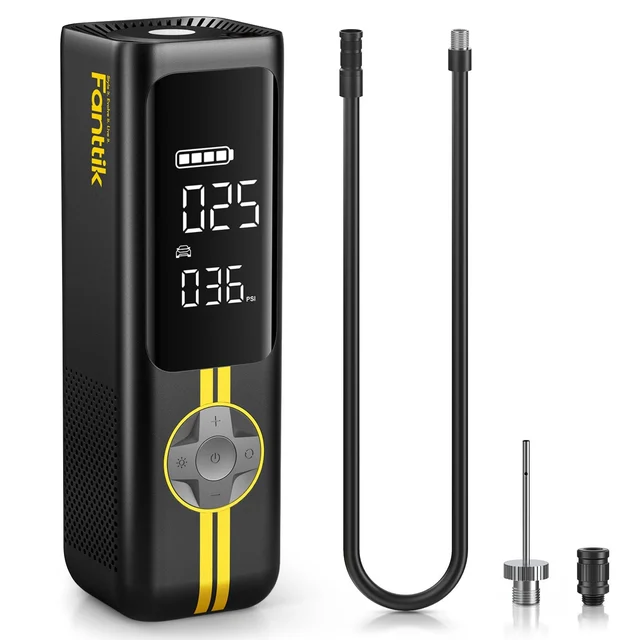
- Buy Fanttik X8 Apex Cordless Tire Inflator The most convenient all-rounder: fully cordless, genuinely fast, and equally happy on car tires or a road bike.
- Buy DEWALT 20V MAX Corded/Cordless Air Inflator (DCC020IB) A do-everything garage inflator that runs off a wall outlet, your car's 12V socket, or a 20V battery.
- It depends Milwaukee M12 Compact Inflator (2475-20) An excellent top-off tool that only makes financial sense if you already own M12 batteries.
- Skip AstroAI 12V Portable Air Compressor Tire Inflator A cheap, capable-on-paper 12V compressor that the cordless generation has quietly made obsolete for most buyers.
What actually matters
- Fill speed is the real headline. It depends on the pump's airflow and motor, not its maximum pressure; look for how long it takes to raise a car tire by a given amount rather than the top-end PSI figure.
- Maximum pressure still matters as a ceiling. Car tires need modest pressure, but bikes, trucks and some SUVs run higher; make sure the max comfortably clears whatever you'll inflate.
- Power source defines convenience versus endurance. Cordless packs are grab-and-go but limited by battery and can overheat on big jobs; 12-volt units run as long as the car does; wall-corded suits home use.
- Auto-shutoff and preset pressure make it accurate and hands-free. Setting a target and having the pump stop there prevents the over-inflation that a manual pump invites.
- Gauge accuracy determines whether the whole thing is trustworthy. A digital readout that tracks a known-good gauge closely is essential; verify it against a separate gauge when you first use it.
- Ergonomics and reach decide real usability: a hose long enough to reach all four valves without moving the car, a screw-on or locking connector that doesn't leak, and a light for night-time roadside fixes.
The specs, in plain English
Green flags vs red flags
Green flags
- A stated fill time or airflow rate, not just a max PSI
- Auto-shutoff with a settable preset pressure
- A digital gauge that matches a trusted separate gauge
- A long hose, a solid valve connector and a work light
Red flags
- A very high max PSI headline with no fill-speed figure
- No auto-shutoff, so you have to watch and guess
- A cordless-only pump with no runtime or overheating guidance
- A short hose or a leaky push-on connector
Who's who: the brands
- Fanttik - Makes fast, compact cordless inflators with clear presets and screens, popular for everyday top-ups.
- Ryobi - Cordless inflators that share batteries with its wider tool range; convenient if you're already in that ecosystem.
- AstroAI - Well-known for affordable 12-volt inflators with digital gauges and auto-shutoff.
- Milwaukee - Higher-end cordless inflators aimed at durability and speed for people who inflate often.
How to read a listing without getting fooled
Skip past the max-PSI banner unless you inflate high-pressure tires; for car tires almost any unit clears it. Look instead for a stated fill speed or airflow rate, then pick your power source by where you'll use it: cordless for roadside and portability, 12-volt for tireless steady filling, wall-corded for the garage. Insist on auto-shutoff with a preset, and plan to check the gauge against a trusted one on first use. The hose length, connector and a built-in light are the details that decide whether it's pleasant to use.
How much should you spend?
Basic 12-volt inflators are inexpensive and perfectly capable for occasional car top-ups, just slower. Mid-range cordless units cost more but add speed, portability, accurate presets and a screen; the sweet spot for most drivers who want a quick, hands-free fill. Premium cordless inflators add durability, faster fills and better duty cycles; worth it if you inflate frequently or handle big tires, overkill for the once-a-month top-up.
A portable tire inflator earns its place in a car faster than almost any other tool. A low-pressure warning or a slow leak stops being a roadside crisis and becomes a two-minute pause. The trouble is that inflators are sold on max PSI, a number that sounds decisive and tells you very little about the two things you’ll actually notice: how fast it fills, and whether it stops where you want.
Max PSI is a ceiling, not a speed
The big pressure number on the box is a limit, not a rate. It tells you the highest pressure the pump can reach before it stalls - useful only if you inflate something demanding, like a high-pressure road-bike tire. Car tires run at modest pressures that virtually any inflator clears with room to spare, so a huge max PSI on a car-focused pump is a spec competing with itself. What you want instead is a fill rate, often given as airflow per minute or as a time to raise a tire by a set amount. That’s the number that decides whether topping up four tires takes three minutes or fifteen.
Power source is the real fork in the road
How an inflator is powered shapes the whole experience. Cordless units, with a built-in battery, are the convenient choice: nothing to plug in, easy to carry to a roadside breakdown, and able to reach all four valves without moving the car. Their limits are battery life and heat - inflate several big tires back to back and a small cordless can get hot and slow. A 12-volt inflator plugs into the accessory socket and runs as long as the engine does, giving steady, tireless power at the cost of a cable and being tied to the car. Wall-corded models are really garage tools. Pick for where you’ll actually reach for it.
The feature that makes it accurate: auto-shutoff
The difference between a good inflator and a frustrating one is usually auto-shutoff with a preset. You dial in your target pressure, connect the hose, and the pump fills and stops on its own. No standing there watching a needle, no over-inflating because you looked away. A manual pump invites both under- and over-inflation, and both hurt handling, wear and fuel economy. Set-and-forget is worth paying a little more for.
Trust, but verify, the gauge
All of that hands-free convenience assumes the built-in gauge is honest. Many are close; some read a few PSI off, which quietly defeats the purpose. The fix is simple: when you first use a new inflator, check it against a trusted standalone gauge. If it’s consistently high or low by a known amount, adjust your target to match. An accurate readout is what lets you rely on the preset without second-guessing it.
The small stuff you’ll actually feel
Beyond the headline specs, a handful of details decide whether an inflator is pleasant. A hose long enough to reach every valve without repositioning the car saves real annoyance. A screw-on or locking valve connector seals properly instead of hissing air; cheap push-on ones leak. A backlit screen and a built-in light matter more than they sound when the flat happens at night. And a decent duty cycle - how long the pump runs before it needs to cool - keeps you moving if you’re filling several large tires.
Choosing without the marketing
Ignore the max-PSI banner unless you inflate high-pressure tires. Find a unit with a stated fill speed, choose the power source that fits where you’ll use it, insist on auto-shutoff with a preset, and plan to sanity-check the gauge on day one. Get those right and you’ll have a tool that turns tire pressure from a worry into a non-event. To see how the leading inflators compare on speed and accuracy - and which popular one we’d skip - read our tire inflator comparison.
Questions, answered
Does a higher max PSI mean a faster inflator?
No, and this is the most common mix-up. Max PSI is the highest pressure the pump can reach - a ceiling that only matters if you inflate high-pressure tires. Fill speed depends on how much air the pump moves per minute, driven by its motor and airflow. For car tires, which need modest pressure, look at fill rate or a stated fill time rather than the top-end number.
Should I get a cordless or a 12-volt tire inflator?
It depends on where you'll use it. Cordless is grab-and-go, great for roadside emergencies and reaching all four tires without a cable, but it's limited by battery and can overheat on large tires. A 12-volt unit plugs into the car socket and runs as long as the engine does, making it steady and tireless but tethered. Frequent or big-tire users often prefer 12-volt or a high-end cordless with a good duty cycle.
How accurate are built-in inflator gauges?
It varies, and it matters, because an inaccurate gauge undoes the whole benefit. Good inflators read within a couple of PSI of a trusted gauge. When you first get one, check it against a separate quality gauge; if it's consistently off by a known amount, you can simply adjust your target. Over-inflation and under-inflation both hurt handling and tire life.
What is auto-shutoff and do I need it?
Auto-shutoff lets you set a target pressure and have the pump stop there on its own, instead of you watching a gauge and switching it off manually. It's one of the most worthwhile features: it prevents over-inflation while you're distracted and makes filling genuinely hands-free. For most buyers it's the difference between a chore and a set-and-forget tool.
Can one inflator handle car, bike and sports equipment?
Often yes, but check two things. First, the max PSI must clear high-pressure road-bike tires if you have them, since those need far more pressure than a car tire. Second, look for the right nozzle adapters for Presta valves, balls and inflatables, which many inflators include. A unit with a good preset range and the right adapters can cover the whole household.
Or jump to the head-to-head: Fanttik X8 Apex Cordless Tire Inflator vs DEWALT 20V MAX Corded/Cordless Air Inflator (DCC020IB).