Explained
Tow Straps and Recovery Gear, Explained
After reading, you'll understand which recovery tool matches which situation, what the published strength numbers really mean, and which attachment mistakes are the dangerous ones.
In this guide
The confusion in this category is baked into the packaging. Manufacturers use "tow strap", "recovery strap" and "snatch strap" loosely, and a lot of listings print one large number with no explanation of whether it is a breaking point or a safe working load. First-time buyers usually get two things wrong: they buy a low-stretch strap with metal hooks and then use it to yank a stuck vehicle, and they attach it to whatever looks solid at the back of the car. Both mistakes have killed people. The good news is that the underlying rules are simple and the reputable makers publish enough to let you get it right.
The 30-second version
- Stretch defines the tool, so decide first whether you are dragging a rolling vehicle or yanking a stuck one, then buy accordingly.
- Minimum breaking strength is not a working load, it is the failure point, and your usable limit is that number divided by a safety factor.
- Metal hooks are the avoidable risk, because a hook that releases under tension travels, so choose loop ends and rated shackles instead.
- The attachment point matters more than the strap, and tow balls, tie-down eyes and towbars are not rated for recovery loads.
- Traction boards are the safest recovery, because nothing is under tension, though they only help when the problem is grip rather than being hung up.
The products this guide is about
Our verdict on each, with the full reasoning on the companion review.
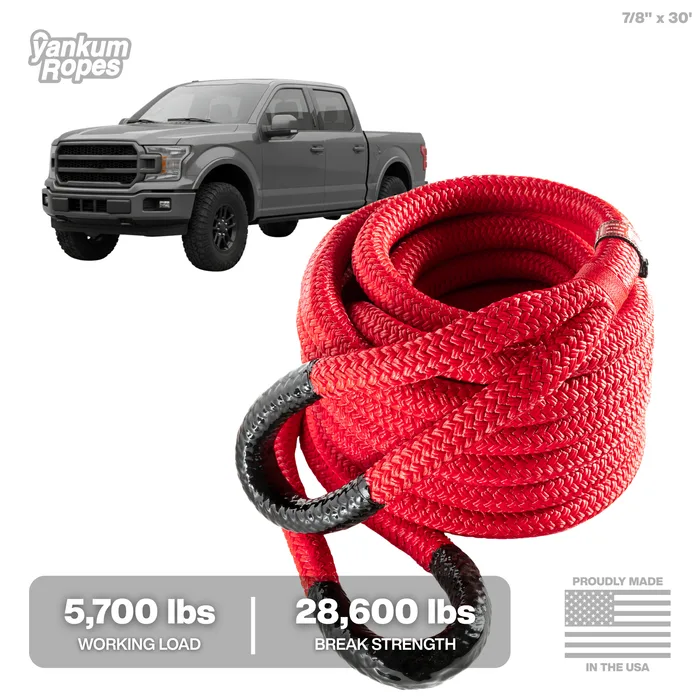
- Buy Yankum Ropes 7/8" Kinetic Recovery Rope "Python" A double braid nylon kinetic rope with a published 28,600 lb minimum breaking strength and, unusually, a published working load limit range. Amazon
- Buy ARB 4x4 Accessories Snatch Strap 17,500lb (ARB705LB) A 30 ft nylon snatch strap with a published 17,600 lb breaking strength, reinforced eyes with protector sleeves and a 3 year warranty. Amazon
- It depends MAXTRAX MKII (pair) Australian-made reinforced nylon traction boards that get one vehicle out of sand, mud or snow with no second vehicle involved. Amazon
- Skip Keeper 20' Emergency Tow Strap (89819) A cheap 2 inch webbing strap with forged metal slip hooks on both ends, marketed for towing and recovery. Amazon
What actually matters
- Stretch percentage - this is the single number that separates a tow strap from a snatch strap. Kinetic gear that stretches around 20 percent or more stores energy so a running start can free a stuck vehicle, while towing gear should stay close to rigid so the pull stays controlled.
- Minimum breaking strength (MBS) - the load at which the item is expected to fail, established by testing. It is a ceiling to stay well below, not a rating you are meant to work at.
- Working load limit (WLL) - the load the maker considers safe in normal use, derived by dividing MBS by a safety factor. Most brands do not publish one, which is why the ones that do stand out.
- Recovery points - a bracket or eye the vehicle or accessory maker rates for recovery loads, usually bolted through the chassis. Everything else on the back of a car, including the tow ball, is designed for a different direction of load.
- End fittings - sewn eyes on a strap or spliced eyes on a rope, with protective sleeves or rubber dipping where they wear. This junction is where cheap gear fails, so it is worth more attention than the headline strength number.
- Shackles - the connectors between the line and the vehicle. Steel bow shackles work when rated and correctly used, and soft shackles do the same job with far less metal mass in the system.
- Dampers - a weighted blanket or purpose-made damper laid over the line. If something lets go, the damper drives the energy into the ground rather than letting the line whip. Use one every time.
The specs, in plain English
Green flags vs red flags
Green flags
- The maker publishes a minimum breaking strength and explains how to derive a working load limit from it.
- Sizing guidance is tied to vehicle weight, and for kinetic gear it names the recovery vehicle rather than the stuck one.
- Ends are sewn or spliced loops with protective sleeves or coated eyes, and the listing shows them clearly.
- The listing states plainly whether the item is for towing or for recovery, and warns against the other use.
- A permanent warning label and instructions for safe use are supplied with the product, which is a legal requirement for recovery straps in some markets.
Red flags
- Forged metal hooks moulded or sewn onto the ends of a strap sold for recovery.
- One large number with no label saying whether it is a breaking strength, a working load limit or a vehicle weight.
- Marketing that uses "tow strap", "recovery strap" and "snatch strap" interchangeably in the same listing.
- Photos or instructions showing the strap attached to a tow ball, a tie-down eye or a bumper.
- Bundled kits that include unrated shackles, or shackles with no stamped rating on the bow.
Who's who: the brands
- ARB 4x4 Accessories - Australian 4x4 outfitter whose snatch straps, recovery points and recovery kits are the default stock in a lot of off-road shops.
- Yankum Ropes - US rope maker known for kinetic recovery ropes and soft shackles, and for publishing working load limits alongside breaking strengths.
- Bubba Rope - One of the earliest names in consumer kinetic recovery rope, with a range built around stretchy nylon kinetic ropes.
- Factor 55 - Idaho maker focused on winch line hardware, closed-system winch shackles and soft shackles intended to keep hooks out of rigging.
- MAXTRAX - Australian company that established the moulded traction board category and still makes its boards in Australia.
How to read a listing without getting fooled
Start at the bottom of the listing, not the top. Find the strength number and check what it is called: a breaking strength tells you where the item fails, a working load limit tells you what you can apply, and a "max vehicle weight" is a third thing entirely. If only a breaking figure is given, divide it by three to five to get a realistic working number, and compare that against the gross mass of the lighter vehicle in the recovery. Next, find the stretch percentage, because that decides whether the item is a towing tool or a recovery tool no matter what the title says. Then look at the ends in the product photos: sewn or spliced loops are what you want, and any metal hook is a reason to keep scrolling. Finally, check what is not there. No published stretch, no end-fitting detail and no warning label are all signs the seller has not thought hard about the product.
How much should you spend?
Budget gear in this category is mostly hook-end webbing straps and unrated shackles, and it is the one place where saving money changes the risk rather than just the durability. Mid-range is where the useful stuff starts: a snatch strap from an established off-road brand with published strength, reinforced eyes and a multi-year warranty sits here, and for most drivers that plus a pair of rated soft shackles and a damper is a complete kit. Premium buys you kinetic rope rather than webbing, published working load limits, heavier coatings and longer service life, and it is also where traction boards live, since a good moulded pair costs about what a premium rope does. Spend the mid-range money on the line and the connectors first. Add boards when you start travelling alone or in sand, and treat a full boxed recovery kit as convenience rather than a discount, because the shackles included in cheap kits are often the weakest part.
Questions, answered
When should I retire a strap or rope?
Inspect before every use and look for cuts, abrasion, stiffness, glazing or heat damage, and any distortion at the eyes. On webbing, check the stitching at the loops, since that is where load concentrates. Nylon also loses some strength when wet, so a soaked strap is not at full capability. There is no fixed expiry, but any line that has been shock loaded hard, abraded on rock or left in the sun for years should be replaced rather than trusted.
Can I use a kinetic rope to tow a broken-down car home?
No, and Yankum states directly on its product page that its ropes are not towing ropes. A kinetic rope is designed to stretch, so under a sustained tow it behaves like a long spring, surging and rebounding, which makes speed and braking hard to control for both drivers. For towing you want a low-stretch strap or a proper tow bar, plus loop ends and rated shackles. Keep the two in separate bags so you never grab the wrong one in a hurry.
Why can't I just wrap a kinetic rope around a tree?
Two reasons. A narrow line cuts into bark and can ring-bark or damage a tree badly, which is why a wide tree saver exists. More importantly, a kinetic rope stretches, so anchoring a winch to one turns your fixed anchor into a spring and stores energy in a system that is supposed to be static. Use a wide, low-stretch tree trunk protector for anchoring, and keep the kinetic rope for vehicle to vehicle recovery only.
Are boxed recovery kits worth buying?
They can be, if you check every item individually. A kit from a reputable off-road brand saves you assembling the pieces and usually includes a strap, shackles, gloves and a bag. The problem with cheap kits is that the headline item is fine and the shackles or the tree saver are unrated filler. Look for a stamped rating on every shackle and a published breaking strength for every strap in the box. If any item has no rating, the kit is worth less than the sum of its parts.
Or jump to the head-to-head: Yankum Ropes 7/8" Kinetic Recovery Rope "Python" vs ARB 4x4 Accessories Snatch Strap 17,500lb (ARB705LB).