Explained
Trailer Hitch Cargo Carriers, Explained
You'll be able to work out, in under two minutes, exactly how many pounds of gear you can safely put on a hitch cargo carrier, and why the big number on the box is almost never that answer.
In this guide
A hitch cargo carrier is a steel or aluminum tray, basket, or box that slides into your vehicle's trailer hitch receiver and hangs off the back, getting bikes, coolers, firewood, and muddy gear out of the cabin. It is one of the cheapest, most useful accessories you can buy, and also one of the easiest to get dangerously wrong. Almost every carrier on the market wears a big rated capacity on the sticker, and that number describes the carrier only. What limits you is your vehicle's tongue weight rating minus the carrier's own weight, and on a lot of crossovers that leaves a fraction of what the sticker implies.
The 30-second version
- The binding number is tongue weight, not the carrier's rating. Take the lower of your vehicle's maximum tongue weight and the carrier's rated capacity, then subtract what the empty carrier itself weighs. Whatever is left is your real cargo limit.
- Hitch class tells you the receiver size and the ballpark ratings, but it is not a promise. Class I and II hitches use a 1.25 inch receiver and are typically limited to roughly 200 to 350 pounds of tongue weight, while Class III and IV use a 2 inch receiver and are usually rated in the 300 to 1,000 pound range. Your vehicle's own manual can rate you lower than the hitch does, and the lower number always wins.
- A carrier's own weight is dead weight you pay for every trip. A heavy steel basket can eat a quarter to a third of a small SUV's tongue weight budget before you load a single item, which is why a lighter carrier with a modest rating often hauls more real cargo than a heavy one with a huge rating.
- Cargo sits behind the hitch pin, so it acts like more weight than it is. The receiver is a cantilever. The farther back the load's center of gravity sits, the more leverage it applies, and hitch makers routinely cut rated capacity roughly in half once an extender or adapter pushes the load further out.
- A rating that looks impossible for the structure usually is. When a thin-walled basket weighs half what a similarly sized rival does and claims the same capacity, treat the claim as marketing rather than engineering, because that mismatch is what encourages the overloading that bends receivers.
The products this guide is about
Our verdict on each, with the full reasoning on the companion review.
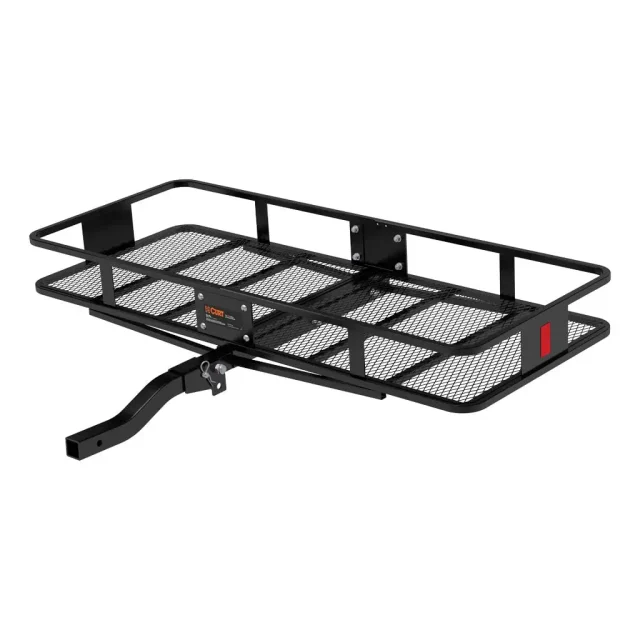
- Buy CURT 18153 Folding Basket Cargo Carrier The default steel basket for anyone with a Class III hitch and payload to spare. Amazon
- Buy Thule Arcos Platform with Arcos Box L The rare hitch carrier whose published load limit already fits inside what a crossover can legally carry. Amazon
- It depends MaxxHaul 70108 Aluminum Cargo Carrier Aluminum buys back tongue weight, and the build quality reads exactly like the price. Amazon
- Skip VEVOR 53 x 19 x 5 in Steel Hitch Cargo Carrier A 28 pound steel carrier wearing a 500 pound sticker, which is precisely the mismatch that gets people hurt. Amazon
What actually matters
- Your vehicle's tongue weight rating. This is the maximum downward force the hitch and vehicle are engineered to carry at the receiver. It appears in your owner's manual and on the label stamped or welded onto the hitch itself. If those two disagree, use the lower one. Every other number in this guide is subordinate to it.
- Carrier tare weight (what the empty carrier weighs). It hangs on the same receiver as your cargo, so it is subtracted from your budget first. A large steel basket is heavy; a comparable aluminum tray weighs noticeably less. Every pound saved is a pound more of gear you get to carry, every single trip.
- Receiver size and hitch class. Most large baskets are sold for 2 inch receivers only. If your vehicle has a 1.25 inch receiver, your product choices narrow sharply and your tongue weight allowance is usually low, so the light, modestly rated carriers become the sensible options rather than a compromise.
- Load distance behind the receiver. Capacity ratings assume the cargo's center of gravity stays close to the hitch. Long carriers, hitch extenders, and adapters push it back and multiply the leverage on the receiver tube. Load heavy items as far forward on the deck as they will go, and avoid extenders unless you have deliberately halved your capacity to allow for one.
- Rear hatch access. A folding shank only helps when the carrier is empty, because you cannot flip up a loaded basket. Tilt and swing-away designs are the ones that let you open the hatch with gear still strapped down, and they cost more for exactly that reason. This one feature decides, more than any other, whether a carrier gets used or resented.
- Weather and theft exposure. An open basket leaves everything you own outdoors, visible, and reachable in a parking lot. A waterproof cargo bag and a cable lock close most of that gap cheaply. A sealed, keyed box closes it properly, at a much higher price and with a fixed shape that awkward loads will not fit.
- Anti-rattle provision and hardware quality. Play between the shank and the receiver produces an endless clunk and, worse, repeated shock loading at the shank-to-frame welds. A wedge, threaded stabilizer, or hitch tightener fixes it. If one is not included, plan on adding one, and expect to re-torque bolt-together frames after the first loaded trip.
The specs, in plain English
Green flags vs red flags
Green flags
- The carrier's own weight looks proportionate to its size and claimed rating when you compare it against similar-sized rivals from established brands.
- The manufacturer publishes a clear tongue weight or maximum load figure and states where the load's center of gravity is assumed to sit.
- A tilt, swing-away, or folding mechanism is included, and the listing is explicit about whether it works loaded or only when empty.
- An anti-rattle wedge or threaded stabilizer is included rather than sold separately.
- The brand has been selling the same model long enough that its weak points and replacement parts are both well documented.
- The listing states the receiver size and any restrictions plainly, instead of vaguely implying it fits everything.
Red flags
- A big headline capacity on a frame that weighs suspiciously little for its size, which almost always means thin tube walls.
- Marketing that leads with the rating and never mentions tongue weight, hitch class, or the vehicle side of the equation at all.
- Owner reports of the carrier sitting visibly crooked in the receiver or needing shims to sit level, which points to loose tolerances at the shank.
- Recurring complaints about supplied fasteners, or advice from owners to replace the hardware before first use.
- No named manufacturer behind the product, or a model sold under rotating brand names, which usually means no warranty support and no spare parts when a weld or bolt lets go.
- A listing that recommends a hitch extender to make the carrier work with your vehicle, without mentioning that doing so roughly halves your allowable capacity.
Who's who: the brands
- CURT - A mainstream towing manufacturer that makes hitches as well as carriers, so its published capacities and warranty support are the sort you can actually cross-check.
- Thule - Premium rack specialist known for tilting platforms and lockable hard-shell boxes whose ratings are conservative enough to fit inside a typical crossover's tongue weight budget.
- MaxxHaul - Value-oriented brand widely stocked online, best known for aluminum trays that save real tongue weight and for build quality that reads exactly like the price.
- VEVOR - High-volume budget seller across many categories; its baskets bundle nets and stabilizers cheaply, but the headline capacities deserve more skepticism than the structure supports.
- Reese and Draw-Tite - Long-established towing names, common as original-equipment hitches, whose carriers and accessories are easy to find parts and documentation for.
- Kuat and Yakima - Enthusiast rack brands whose hitch platforms lean toward bikes and gear rather than bulk hauling, with strong hardware and tilt mechanisms at premium prices.
How to read a listing without getting fooled
Start at the bottom of the listing, not the top. The headline is always the carrier's rated capacity, and it is the least useful number on the page for deciding what you can carry. Find three things instead: the receiver size, the carrier's own shipping or product weight, and the deck dimensions. Then open your owner's manual, find the maximum tongue weight, and check it against the label on the hitch itself. Take the lower of your tongue weight rating and the carrier's rating, subtract the carrier's weight, and that difference is your actual cargo allowance. Do that arithmetic before you compare features, because it frequently eliminates half the products you were considering. While you are in the listing, treat two phrases as warnings rather than features: a capacity quoted without any mention of load position usually assumes the weight sits right at the receiver, and a recommendation to add a hitch extender means the real capacity is roughly half what is printed. Finally, sanity-check the structure against the claim. Compare the carrier's weight to a similar-sized model from a manufacturer that also makes hitches. If one weighs half as much and claims the same load, the difference is tube wall thickness, and steel does not become stronger by being cheaper.
How much should you spend?
Price in this category tracks three things: material and wall thickness, whether the carrier does anything clever about hatch access, and whether your gear ends up sealed and locked or sitting in the rain. Budget open baskets are cheap because the tube is thin and nothing folds, tilts, or closes, and the savings are real if your loads are light and bulky rather than heavy. The mid-range is where most people should land: a basket or tray from a manufacturer that also makes hitches, with a folding shank, hardware worth trusting, and enough documented history that owners know to re-torque the bolts and add an anti-rattle wedge. Spending up from there buys two specific things, and you should only pay for them if you need them. One is a mechanism that tilts or swings a fully loaded carrier out of the way so you can open the hatch at a rest stop. The other is a sealed, keyed box that keeps wet, filthy, or expensive gear outside the cabin and out of a stranger's reach. On tongue-weight-limited vehicles there is a third reason to spend more: lighter materials and a system designed around a modest, honest rating can leave you carrying more usable cargo than a heavier, cheaper unit with a far bigger sticker. Where extra money is not worth it is a headline capacity you will never legally use, which is the most common way buyers overspend and simultaneously overload.
Questions, answered
How much weight can I actually put on a hitch cargo carrier?
Work it out in three steps. First, find your vehicle's maximum tongue weight in the owner's manual and on the label attached to the hitch, and use the lower of the two. Second, compare that against the carrier's own rated capacity and again take the lower number. Third, subtract what the empty carrier weighs, because it hangs on the receiver too. If your vehicle allows 350 pounds at the receiver and your steel basket weighs 60, you have about 290 pounds for cargo. If your vehicle allows 200 pounds, the same basket leaves you around 140. The big number on the sticker is a ceiling for the carrier's structure, never a permission slip for your vehicle.
Why is tongue weight the limit rather than the carrier's rating?
Because the receiver is a cantilever, and load on a carrier sits a foot or more behind the hitch pin instead of directly over it. That distance turns the weight into leverage that pries on the receiver tube and on the bolts holding the hitch to the vehicle frame. Hitch and carrier makers publish their capacities assuming the load's center of gravity stays close to the receiver, and they explicitly derate as that distance grows: adding a hitch extender or an adapter typically cuts allowable capacity roughly in half for exactly this reason. Exceeding tongue weight bends receivers, cracks welds, and in the worst case drops the carrier at highway speed.
What is my hitch class and does it decide my limit?
Hitch class is a shorthand for what a hitch is built to handle. Class I and II use a 1.25 inch receiver and are usually limited to somewhere around 200 to 350 pounds of tongue weight. Class III and IV use a 2 inch receiver and generally range from about 300 to 1,000 pounds. Class V is heavier still, with a 2.5 or 3 inch receiver. Class is useful for knowing what physically fits and roughly what to expect, but it is not your limit. Your limit is the specific rating on your hitch label and in your owner's manual, and where those disagree the lower one governs. A vehicle manufacturer can and often does rate the vehicle below what the hitch alone could handle.
Does a loaded carrier change how the vehicle drives?
Yes, more than most people expect. Weight hung behind the rear axle levers load off the front axle, which lightens the steering and cuts front braking grip, while the rear suspension squats and the tail becomes more willing to step out in crosswinds and emergency maneuvers. Load the heaviest items as far forward on the deck as they will go, keep speeds moderate, leave extra following distance, and re-check your straps at the first stop and periodically after that. Also walk around the vehicle before you set off and confirm the carrier is sitting level in the receiver.
Do I need extra lights or a license plate on the carrier?
Often, yes. Many states require the rear plate and the tail, brake, and turn signals to stay visible, and a loaded carrier blocks all of them on plenty of vehicles. Add-on light kits with a lit plate bracket are widely available and plug into the trailer connector. Check the rules for every state you plan to drive through, not just the one where the vehicle is registered.
Should I buy an open basket or an enclosed box?
A basket wins on price, on bulky or awkward loads, and on being able to strap down anything that would never fit inside a box. An enclosed box wins on weather, security, and aerodynamics, and the better designs tilt or swing so you can still open the hatch with the box loaded. If your gear is dirty, wet, or expensive, the box earns its cost. If you are hauling firewood, bagged bulk goods, or gear on wheels, the basket is the smarter buy. And if your tongue weight rating is modest, check the total system weight either way, because a light box on a light platform can put less on the receiver than a big steel basket does empty.
Or jump to the head-to-head: CURT 18153 Folding Basket Cargo Carrier vs Thule Arcos Platform with Arcos Box L.