

Automotive
The Best Trailer Hitch Cargo Carriers: 4 Compared (and One to Skip)
We compared four hitch cargo carriers and baskets on real usable capacity, tongue weight math, build quality, and hatch access.
The short version
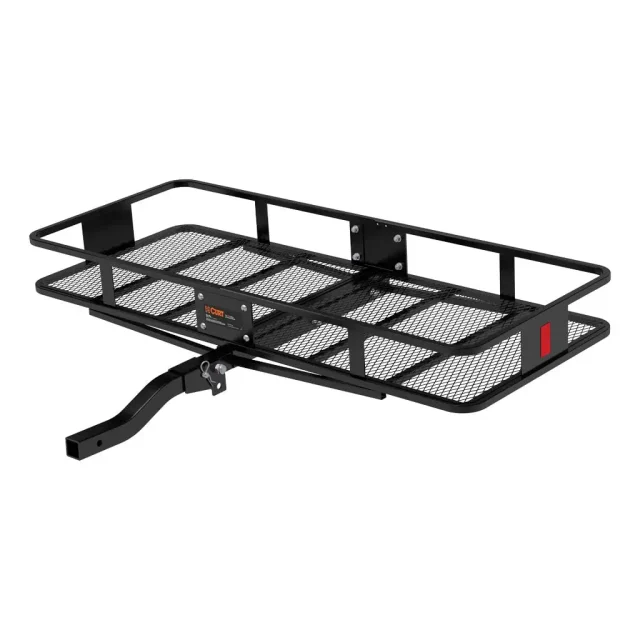
Buy the CURT 18153 if you drive a truck or full-size SUV: 60 by 24 inches of deck, a shank that folds it out of the way, and a rating your hitch can actually use. Buy the Thule Arcos Platform with the Arcos Box L if your vehicle has a small hitch or you need locking, weatherproof space, since the whole system weighs less loaded than a big steel basket does empty. The MaxxHaul 70108 makes sense only when saving tongue weight matters more than fit and finish. Skip the VEVOR budget basket: a 28 pound carrier rated for 500 pounds is a claim, not a specification. Whatever you pick, the binding number is your vehicle's tongue weight rating minus the carrier's own weight, not the number printed on the box. Best for: drivers who want gear out of the cabin and are willing to do two minutes of tongue weight math before loading.
Our picks at a glance
- CURT 18153 Folding Basket Cargo Carrier - Buy. The default steel basket for anyone with a Class III hitch and payload to spare.
- Thule Arcos Platform with Arcos Box L - Buy. The rare hitch carrier whose published load limit already fits inside what a crossover can legally carry.
- MaxxHaul 70108 Aluminum Cargo Carrier - It depends. Aluminum buys back tongue weight, and the build quality reads exactly like the price.
- VEVOR 53 x 19 x 5 in Steel Hitch Cargo Carrier - Skip. A 28 pound steel carrier wearing a 500 pound sticker, which is precisely the mismatch that gets people hurt.
The verdict in 30 seconds
What mattered most
- Carrier type
- Cargo space
- Rated load
- Carrier's own weight
- Receiver fit
- Rear hatch access
A hitch cargo carrier is the cheapest way to get muddy gear, coolers, and luggage out of the cabin. It is also the accessory buyers most often overload, because the number stamped on the basket has almost nothing to do with the number your vehicle can legally carry. The four carriers below span a folding steel basket, a locking box on a tilting platform, a lightweight aluminum tray, and a budget basket whose rating we do not believe. One of them is the right answer for most people, and one of them should stay in the cart.
The default steel basket for anyone with a Class III hitch and payload to spare.
Best for: Truck and full-size SUV owners with a Class III or IV hitch who want the most open deck space per dollar.
- 60 by 24 inch deck swallows coolers, totes, and firewood without touching the roof
- Bent shank folds the empty basket up against the bumper, so it clears most garage doors
- Raised mesh floor and full perimeter rail give straps and nets somewhere to bite
- Limited lifetime frame warranty and parts you can still buy years later
- A heavy steel frame (CURT lists a 70 pound shipping weight) is spent before you load a single item, and all of it counts against tongue weight
- 2 inch receiver only, which rules out the Class I and Class II hitches on many crossovers
- Bolt-together assembly takes a while, and the hardware wants re-torquing after the first trip
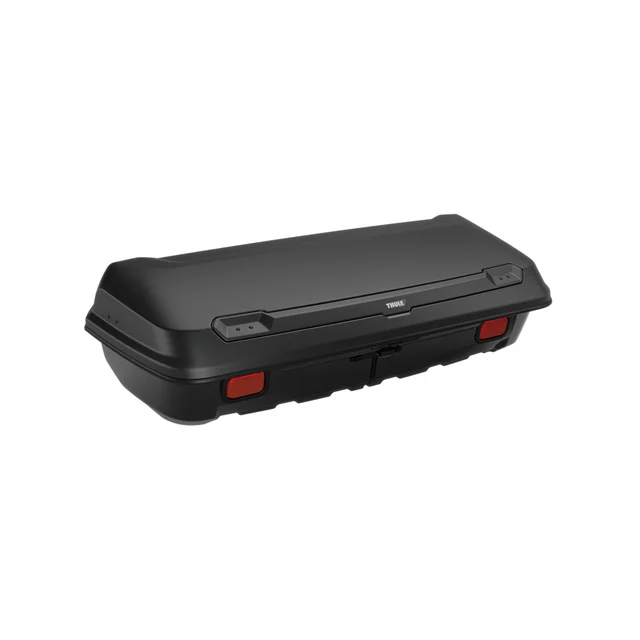
The rare hitch carrier whose published load limit already fits inside what a crossover can legally carry.
Best for: Crossover and small SUV owners with a modest tongue weight rating who want dry, lockable storage they can access at a rest stop.
- Standard platform (23.5 lb) and box (43 lb) together weigh under 70 pounds, leaving real headroom under a 200 pound tongue weight limit
- With Thule's separate Arcos tilt platform, the loaded box tilts down for hatch access, no unloading required
- Locking hard-shell 14 cubic feet keeps wet and filthy gear out of the cabin
- Thule sells the tilt platform in 1.25 inch and 2 inch versions
- Platform and box are sold separately, so the entry cost is the steepest here by a wide margin
- 110 pound box rating looks small next to a basket claiming 500, even though it is the more usable number
- Fixed box shape means long or oddly shaped items still have to ride somewhere else
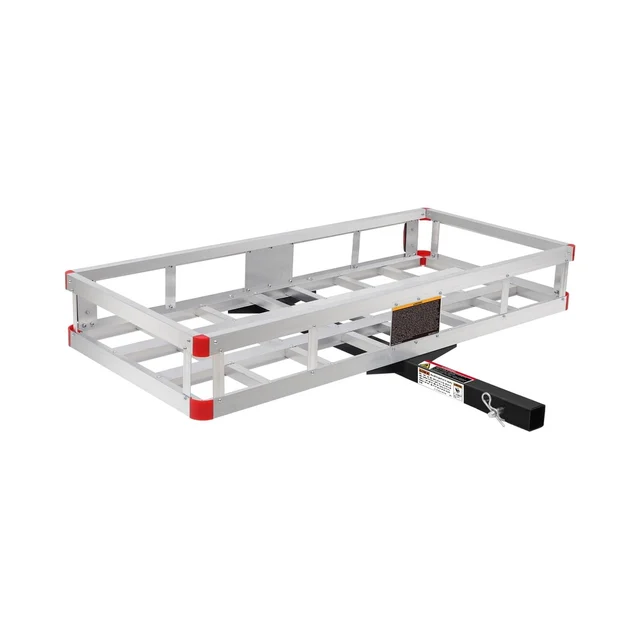
Aluminum buys back tongue weight, and the build quality reads exactly like the price.
Best for: Mid-size SUV owners protecting every pound of tongue weight who can live with a plainer build and a smaller deck.
- Extruded aluminum basket keeps carrier weight down, so more of your tongue weight rating goes to actual cargo
- The aluminum basket resists rust (the under frame and shank are steel), which matters when the carrier lives on the hitch through a salted winter
- 49 by 22.5 inch deck is far easier to live with in tight parking than a 60 inch basket
- Long, fiddly bolt-together assembly, and owners commonly replace the supplied hardware
- No folding shank, so it stays sticking out behind the bumper unless you pull the whole carrier
- The 500 pound figure is theoretical: reviewers report visible flex in the extrusions well before that
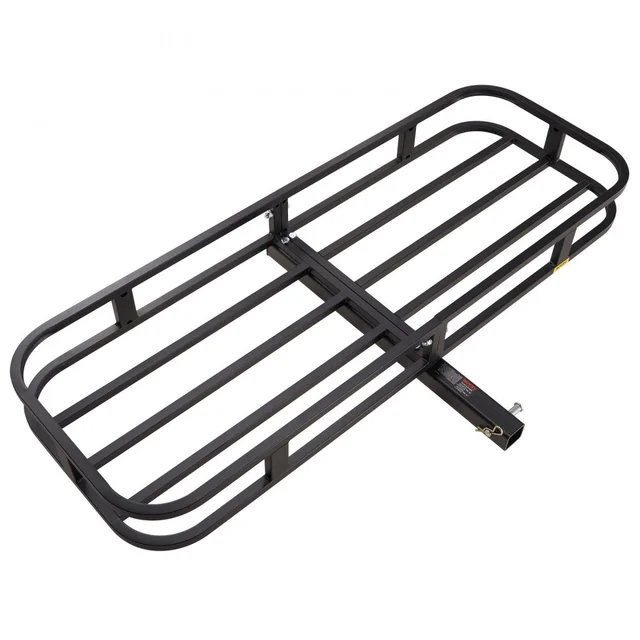
A 28 pound steel carrier wearing a 500 pound sticker, which is precisely the mismatch that gets people hurt.
Best for: Light, bulky, low-value loads on short trips, and only if you treat the rating as marketing rather than engineering.
- Cheapest route to getting bulky gear out of the passenger compartment
- Cargo net, straps, and an anti-rattle stabilizer are included rather than sold separately
- Thin tube sections and a 500 pound claim the structure does not visibly justify
- Owners regularly report the carrier hanging crooked in the receiver and shimming it to sit level
- No folding shank and no weather protection, so it is permanently in the way and permanently exposed
- Support and warranty are thin if a weld or a shank bolt lets go on the highway
| Criteria | CURT 18153 Folding Basket Cargo Carrier Top pick | Thule Arcos Platform with Arcos Box L | MaxxHaul 70108 Aluminum Cargo Carrier | VEVOR 53 x 19 x 5 in Steel Hitch Cargo Carrier |
|---|---|---|---|---|
| Verdict | Buy it | Buy it | It depends | Skip it |
| Best for | Truck and full-size SUV owners with a Class III or IV hitch who want the most open deck space per dollar. | Crossover and small SUV owners with a modest tongue weight rating who want dry, lockable storage they can access at a rest stop. | Mid-size SUV owners protecting every pound of tongue weight who can live with a plainer build and a smaller deck. | Light, bulky, low-value loads on short trips, and only if you treat the rating as marketing rather than engineering. |
| Price tier | $ · mid-range | $$ · flagship | $ · mid-range | $ · budget |
| Carrier type | Open steel basket, folding shank | Locking box on a platform, tilt version sold separately | Open aluminum tray, fixed | Open steel basket, fixed |
| Cargo space | 60 by 24 in open deck | 14 cu ft enclosed box | 49 by 22.5 in open deck | 53 by 19 in open deck |
| Rated load | 500 lb | 110 lb in the box | 500 lb | 500 lb |
| Carrier's own weight | Not published, 70 lb shipping weight | About 67 lb, platform plus box | Lighter than steel, figure not published | 28 lb with accessories |
| Receiver fit | 2 in only | Tilt platform in 1.25 in or 2 in | 2 in only | 2 in only |
| Rear hatch access | Folds up when empty, otherwise unload | Tilts down loaded, with tilt platform | Remove the carrier | Remove the carrier |
| Weather and theft protection | None, add a bag and a cable lock | Hard shell, locking | None, add a bag and a cable lock | Net, straps and stabilizer included, no weather cover |
| Price tier | $ · mid-range | $$ · flagship | $ · mid-range | $ · budget |
Which one is right for you?
- Truck and full-size SUV owners with a Class III or IV hitch who want the most open deck space per dollar. Buy it CURT 18153 Folding Basket Cargo Carrier
- Crossover and small SUV owners with a modest tongue weight rating who want dry, lockable storage they can access at a rest stop. Buy it Thule Arcos Platform with Arcos Box L
- Mid-size SUV owners protecting every pound of tongue weight who can live with a plainer build and a smaller deck. It depends MaxxHaul 70108 Aluminum Cargo Carrier
- Light, bulky, low-value loads on short trips, and only if you treat the rating as marketing rather than engineering. Skip it VEVOR 53 x 19 x 5 in Steel Hitch Cargo Carrier
How we judged the field
We do not run a test track. What we do is read across independent testing, manufacturer engineering documents, and a large volume of owner reports, then weight them by how consistently the same complaint shows up. For hitch cargo carriers, that filtering process kept returning to one criterion above all others: usable capacity, meaning what the carrier can hold once your vehicle’s limits are applied, not what the marketing copy says.
That leads to four things we cared about, in order. First, tongue weight math: a carrier’s own weight is deducted from your budget before any cargo goes on, so a light carrier with a modest rating can carry more real gear than a heavy one with a huge rating. Second, structural honesty: whether the frame section, welds, and shank look proportionate to the number stamped on them. Third, living with it: does the hatch still open, does it fold, does it clear the garage, does it rattle. Fourth, weather and theft exposure, since an open basket means everything you own is sitting outside in the rain behind a stranger’s headlights.
We also checked what owners actually break. Across brands, the recurring failures are the same short list: shank bolts working loose, welds cracking at the shank-to-frame junction, receivers deforming under overloaded carriers, and cheap hardware corroding into place. Every one of those is worse when the carrier is loaded past what the hitch was designed for.
This is the basket most people should default to. The 60 by 24 inch deck is genuinely large, the mesh floor and perimeter rail give straps a real anchor rather than a single flimsy crossbar, and the bent folding shank lets you flip the empty basket vertical against the bumper so it clears garage doors and parking structures. That last detail is why it stays on a lot of vehicles year round instead of living in a garage corner.
The cost is mass. CURT does not publish a product weight, only a 70 pound shipping weight, so assume something close to that in powder-coated steel is spent before you load anything, and it comes straight off your tongue weight budget. On a Class III hitch rated for 350 pounds that still leaves well over 250 pounds of usable cargo, which is more than most people actually strap down. On a small crossover with a 200 pound limit, it leaves well under 150, and at that point a lighter carrier makes more sense. It is also a 2 inch receiver product only.
Assembly is a bolt-together job that takes some time, and the near-universal owner advice is to re-torque everything after the first loaded trip and add an anti-rattle device. Do those two things and the complaints largely stop. Reviewers consistently describe the frame as rigid under real loads, and CURT’s parts and warranty support is a meaningful advantage over anonymous baskets sold under rotating brand names.
The Arcos is the only product here designed around the constraint that actually binds. Thule lists the standard platform at 23.5 pounds and the large box at 43, and the box is rated for 110 pounds of cargo. Add it up and a fully loaded Arcos puts about 177 pounds on the receiver, which sits comfortably under the tongue weight rating of most crossovers and small SUVs. A 500 pound steel basket cannot say that, because filling it to its own rating would exceed those vehicles’ limits several times over.
What you get for the flagship price is the pair of features open baskets cannot deliver. The 14 cubic foot hard shell locks and, in Thule’s words, protects your load from dirt and water, so wet tents, muddy boots, and camp kitchens stay outside the cabin and stay put in a parking lot. Thule also sells a separate Arcos tilt platform that lets the loaded box tilt down, which means you can open the hatch at a rest stop without unstrapping anything; on the standard platform, Thule says the low wedge shape still allows trunk access. Reviewers repeatedly call that out as the feature that changes whether a hitch carrier gets used or resented. The tilt platform comes in a 1.25 inch version, which opens it up to vehicles the big steel baskets exclude.
The trade-offs are real. Platform and box are separate purchases, so the entry cost is by far the highest in this group. The box shape is fixed, so anything long or awkward still has to ride elsewhere, and the tilt platform adds weight over the standard one. Buy it for what it is: the carrier that respects your hitch rating and keeps your gear dry.
The case for the 70108 is weight: its basket is extruded aluminum rather than steel, so more of your tongue weight goes to cargo, every trip, though MaxxHaul does not publish a product weight. The aluminum basket also resists rust, although the under support frame and shank are steel, which matters if the carrier lives on the hitch through road salt season. At 49 by 22.5 inches the deck is smaller than the CURT, but it is also much easier to park with.
The case against it is everything else. Assembly is long and fiddly, and a common owner move is to replace the supplied fasteners with better hardware before first use. It does not fold, so it sits out behind the bumper permanently unless you pull the whole carrier off the vehicle. And the 500 pound rating deserves the same skepticism we apply to any budget basket: reviewers describe visible flex in the extrusions at loads well below that figure. Treat it as a light-to-moderate duty carrier and it is fine. Treat the sticker as a target and you will be disappointed.
So it depends on why you are shopping. If your limiting factor is tongue weight and you want a rust-resistant tray you can leave outside, this is a rational buy. If you want a carrier that feels solid and disappears when not in use, spend elsewhere.
This one fails the test that matters most. A 53 inch steel carrier that VEVOR lists at 28 pounds including its accessories is built from thin tube, and thin tube rated at 500 pounds is a marketing number rather than an engineering one. The CURT basket is a useful reference point: similar material, larger deck, and far more mass for the same headline rating. Steel does not get stronger by being cheaper.
The owner reports back this up in the ways you would predict. The most frequently repeated complaint is the carrier sitting visibly crooked in the receiver, with buyers shimming it to get it level, which is a symptom of loose tolerances at the shank. There is no folding shank, so it is permanently protruding, and there is no weather protection, so everything on it is exposed. The included net, straps, and anti-rattle stabilizer are a genuine value add, and the price is low, but a bundled accessory kit does not compensate for a structure you have to second-guess.
The deeper problem is what the rating encourages. Someone who buys this specifically because it says 500 pounds is exactly the person who will load it with a generator, a full cooler, and firewood on a vehicle rated for 350 pounds at the receiver, and then wonder why the hitch deformed. If budget is the constraint, a smaller load on a better-built carrier is the safer purchase.
CURT 18153 vs Thule Arcos Platform with Arcos Box L: which should you buy?
This comes down to your hitch rating and your cargo. Start with the tongue weight figure in your owner’s manual, because it decides which of these is even eligible.
If you drive a truck, a full-size SUV, or anything with a Class III or IV hitch rated 350 pounds or more at the receiver, the CURT 18153 gives you the most usable space for the money. Sixty by twenty-four inches takes coolers, totes, gas cans, and firewood in shapes no box will accept, it folds up when empty, and after subtracting its own weight you still have a large margin you will probably never use. Add a waterproof cargo bag and a cable lock and you have covered most of what the box does, for a fraction of the outlay.
If you drive a crossover or a small SUV, especially one with a 1.25 inch receiver or a tongue weight rating near 200 pounds, the arithmetic flips. A big steel basket spends a third of your budget on itself before you load anything. The Arcos system on the standard platform, fully loaded, lands under 180 pounds on the receiver, and it delivers the two things a basket never will: your gear arrives dry and locked, and you can open the hatch without unloading. That is worth the flagship price if you road trip with family gear rather than haul bulk materials.
One tiebreaker: if the carrier will be on the vehicle most weekends and you park in a garage, the CURT’s folding shank and the Arcos tilt platform both solve daily annoyances that will otherwise decide whether you keep using the thing.
What to look for
- Your tongue weight rating first, everything else second. Find it in the owner’s manual and on the hitch label, take the lower of that and the carrier’s rating, then subtract the carrier’s own weight. That result is your real cargo limit.
- Carrier tare weight. Every pound the carrier weighs is a pound of cargo you cannot carry. On tongue-weight-limited vehicles, a light carrier with a modest rating beats a heavy one with a big rating.
- Receiver size and class. Most large baskets are 2 inch only. If you have a 1.25 inch receiver, your options narrow sharply and your tongue weight limit is usually low.
- Hatch access. Folding shanks help only when the carrier is empty. Tilting and swing-away designs are the ones that work with a full load, and they cost more for exactly that reason.
- Anti-rattle provision. A hitch tightener, wedge, or threaded stabilizer stops the clunk and reduces cyclic stress on the shank. If one is not included, budget for it.
- Frame section and welds relative to the rating. Compare the carrier’s weight against similar-sized rivals. A large steel basket that weighs suspiciously little is telling you something about its tube wall thickness.
- Lighting and plate visibility. Check whether the loaded carrier blocks your plate and lights, and add a light kit if it does.
- Overhang and parking reality. A 60 inch basket adds roughly two feet to your vehicle. Measure your garage and think about parallel parking before you commit.
Our final take
Buy the CURT 18153 if your hitch can use it. It is the most deck space per dollar in this group, the folding shank keeps it practical, and its long production history means its weak points are documented and fixable with a torque wrench and an anti-rattle wedge.
Buy the Thule Arcos Platform with the Arcos Box L if your vehicle’s tongue weight rating is modest, if you have a 1.25 inch receiver (pair it with the 1.25 inch tilt platform), or if the whole point is keeping gear dry, locked, and accessible without unloading. Its 110 pound box rating looks conservative next to the 500 pound claims elsewhere, and that is exactly why it is the more useful number.
The MaxxHaul 70108 is a reasonable pick for one specific reason, saving tongue weight, and a mediocre one on every other axis. And skip the VEVOR budget basket. The problem is not that it is cheap, it is that its rating invites the exact overloading that damages hitches and drops cargo on the highway. Whichever way you go, do the subtraction before you load: vehicle tongue weight limit, minus carrier weight, equals what you can actually carry.
Questions, answered
How much weight can I actually put on a hitch cargo carrier?
Take the lower of two numbers: the carrier's rated capacity and your vehicle's maximum tongue weight, which appears in the owner's manual and on the label welded to the hitch itself. Then subtract the carrier's own weight, because that hangs on the receiver too. A 350 pound tongue weight rating with a 60 pound steel basket leaves about 290 pounds of cargo, and a 200 pound rating with the same basket leaves roughly 140. The 500 pound sticker on the basket is a ceiling for the basket, never a permission slip for your vehicle.
Why is the tongue weight rating the limit rather than the carrier's rating?
The receiver is a cantilever. Load on a cargo carrier sits one to three feet behind the hitch pin, so it applies far more leverage than the same weight would sitting directly on the ball. Hitch and carrier makers publish capacities assuming the load's center of gravity stays close to the receiver, and several explicitly derate capacity as that distance grows. Exceeding tongue weight bends receivers, cracks welds, and in the worst cases drops the carrier at highway speed.
Does a loaded hitch carrier change how the vehicle drives?
Yes, and more than people expect. Weight hung behind the rear axle levers load off the front axle, which lightens the steering and reduces front braking grip, while the rear suspension squats and the tail becomes more willing to swing in crosswinds and emergency maneuvers. Load the heaviest items as far forward in the carrier as they will go, keep speeds down, leave extra following distance, and re-check the straps at the first stop.
Do I need extra lights or a license plate on the carrier?
Often, yes. Many states require the rear plate and the tail, brake, and turn signals to remain visible, and a loaded carrier blocks all of them on a lot of vehicles. Add-on light kits with a lit plate bracket are widely sold and plug into the trailer connector. Check the rules for the states you plan to drive through rather than the one you registered in.
Should I get an open basket or an enclosed box?
A basket wins on price, on bulky and awkward loads, and on being able to strap down anything that will not fit in a box. An enclosed box wins on weather, security, and aerodynamics, and better designs tilt or swing so you can still open the hatch. If your gear is dirty, wet, or expensive, the box earns its cost. If it is firewood, bikes on wheels, or bagged bulk items, the basket is the smarter buy.
Deciding between the top two? See our head-to-head: CURT 18153 Folding Basket Cargo Carrier vs Thule Arcos Platform with Arcos Box L.
More Automotive reviews
 The Best Trim Restorers: 4 Compared (and One to Skip)
  The Best Wash Mitts: 4 Compared (and One to Skip)
  The Best Water Spot Removers: 4 Compared (and One to Skip)
  The Best Wheel Brushes: 4 Compared (and One to Skip)
  The Best Wheel Cleaners: 4 Compared (and One to Skip)
  The Best Windshield Repair Kits: 4 Compared (and One to Skip)