

Automotive
The Best Water Spot Removers: 4 Compared (and One to Skip)
Four water spot removers that work in two completely different ways, and the one whose bottle carries a hazard word its product page never mentions.
The short version
Adam's Water Spot Remover is the pick, because it is the only one of the four that tells you on the product page what chemistry it uses and which surfaces it is safe on, including coated paint. Meguiar's Water Spot Remover & Multi-Surface Polish is the value choice and the safest for a first attempt, but it works by polishing, so it will thin a ceramic coating rather than leave it alone. Chemical Guys Heavy Duty Water Spot Remover is a capable gel acid whose bottle reads DANGER: CORROSIVE while its product page describes only a specially formulated gel. Skip Torque Detail Water Spot Remover: its own page rules out side mirrors, raw aluminum, bare metal and plastic, warns that it will etch glass past 30 seconds, and states no coating compatibility. Buy on mechanism, not on the word heavy duty. Best for: anyone deciding between dissolving a deposit and polishing it off.
Our picks at a glance
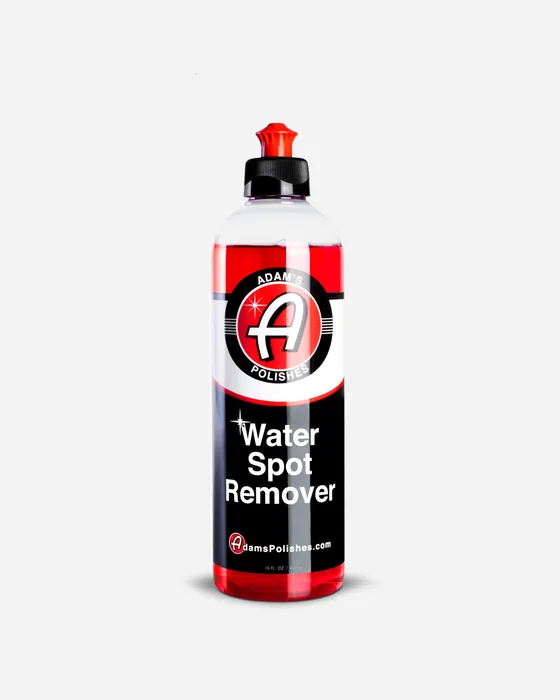
- Adam's Polishes Water Spot Remover - Buy. The only one that states its chemistry and its coating safety on the page where you buy it.
- Meguiar's Water Spot Remover & Multi-Surface Polish - Buy. Not an acid at all, which makes it the low-risk first attempt and the wrong tool for a coated car.
- Chemical Guys Heavy Duty Water Spot Remover - It depends. A gel acid that works, sold by a page that never uses the word its own bottle puts in capitals.
- Torque Detail Water Spot Remover (16oz) - Skip. An acid that its own page keeps off side mirrors, bare metal and plastic, and off glass for more than 30 seconds.
The verdict in 30 seconds
What mattered most
- Removal mechanism
- Mechanism stated on the product page
- Hazard wording on the front label
- Coating compatibility stated
- Consistency
- Applicator
A water spot is a mineral deposit left behind when hard water dries on a surface. There are only two ways to take one off: dissolve the mineral with an acid, or abrade the surface until the deposit is gone. Those are different products with different risks, and the category name covers both without distinguishing them. We compared four, and the mechanism turned out to matter more than the strength.
The only one that states its chemistry and its coating safety on the page where you buy it.
Best for: Coated cars, and anyone who wants the chemistry stated before they buy rather than printed on the bottle that arrives.
- States the mechanism plainly: a mild acid with specialty surfactants that neutralizes and dissolves the mineral.
- Explicitly listed as safe on clear coat, glass, and ceramic or graphene coated surfaces, which none of the other three claim.
- Thickened so it clings where applied, which matters on vertical glass where a thin liquid runs off before it works.
- Described as preparing the surface for protection, so it is aimed at the decontamination step rather than sold as a finishing product.
- Acid based, and Adam's says to wear nitrile gloves when able and warns the acid could etch glass if left past 30 seconds.
- A 30 second maximum dwell per pass, so baked-on spots take repeat applications.
- Black licorice scent is distinctive and not to everyone's taste.
- Being thickened, it needs more rinsing than a thin liquid to clear fully.
Own the Adam's Polishes Water Spot Remover? Tell us how it held up.
Thanks. Counted, and shown once enough owners have weighed in.
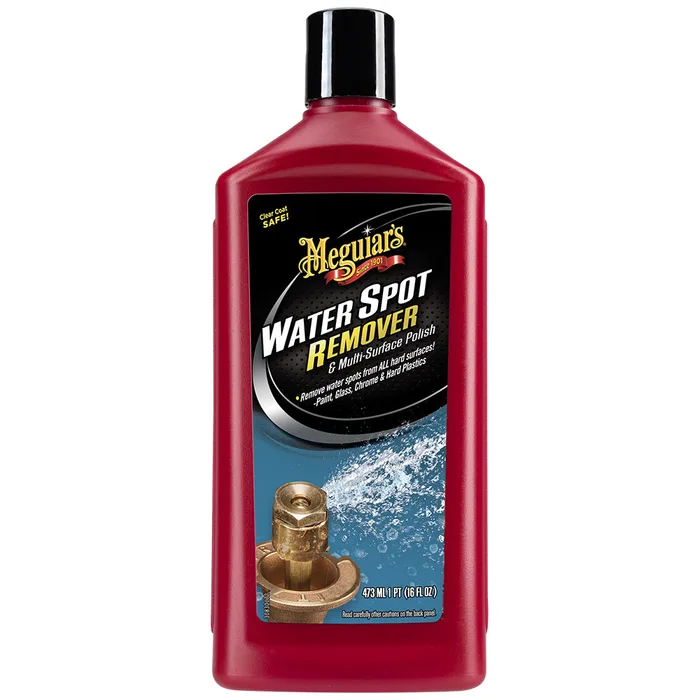
Not an acid at all, which makes it the low-risk first attempt and the wrong tool for a coated car.
Best for: Uncoated clear coat with light to moderate spotting, and anyone who would rather not handle an acid.
- Works by gentle polishing, so there is no acid to neutralize, no rinse window and no corrosive handling.
- Stated for paint, glass, chrome, hard plastic and metals, the widest surface list of the four.
- Front label carries a Clear Coat Safe badge, so the compatibility claim is on the bottle and not only in the copy.
- The forgiving option when you are not sure how bad the spotting is, because you can stop at any point.
- Polishing removes a thin layer of whatever it touches, so it will cut into a ceramic or graphene coating rather than leave it intact.
- Explicitly not for use on flat, matte or satin finishes.
- Slower than an acid on baked-on mineral deposits, because you are working the deposit off by hand.
- Being a polish, it does very little on glass etching that has gone below the surface.
Own the Meguiar's Water Spot Remover & Multi-Surface Polish? Tell us how it held up.
Thanks. Counted, and shown once enough owners have weighed in.
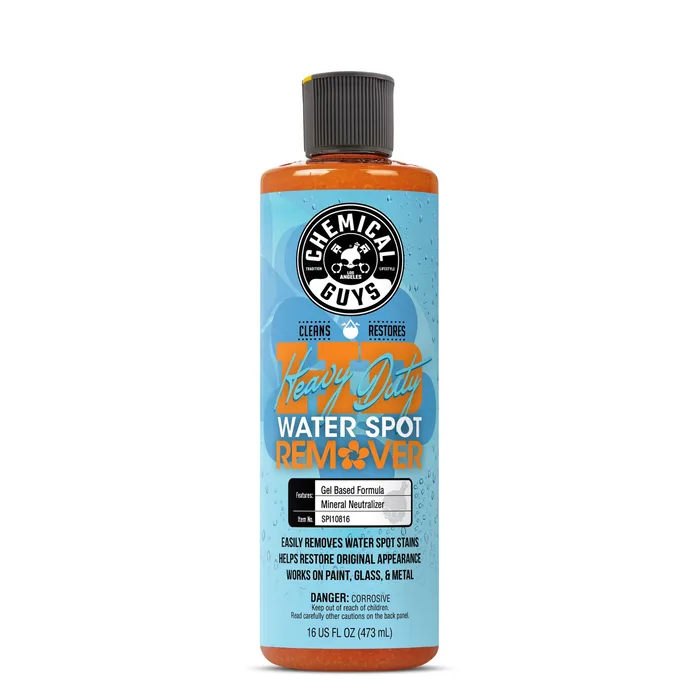
A gel acid that works, sold by a page that never uses the word its own bottle puts in capitals.
Best for: Someone who already knows how to work with an acid and wants gel cling, not someone buying off the page description.
- Gel consistency holds position on vertical glass and body panels better than a thin liquid.
- The bottle names the mechanism in a features box: Gel Based Formula and Mineral Neutralizer.
- Front label states the surfaces plainly: works on paint, glass, and metal.
- Genuinely strong on established deposits that a polish will not shift quickly.
- The front label reads DANGER: CORROSIVE, while the product page describes only a specially formulated gel and never mentions acid or corrosivity.
- No coating compatibility statement anywhere, so a coated car is a guess.
- No published dwell time or neutralizing step, which matters more for a corrosive than for a polish.
- The page frames it as an after-wash tidy-up, which understates what you are handling.
Own the Chemical Guys Heavy Duty Water Spot Remover? Tell us how it held up.
Thanks. Counted, and shown once enough owners have weighed in.
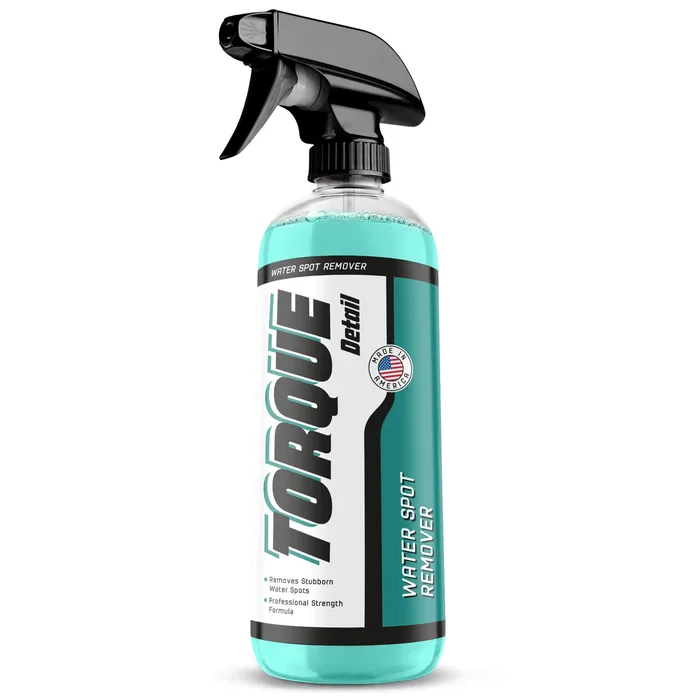
An acid that its own page keeps off side mirrors, bare metal and plastic, and off glass for more than 30 seconds.
Best for: Almost nobody at this price, given that Adam's publishes the same 30 second procedure and also states coating safety.
- States the chemistry directly: a carefully formulated acid based formula that breaks down calcium, mineral and fluoride deposits.
- Publishes an actual procedure, including the dwell ceiling and the neutralizing step, as Adam's also does.
- Names its surfaces: paint, rims, chrome and glass.
- The page rules out side mirrors, raw aluminum and bare metal, and does not recommend it on plastic, a narrower list than the Meguiar's polish.
- Its glass warning says it will etch glass if left on longer than 30 seconds and must not be sprayed directly on glass, although it ships in a trigger sprayer.
- Dwell is capped at 30 seconds maximum, then requires an immediate neutralizing wash, so the working window is narrow and unforgiving.
- Recommends nitrile gloves and warns to use with caution, with no coating compatibility statement to go with it.
Own the Torque Detail Water Spot Remover (16oz)? Tell us how it held up.
Thanks. Counted, and shown once enough owners have weighed in.
| Criteria | Water Spot Remover Top pick Buy it Buy | Water Spot Remover & Multi-Surface Polish Buy it Buy | Heavy Duty Water Spot Remover It depends Buy | Water Spot Remover (16oz) Skip it Buy |
|---|---|---|---|---|
| Best for | Coated cars, and anyone who wants the chemistry stated before they buy rather than printed on the bottle that arrives. | Uncoated clear coat with light to moderate spotting, and anyone who would rather not handle an acid. | Someone who already knows how to work with an acid and wants gel cling, not someone buying off the page description. | Almost nobody at this price, given that Adam's publishes the same 30 second procedure and also states coating safety. |
| Price tier | $$ · mid-range | $ · budget | $$ · mid-range | $$ · mid-range |
| Removal mechanism | Mild acid plus surfactants | Mechanical polishing | Acid gel | Acid |
| Mechanism stated on the product page | Yes, mild acid and acidic actives | Yes, gently polish away | No, described only as a gel | Yes, acid based formula |
| Hazard wording on the front label | Not shown on the front | Clear Coat Safe badge | DANGER: CORROSIVE | Not shown on the front |
| Coating compatibility stated | Yes, ceramic and graphene coated surfaces | No, and polishing thins a coating | Not stated | Not stated |
| Consistency | Thickened, clings where applied | Liquid polish | Gel | Liquid |
| Applicator | Squeeze bottle, apply to a microfiber applicator | Squeeze bottle | Screw-cap bottle | Trigger sprayer, instructions say apply to towel |
| Stated surfaces | Paintwork and glass | Paint, glass, chrome, hard plastic, metals | Paint, glass and metal | Paint, rims, chrome, glass; not side mirrors, bare metal or plastic |
| Published dwell limit | 30 seconds maximum | Not applicable | Not specified | 30 seconds maximum |
| Neutralizing rinse required | Yes, re-clean and wipe after dwell | No | Not specified | Yes, immediately after dwell |
Which one is right for you?
- Coated cars, and anyone who wants the chemistry stated before they buy rather than printed on the bottle that arrives. Buy it Adam's Polishes Water Spot Remover
- Uncoated clear coat with light to moderate spotting, and anyone who would rather not handle an acid. Buy it Meguiar's Water Spot Remover & Multi-Surface Polish
- Someone who already knows how to work with an acid and wants gel cling, not someone buying off the page description. It depends Chemical Guys Heavy Duty Water Spot Remover
- Almost nobody at this price, given that Adam's publishes the same 30 second procedure and also states coating safety. Skip it Torque Detail Water Spot Remover (16oz)
How we judged the field
Five things decide a water spot remover, and the first is the one the category name hides: which mechanism it uses. An acid dissolves the mineral deposit and leaves the surface it sat on. A polish abrades the surface until the deposit goes with it. Second is whether the product tells you which of those it is before you buy, because the two carry different risks and suit different cars. Third is coating compatibility, which follows directly from mechanism: a polish will thin a ceramic or graphene coating by definition, and an acid may or may not, depending on formulation. Fourth is consistency, because water spots are usually worst on vertical glass where a thin liquid runs off before it has done anything. Fifth is the handling procedure, meaning dwell time, whether a neutralizing rinse is required, and what protective equipment the maker expects you to be wearing.
The field splits cleanly in two, and not along price lines. Three of the four products here are acids and one is a polish, which means the cheapest product in the group is also the one working by a completely different principle. Within the acids, the split is about disclosure rather than strength: one states its chemistry and its coating safety on the page, one states its chemistry and publishes a procedure, and one describes itself as a gel and saves the hazard information for the bottle. We picked these four because between them they cover both mechanisms, all three disclosure postures, and the full range of applicator formats from squeeze bottle to trigger sprayer.
Adam’s Polishes Water Spot Remover
Buy itAdam’s Water Spot Remover is the only product in this comparison that answers the two questions that actually decide the purchase in the same place you make it. The page states the mechanism, a mild acid with specialty surfactants that neutralizes and dissolves the minerals and salts in an alkaline water spot. It then states the compatibility, listing clear coat, glass, and ceramic or graphene coated surfaces as safe. Every other product here leaves you to infer at least one of those. The formula is thickened so it stays where you put it, which is the practical difference on a windscreen or a door glass, where a thin liquid is at the bottom of the panel before it has begun working. It is positioned as a decontamination step that prepares the surface for protection, which is the honest framing for something acidic. The costs are real: it is still an acid, with a 30 second maximum dwell, a re-clean step to neutralize it, a nitrile glove recommendation and a warning that it could etch glass if left too long, and the black licorice scent is a genuine acquired taste. For a coated car, it is the one to reach for.
Meguiar’s Water Spot Remover & Multi-Surface Polish
Buy itMeguiar’s Water Spot Remover & Multi-Surface Polish is the odd product in the group and the reason the comparison is worth making at all. It is not an acid. It removes water spots by gently polishing them away, which means it takes a thin layer of the surface with them. That single fact drives everything else. There is nothing to neutralize, no rinse window to hit, no gloves required and no corrosive handling, which makes it the least intimidating first attempt when you are not sure how bad the spotting is. It carries the widest surface list here, covering paint, glass, chrome, hard plastic and metals, and the front label carries a Clear Coat Safe badge so the claim is on the bottle rather than only in the copy. The trade-off is absolute and unavoidable: on a ceramic or graphene coated car it will cut into the coating, and it is explicitly not for flat, matte or satin finishes. On established deposits it is slower than an acid because you are doing the work by hand. Right tool for uncoated paint, wrong tool for a coated one.
Chemical Guys Heavy Duty Water Spot Remover
It dependsChemical Guys Heavy Duty Water Spot Remover is a capable product wrapped in a disclosure problem. The gel consistency is a real advantage, holding position on vertical glass and panels where thinner products run, and the bottle’s own features box names the mechanism cleanly: Gel Based Formula and Mineral Neutralizer. The front label also states the surfaces without fuss, listing paint, glass and metal. The difficulty is what the product page leaves out. It describes a specially formulated gel that tackles tough water stains, suggests using it after washing, and never uses the word acid or the word corrosive. The bottle that arrives reads DANGER: CORROSIVE in capitals, above a line telling you to read the other cautions on the back panel. Nothing here is false, and hazard labelling on the container is exactly where regulation requires it. But a buyer choosing between four products on their web pages has no way to know that this is the one that needs gloves. There is also no coating compatibility statement at all. It earns a depends rather than a skip because the product works and the information exists, just not in time.
Torque Detail Water Spot Remover (16oz)
Skip itTorque Detail Water Spot Remover deserves credit for publishing an actual procedure and then loses the comparison on what the procedure says. It names its chemistry directly as an acid based formula that breaks down calcium, mineral and fluoride deposits, and, like Adam’s, it tells you the dwell ceiling and the neutralizing step. Read the rest of the page, though, and the list of places you should not use it is long. It says not to use it on side mirrors, not on raw aluminum or bare metal, and it does not recommend it on plastic. Its glass warning says it will etch glass if left on longer than 30 seconds and tells you not to spray it directly on glass, which sits oddly with the trigger sprayer it ships in; step three has you spray onto a microfiber towel instead. Dwell is capped at 30 seconds on any surface, and step four requires you to clean the surface with water, soap or waterless wash immediately afterwards to neutralize it. It also recommends nitrile gloves and offers no coating compatibility statement, although step six tells you to apply a coating afterwards. Adam’s publishes the same 30 second ceiling but also states coating safety, and the Meguiar’s polish avoids the acid window entirely.
Sources
Specs in this review come from these pages.
- Adam's Polishes Water Spot Remover product page (adamspolishes.com)
- Chemical Guys Heavy Duty Water Spot Remover product page (chemicalguys.com)
- Meguiar's Water Spot Remover & Multi-Surface Polish product page (meguiarsdirect.com)
- Torque Detail Water Spot Remover product page (torquedetail.com)
- OSHA Hazard Communication Standard, labelling and pictograms (osha.gov)
- USGS Water Science School, hardness of water (usgs.gov)
Adam’s Polishes Water Spot Remover vs Meguiar’s Water Spot Remover & Multi-Surface Polish: which should you buy?
Adam’s and the Meguiar’s are the two to choose between, and the choice is not about which works better. It is about whether your paint is coated. If it is, Adam’s is the answer and the Meguiar’s is disqualified, because polishing a coating thins it and you will be re-applying protection to every panel you touch. Adam’s is the only product in this comparison that states ceramic and graphene coated surfaces as safe, and that single sentence is what you are paying the difference for.
If your paint is not coated, the argument reverses. The Meguiar’s polish is cheaper, needs no gloves, has no dwell window to miss and no neutralizing step to forget, and covers chrome and hard plastics that an acid may not suit. Its ceiling is lower, so a badly baked deposit will take real effort or defeat it entirely, and it is off the table on matte or satin finishes. A reasonable sequence for an uncoated car is to try the Meguiar’s first, since the failure mode is only wasted effort, and to move to Adam’s if the deposit does not shift. On a coated car there is no sequence to try. Start with Adam’s.
What to look for
- Mechanism before strength: decide whether you need an acid to dissolve a deposit or a polish to abrade it, because heavy duty on a label tells you nothing about which one is in the bottle.
- A coating statement, or its absence: if a product does not say it is safe on ceramic or graphene coatings, treat the silence as the answer rather than assuming it is fine.
- Consistency for vertical panels: a gel or a thickened liquid stays on glass long enough to work, while a thin liquid is at the bottom of the window before it has started.
- The published procedure: a stated dwell time and a stated neutralizing step tell you the maker has thought about the failure mode, but read what they actually say before treating it as reassurance.
- The hazard panel, not the product page: the front label carries regulated hazard wording that marketing copy has no obligation to repeat, so look at the bottle photograph before you buy.
- Whether the spot is etched: none of these products restore glass or paint that has already been etched, so confirm you have a surface deposit before spending anything.
Our final take
Water spot removers look like one category and behave like two. Three of these four dissolve the deposit with an acid and one abrades it off with a polish, and that distinction decides coating safety, handling, speed and which surfaces are in scope. Adam’s wins because it is the only product that puts both halves of the decision, the chemistry and the coating compatibility, on the page where you are choosing. Meguiar’s earns its place as the low-risk option for uncoated paint. Chemical Guys works, but its bottle says something in capitals that its listing never mentions. Torque Detail publishes the most detail and the detail is the problem.
Questions, answered
Is a water spot remover the same thing as a polish?
No, and this is the decision that matters most in the category. An acid remover dissolves the mineral deposit chemically and leaves the surface underneath alone. A polish takes the deposit off by abrading a thin layer of the surface. Meguiar's product here is a polish and says so, while the Adam's, Chemical Guys and Torque Detail products are acids. Both approaches remove spots, but only one of them removes surface along with the spot.
Will a water spot remover damage my ceramic coating?
An acid remover may be formulated to leave a coating intact, but only Adam's states that here, listing ceramic and graphene coated surfaces as safe. A polish will always take some coating off, because removing a thin layer is how it works. If your car is coated and you use a polish on it, expect to have to re-apply protection to that panel. If you cannot find a coating statement on the product, treat its absence as a real answer rather than an oversight.
Why does the same product describe itself differently on the bottle and on the website?
Bottles carry regulated hazard communication, so a corrosive product has to say so in a prescribed way. Websites carry marketing copy, which has no equivalent requirement to disclose the hazard class. The Chemical Guys product here is the clearest example: the front label reads DANGER: CORROSIVE, while the product page describes a specially formulated gel and never uses the word acid. Neither statement is false. Only one of them is complete, and it is the one you see after the purchase.
Can I use these on glass?
All four name glass among their surfaces, but the caveats differ sharply. Torque Detail's own page warns that its product will etch glass if left on longer than 30 seconds, says not to spray it directly on glass and rules out side mirrors, and Adam's warns its acid could etch glass past a 30 second dwell, which is worth weighing given that glass is where water spotting is usually most visible. Acids work well on glass deposits that have not yet etched. Once a spot has etched into the glass, no chemical will restore it and you are into polishing with a cerium oxide compound or replacing the panel.
How do I know if the spot is etched or just sitting on the surface?
Wash the panel and dry it, then run a fingernail lightly across the spot. A deposit sitting on top will usually catch slightly and can often be felt as raised. An etched spot is a depression in the surface and will feel smooth or slightly dished. You can also wet the area: a surface deposit tends to disappear visually while wet and reappear as it dries, while etching stays visible either way. Surface deposits are what these products are for.
Deciding between the top two? See our head-to-head: Adam's Polishes Water Spot Remover vs Meguiar's Water Spot Remover & Multi-Surface Polish.
More in Automotive
Water Spot Removers, Explained Plain-English guide → Adam's Polishes Water Spot Remover vs Meguiar's Water Spot Remover & Multi-Surface Polish Head-to-head →  The Best Wheel Brushes: 4 Compared (and One to Skip)
  The Best Wheel Cleaners: 4 Compared (and One to Skip)
  The Best Windshield Repair Kits: 4 Compared (and One to Skip)
  The Best Windshield Sun Shades: 4 Compared (and One to Skip)