

Automotive
The Best Windshield Repair Kits: 4 Compared (and One to Skip)
We compared four DIY windshield chip repair kits on the thing that actually decides the outcome: whether the tool can pull air out of the break and push resin in, and whether the maker is honest about what the finished repair will look like.
The short version
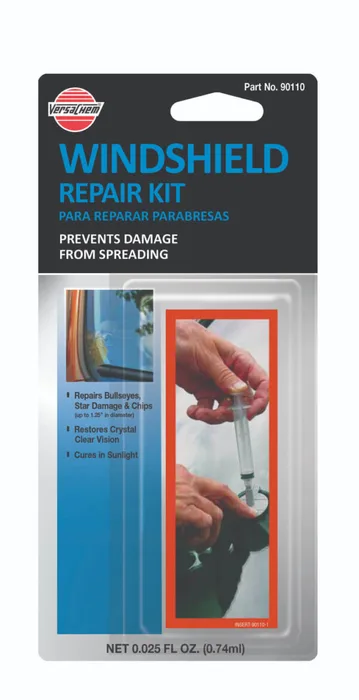
The Versachem Windshield Repair Kit is the pick for most people because its injector locks into a real two-stage cycle, at least ten minutes of vacuum to pull air out of the break and at least twenty minutes of pressure to drive resin in, which is exactly what the repair standard describes. The Permatex Windshield Repair Kit is the value choice for a single clean bullseye, and Permatex is refreshingly blunt that the repair may not completely remove the blemish. The Delta Kits EZ-200S is a professional bridge system with a low viscosity 20 cps bond resin, a thick 3000 cps pit resin, and an LED UV lamp, and it only makes sense if you plan to do many repairs rather than one. Skip the Rain-X Windshield Repair Kit unless your damage is a small fresh chip, because its headline claim of cracks up to 12 inches is the promise that pushes people into jobs a suction-cup applicator and one general purpose resin handle poorly. Before you buy anything, measure the damage and find out whether it sits in the driver's primary viewing area, because that is where the standard stops allowing repair. And know up front that no kit makes the blemish disappear. Best for: a driver with a fresh chip smaller than a quarter, outside the strip of glass directly in front of the wheel, who wants it sealed before it runs.
Our picks at a glance
- Versachem Windshield Repair Kit (90110) - Buy. The shelf kit with a real vacuum-then-pressure injector cycle, published timings and all.
- Permatex Windshield Repair Kit (09103) - Buy. The straightforward bullseye kit, and the one whose maker tells you the blemish may not fully disappear.
- Delta Kits EZ-200S Mini Mobile Windshield Repair System - It depends. A professional bridge system with two resins and a UV lamp, which is either exactly right or wildly over the top depending on how many chips you expect to fix.
- Rain-X Windshield Repair Kit (600001) - Skip. The default supermarket grab, sold on a crack-repair promise that its tooling and single resin are not set up to keep.
The verdict in 30 seconds
What mattered most
- Damage types the maker lists
- Maximum damage size stated
- Applicator
- Published vacuum and pressure cycle
- Cure method
- Resin supplied
A windshield chip repair kit is a small syringe or injector, a suction pedestal, and a gram or two of clear resin. Used on the right damage it seals the break, stops it spreading, and keeps you from replacing a whole windshield. Used on the wrong damage it wastes an afternoon and can leave you driving a car whose glass should have been replaced. So this comparison is as much about knowing when to put the kit down as about which kit to buy, because a windshield is a structural safety component and the industry standard is specific about what must not be repaired.
The shelf kit with a real vacuum-then-pressure injector cycle, published timings and all.
Best for: A first-timer with one fresh chip who is willing to follow the clock instead of eyeballing it.
- The injector locks in two positions, holding vacuum for at least ten minutes and then pressure for at least twenty, which is the air removal and resin displacement the repair standard calls for.
- The maker lists bullseyes, star damage and chips up to 1.25 inches in diameter rather than bullseyes alone.
- Instructions give a specific glass temperature window of 55 to 75 degrees F and a cure of at least 15 minutes in direct sun, or at least an hour on a cloudy day.
- One adhesive seal and one pedestal means it is realistically a single repair per kit.
- The full sequence takes the better part of an hour of standing around, and you cannot rush the vacuum stage.
- It ships one general purpose resin, so a tight crack and a wide bullseye get the same viscosity.
- Like every DIY kit it needs sunlight, which makes it awkward in winter or a covered garage.
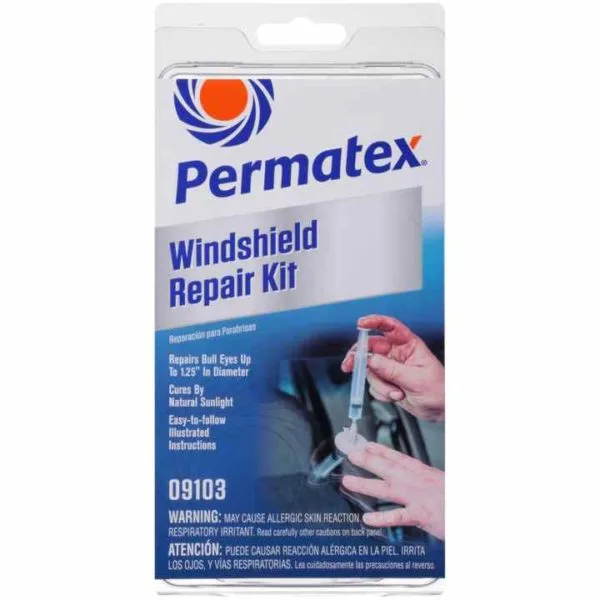
The straightforward bullseye kit, and the one whose maker tells you the blemish may not fully disappear.
Best for: Someone with a single clean bullseye who wants the shortest honest path to a sealed chip.
- Contents are spelled out on the product page: syringe and plunger, 0.75 ml of repair compound, adhesive disc, pedestal, curing strip, push pin, razor blade and an alcohol towelette.
- Permatex states plainly that the repair may not completely remove the blemish or permanently fill the pit, which is the expectation most buyers get wrong.
- Clear working conditions are published: a shaded area with the windshield between 50 and 75 degrees F, then 15 minutes of bright sun or at least an hour of UV on a cloudy day.
- The product page describes bullseye damage up to 1.25 inches, so a sprawling star break is outside what the maker claims.
- A syringe plunger without a published timed vacuum stage gives you less control over trapped air than a locking injector.
- One adhesive disc, one pedestal and one curing strip means one repair.
- The 0.75 ml of compound leaves no room for a second attempt if you contaminate the break.
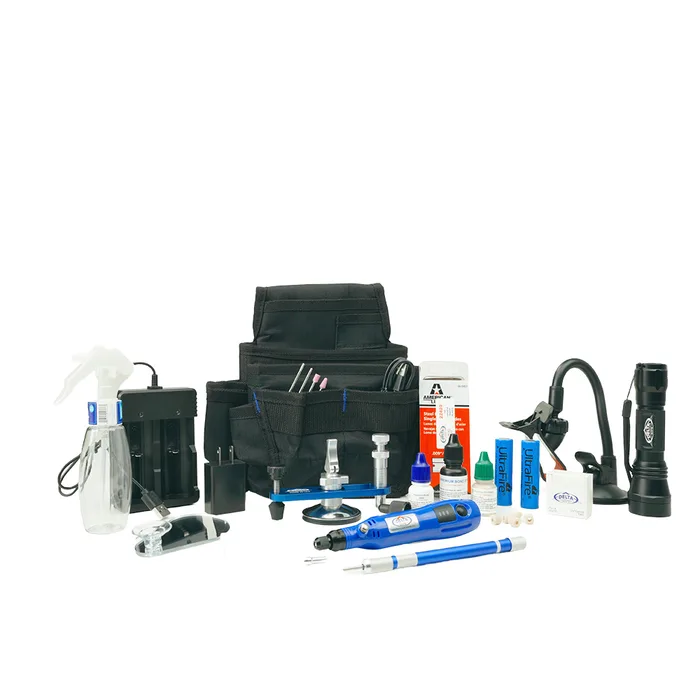
A professional bridge system with two resins and a UV lamp, which is either exactly right or wildly over the top depending on how many chips you expect to fix.
Best for: Someone who fixes glass repeatedly, runs a fleet or a side business, or lives on a gravel road and expects a chip every season.
- It ships two resins matched to different jobs: Premium Bond 20 at 20 cps, which Delta Kits describes as an outstanding long crack resin, and Premium Bond 3000 pit resin at 3000 cps for filling the pit.
- An Ignite LED UV lamp with charger removes the dependence on sunshine, so you can work in a garage or in winter.
- The B150 bridge with a screw-type aluminum injector, a mini rotary tool, a scribe and carbide burs give you the access and control a professional technician uses, and the maker says there are supplies for at least 50 repairs.
- It sits in a completely different price tier from shelf kits, which is impossible to justify for one chip.
- Drilling and probing a break is a skill, and the standard expects a technician to be trained with both coursework and a practical exam.
- There is far more to learn, store and maintain than a one-shot kit.
- Owning better tools does not change the rules about where a repair is allowed.
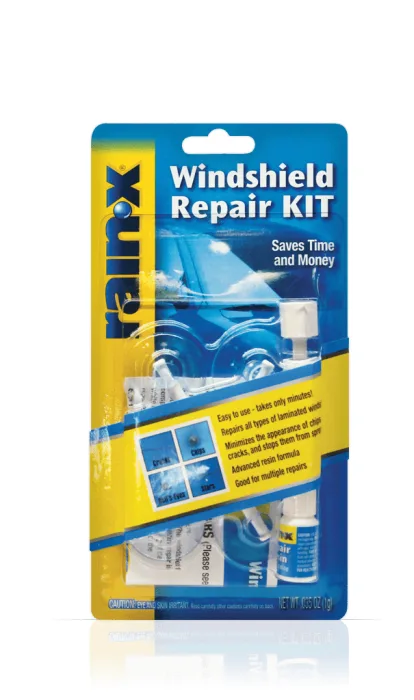
The default supermarket grab, sold on a crack-repair promise that its tooling and single resin are not set up to keep.
Best for: A driver who only wants a small fresh chip sealed today and is buying whatever is on the shelf at the gas station.
- It is the easiest kit to actually find, and the contents are simple: a 1 gram resin bottle, a repair device with a suction cup, curing strips and a sleeved razor blade.
- Rain-X is upfront that it will not repair damage through more than one layer of glass and that the kit minimizes the appearance of damage rather than erasing it.
- For a small fresh chip caught before dirt and water get in, it does the basic job of sealing the break.
- The headline claim covers cracks up to 12 inches long, but crack repair is a separate procedure in the standard and professional systems use a dedicated low viscosity crack resin rather than one general purpose bottle.
- The applicator is a suction-cup device rather than a pedestal with a locking injector, so you get less positive control over the vacuum and pressure stages.
- No glass temperature window is published on the product page, and temperature strongly affects whether resin flows into the legs of a break.
- The crack claim tempts people into damage the standard says not to repair at all, such as stress cracks and edge cracks that intersect more than one edge.
| Criteria | Windshield Repair Kit (90110) Top pick | Windshield Repair Kit (09103) | EZ-200S Mini Mobile Windshield Repair System | Windshield Repair Kit (600001) |
|---|---|---|---|---|
| Verdict | Buy it | Buy it | It depends | Skip it |
| Best for | A first-timer with one fresh chip who is willing to follow the clock instead of eyeballing it. | Someone with a single clean bullseye who wants the shortest honest path to a sealed chip. | Someone who fixes glass repeatedly, runs a fleet or a side business, or lives on a gravel road and expects a chip every season. | A driver who only wants a small fresh chip sealed today and is buying whatever is on the shelf at the gas station. |
| Price tier | $ · budget | $ · budget | $$$ · premium | $ · budget |
| Damage types the maker lists | Bullseyes, star damage and chips | Bullseye damage | Rock chips and small cracks | Chips, bullseyes, star breaks and cracks |
| Maximum damage size stated | Up to 1.25 in diameter | Up to 1.25 in diameter | No single figure published | Round damage up to 1 in, cracks up to 12 in |
| Applicator | Pedestal with spring-lock syringe injector | Pedestal, adhesive disc and syringe plunger | B150 bridge with aluminum screw-type injector | Repair device with suction cup |
| Published vacuum and pressure cycle | Vacuum at least 10 min, then locked pressure at least 20 min | Not published on the product page | Technician-controlled with a screw injector | Not published on the product page |
| Cure method | Sunlight, at least 15 min direct or 1 hour cloudy | Sunlight, 15 min bright or at least 1 hour cloudy | Ignite LED UV lamp included | Sunlight, curing strips supplied |
| Resin supplied | One resin tube | 0.75 ml repair compound | Premium Bond 20 at 20 cps plus Premium Bond 3000 pit resin at 3000 cps | 1 gram resin bottle |
| Glass temperature window | 55 to 75 degrees F | 50 to 75 degrees F | Not published on the product page | Not published on the product page |
| Repairs per kit | One adhesive seal and pedestal supplied | One adhesive disc, pedestal and curing strip | Maker states supplies for at least 50 repairs | Maker says the kit can be used for multiple repairs |
Which one is right for you?
- A first-timer with one fresh chip who is willing to follow the clock instead of eyeballing it. Buy it Versachem Windshield Repair Kit (90110)
- Someone with a single clean bullseye who wants the shortest honest path to a sealed chip. Buy it Permatex Windshield Repair Kit (09103)
- Someone who fixes glass repeatedly, runs a fleet or a side business, or lives on a gravel road and expects a chip every season. It depends Delta Kits EZ-200S Mini Mobile Windshield Repair System
- A driver who only wants a small fresh chip sealed today and is buying whatever is on the shelf at the gas station. Skip it Rain-X Windshield Repair Kit (600001)
How we judged the field
Five things decide whether a windshield repair works. First, whether the damage is repairable at all, which is a question the ANSI standard answers with numbers rather than opinions. Second, whether the tool can remove air from the break, by vacuum or by displacement, and then push resin into the legs of the break under pressure, because a break full of trapped air is a break that will keep growing. Third, whether the resin is right for the job, since a hairline crack needs a thin resin that wicks and a pit needs a thick one that stays put and polishes flush. Fourth, the cure, which on consumer kits means sunlight and on professional systems means a UV lamp you control. Fifth, and least glamorous, whether the maker publishes working conditions, because glass temperature and shade change the outcome more than brand loyalty does.
The field splits cleanly in two. On one side are shelf kits built around a single-use pedestal, one small bottle of resin and a sunlight cure, aimed at one chip on one car. On the other are professional bridge systems with a screw injector, separate bond and pit resins, a drill and a UV lamp, priced for someone who will do this fifty times. We took two of the better shelf kits, one entry-level professional system to show what the extra money actually buys, and the shelf kit most people reach for by default, because the reasons not to reach for it are worth spelling out.
Versachem Windshield Repair Kit (90110)
Buy itVersachem’s kit is the shelf option that actually walks you through the physics instead of hand-waving it. Its injector locks in two positions: pull the plunger up until the lower notch clears the barrel and hold vacuum for at least ten minutes to draw air out of the break, then push it down to the upper notch and lock it under pressure for at least twenty minutes to drive resin in. That two-stage cycle is exactly the air removal and resin filling the repair standard describes, and it is the step cheap applicators skip. The maker lists bullseyes, star damage and chips up to 1.25 inches, says the windshield should be between 55 and 75 degrees before you start, and then to park in unshaded sun for at least fifteen minutes to cure, or an hour if it is overcast. You get a resin tube, adhesive seal, pedestal, injector with spring clips, a safety razor and cure strips, which is one repair. Best for a first-timer with one fresh chip who will follow a timer rather than a hunch.
Permatex Windshield Repair Kit (09103)
Buy itPermatex sells the least mysterious kit in the category. The box lists everything: syringe and plunger, 0.75 ml of repair compound, one adhesive disc, one pedestal, one curing strip, a push pin, a razor blade and an alcohol towelette. The compound needs no mixing, cures in natural sunlight in about fifteen minutes of bright sun or at least an hour of UV on a cloudy day, and the instructions ask you to work in shade with the windshield between 50 and 75 degrees F. It is described for bullseye damage up to 1.25 inches, which is narrower than Versachem’s claim but also more honest about what a simple syringe and pedestal are good at. The line that earns it a recommendation is on Permatex’s own page: the repair may not completely remove the blemish or permanently fill the pit. That is the correct expectation, printed by the manufacturer, and it is the sentence most buyers wish they had read first. Best for someone with one clean bullseye who wants the shortest honest route to a sealed chip.
Delta Kits EZ-200S Mini Mobile Windshield Repair System
It dependsThe Delta Kits EZ-200S is what the professional version of this looks like, and seeing it makes the shelf kits legible. It pairs a B150 bridge and an aluminum screw-type injector with two different resins: Premium Bond 20, a 20 cps bond resin the maker calls an outstanding long crack resin, and Premium Bond 3000, a 3000 cps pit resin for filling and polishing the surface flush. That difference in viscosity, a hundred and fifty times thicker for one job than the other, is the thing no single-bottle kit can replicate. It also includes an Ignite LED UV lamp with a charger, so you are not waiting on the weather, plus a mini rotary tool, a steel scribe, carbide burs, injector end seals, curing tabs, an inspection mirror and a training packet, with supplies the maker says cover at least 50 repairs. The catch is obvious: it costs a different order of magnitude, and drilling into a break is a learned skill the standard expects to be taught with coursework and a practical exam. Best for anyone who will fix glass repeatedly rather than once.
Rain-X Windshield Repair Kit (600001)
Skip itThe Rain-X kit is the one most people buy, which is precisely why it needs a hard look. Contents are a 1 gram resin bottle, a repair device with a suction cup, curing strips and a sleeved razor blade, and it works fine on the job it should be doing: a small, fresh, uncontaminated chip sealed before dirt and water get into the break. The problem is the second half of the pitch. The product page says it works best on round damage up to one inch and cracks up to 12 inches, and crack repair is not a scaled-up version of chip repair. The standard treats it as its own procedure requiring the appropriate resin, and professional systems ship a thin dedicated crack resin for exactly this reason. One gram of general purpose resin behind a suction cup is not that, and no glass temperature window is published on the page even though temperature governs how resin flows. Buy it for a chip if it is what is in front of you. Do not buy it because of the crack claim.
Sources
Specs in this review come from these pages.
- ANSI/AGSC/NWRD/ROLAGS 002-2022, Repair of Laminated Automotive Glass Standard (rolags.com)
- Auto Glass Safety Council: Windshields Save Lives (agsc.org)
- Mazda Workshop Manual: Forward Sensing Camera (FSC) Aiming Procedure (mazdamanuals.com.au)
- California Vehicle Code Section 26710 (windshield condition and driver vision) (leginfo.legislature.ca.gov)
- Versachem Windshield Repair Kit (90110) product page and directions (versachem.com)
- Delta Kits Premium Bond 20 Resin specification (deltakits.com)
Versachem Windshield Repair Kit (90110) vs Permatex Windshield Repair Kit (09103): which should you buy?
Versachem and Permatex look almost interchangeable on a shelf, and the difference between them is entirely in the injector. Versachem’s spring-lock plunger holds a measured vacuum for at least ten minutes and then a measured pressure for at least twenty, which gives the resin a genuine chance to reach the ends of the legs on a star break. Permatex’s syringe and plunger does the same job with less published structure and is described for bullseye damage rather than stars. If the damage is a plain circular bullseye with no legs running off it, that structure buys you less, and Permatex’s simpler kit and clearer disclaimer make it the easier win.
So choose on the shape of the damage, not the brand. Circle with a dark cone and no legs, under an inch, well outside the strip of glass in front of the wheel: Permatex, and you will be done in under an hour. Anything with legs radiating out of the impact point, or a break closer to the one-and-a-quarter inch limit: Versachem, and give the vacuum stage its full ten minutes even though nothing appears to be happening. In both cases move the car into shade first and get the glass into the published temperature range, because a hot windshield in direct sun will start curing resin before it has finished travelling.
What to look for
- Measure before you buy: the standard puts a bullseye at one inch, a combination break at two inches of body, a star break at three inches and a single crack at 14 inches, so a tape measure decides this, not a brand.
- Find the driver’s band first: the Driver’s Primary Viewing Area is 12 inches wide, centred on the driver, running the full height of the wiper sweep, and inside it repair stops being allowed once damage exceeds one inch or the finished pit would exceed 3/16 inch.
- Look for a locking injector, not just a suction cup: the whole point of the tool is holding a vacuum long enough to pull air out of the break and then holding pressure long enough to replace it with resin.
- Check whether the maker publishes a temperature window: kits that tell you to work in shade with the glass between roughly 50 and 75 degrees F are telling you something real about how the resin behaves.
- One resin means one kind of job: professional systems carry a thin bond resin near 20 cps for cracks and a thick pit resin near 3000 cps for the surface, so a single general purpose bottle is a compromise, not a feature.
- Treat value-added features as a stop sign: rain sensors, heads-up displays and forward-facing cameras live in specific patches of glass, and the standard says not to repair where those could be affected without checking the vehicle maker’s guidance first.
Our final take
Buy the Versachem kit if you want the shelf option that behaves most like the professional process, and the Permatex kit if your damage is a simple bullseye and you would rather spend twenty minutes than an hour. Buy the Delta Kits EZ-200S only if chips are a recurring fact of your life. Approach the Rain-X kit as a chip kit and ignore the crack marketing. Whichever you pick, do the measuring and the location check before you open the packaging, because the windshield holds the roof up in a rollover, keeps occupants inside the car, and gives the passenger airbag something to push against. A blemish you can still see is a success. A repair in the wrong place is not.
Questions, answered
How big can a chip be before a kit is the wrong answer?
The industry standard, ANSI/AGSC/NWRD/ROLAGS 002-2022, sets repairable dimensions by damage type. A bullseye or half moon is repairable at a diameter no larger than one inch, or 25 mm. A star break is repairable up to three inches, or 75 mm, and a combination break up to two inches of body diameter excluding the legs. A single crack is repairable up to 14 inches, or 350 mm. Consumer kits generally claim less than that, typically round damage in the one to one-and-a-quarter inch range, so measure the damage before you buy rather than after.
Will the chip actually disappear?
No, and any kit that implies otherwise is selling you a disappointment. The standard has a term for what is left behind: a cosmetic blemish, meaning a remnant of the damage that is still visible after the repair is completed. What a good repair achieves is improved optical clarity in the damaged area, a smooth surface that does not catch the wipers, and enough added strength to stop the damage spreading. Permatex says on its own product page that the repair may not completely remove the blemish or permanently fill the pit. Judge the result by whether the break stopped growing, not by whether you can still find it.
The chip is right in front of my face. Can I repair it?
Usually not, and this is the single most important thing to check. The standard defines the Driver's Primary Viewing Area as a band on the outside of the windshield 12 inches wide, or 300 mm, centred on the driver's position and running from the top to the bottom of the wiper sweep. Inside that band, replacement is recommended instead of repair if the damage diameter is larger than one inch, if the finished pit will be larger than 3/16 inch or 5 mm, or if the repair would sit within four inches of another repair, because two repairs close together can defeat binocular vision and create a genuine blind spot. Many states also have laws about obstructed vision, and California Vehicle Code 26710 makes it unlawful to drive with a windshield in such a defective condition that it impairs the driver's vision. Measure the band before you open the box.
Will fixing a chip mess up my lane-keeping camera?
Repair and replacement are two different situations here. Replacing a windshield on a car with a forward-facing camera generally requires the camera to be recalibrated afterwards. Mazda's workshop manual, for example, lists windshield replacement as one of the events that triggers the forward sensing camera aiming procedure, which involves a target set at a specified distance and diagnostic equipment. A chip repair does not remove the glass or disturb the camera bracket, so it does not itself trigger that procedure. But the standard does say not to repair damage in an area of the windshield where value-added features such as rain sensors, heads-up displays or cameras could be negatively affected by the damage or by the repair process, and it tells technicians to consult the vehicle maker's recommendations first. If the chip is near the camera housing behind the mirror, that is a conversation with a shop, not a kit.
Can a DIY kit fix a long crack?
Sometimes, and less often than the packaging suggests. The standard allows repair of a single crack up to 14 inches, but it also lists cracks that should send you to replacement instead: stress cracks with no impact point, edge cracks that intersect more than one edge, and damage with three or more long cracks coming from a single impact point. Crack repair is also a separate procedure that calls for the appropriate resin, and professional systems ship a thin, low viscosity resin for cracks alongside a thick one for filling the pit. A shelf kit with a single gram of general purpose resin and a suction-cup applicator is not that. If the crack is long, reaches an edge, or appeared without anything hitting the glass, get it looked at.
Deciding between the top two? See our head-to-head: Versachem Windshield Repair Kit (90110) vs Permatex Windshield Repair Kit (09103).
More Automotive reviews
 The Best Windshield Sun Shades: 4 Compared (and One to Skip)
  The Best Winter Tires: 4 Compared (and One to Skip)
  The Best Wireless CarPlay Adapters: 4 Compared (and One to Skip)
  The Best Car Wax: 4 Compared (and One to Skip)
  The Best Dual Action Polishers: 4 Compared (and One to Skip)
  The Best Microfiber Towels for Car Detailing: 4 Compared (and One to Skip)