Explained
Water Spot Removers, Explained
After reading, you'll know whether you need an acid or a polish, whether your spots are etched, and why a coating changes the answer.
In this guide
Most people buy a water spot remover after noticing that a wash has not shifted the marks. What trips them up is that the category contains two unrelated types of product sold under one name, and the packaging rarely leads with which one it is. Buy the wrong type for a coated car and you will strip protection you paid for. Buy any type for an etched spot and nothing will happen at all.
The 30-second version
- The name covers two products, one that dissolves the mineral with acid and one that polishes the surface until the deposit goes with it.
- A coating changes the answer, because polishing thins a ceramic or graphene layer while a suitably formulated acid can leave it intact.
- Etched spots are not removable, since the deposit has already eaten into the surface and there is nothing sitting on top to take off.
- Consistency decides glass, as a thin liquid runs off a vertical pane long before it has had time to work on the deposit.
- The bottle says more than the listing, because hazard wording is regulated on the container and optional in marketing copy.
The products this guide is about
Our verdict on each, with the full reasoning on the companion review.
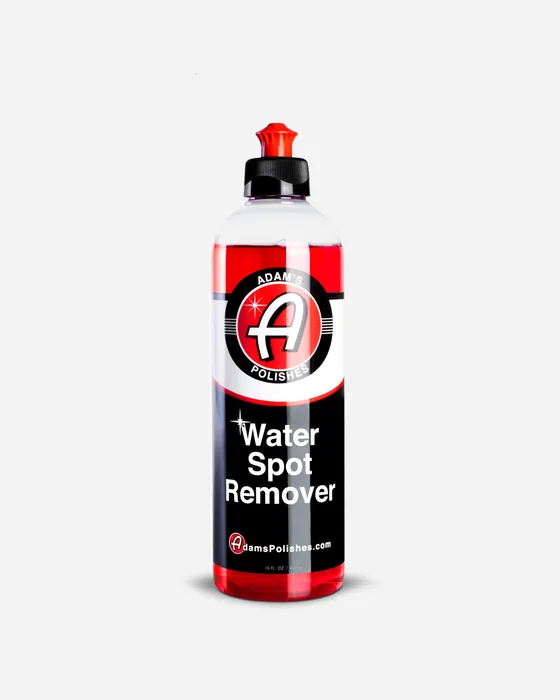
- Buy Adam's Polishes Water Spot Remover The only one that states its chemistry and its coating safety on the page where you buy it. Amazon
- Buy Meguiar's Water Spot Remover & Multi-Surface Polish Not an acid at all, which makes it the low-risk first attempt and the wrong tool for a coated car. Amazon
- It depends Chemical Guys Heavy Duty Water Spot Remover A gel acid that works, sold by a page that never uses the word its own bottle puts in capitals. Amazon
- Skip Torque Detail Water Spot Remover (16oz) An acid that its own page keeps off side mirrors, bare metal and plastic, and off glass for more than 30 seconds.
What actually matters
- Mechanism - whether the product dissolves the deposit chemically or abrades it away mechanically. This single fact determines coating safety, handling requirements, speed on baked-on spots and which surfaces are in scope.
- Coating compatibility - whether a ceramic or graphene layer survives the treatment. A polish removes a thin layer of whatever it touches, so a coating goes with the spot, while an acid may be formulated to spare it.
- pH and hazard class - how aggressive the chemistry is and how it must be handled. A corrosive product carries prescribed hazard wording and a pictogram on the container regardless of how gently the website describes it.
- Consistency - whether the product is thin, thickened or a gel. Water spotting concentrates on vertical glass, where anything thin drains away before the chemistry has had contact time.
- Dwell time - how long the product should stay on the surface. Acids that need a neutralizing rinse usually publish a maximum rather than a minimum, and exceeding it is how damage happens.
- Surface list - which materials the maker actually names. Paint, glass, chrome, trim, hard plastic and coated paint are separate questions, and a product covering one may be wrong on another.
- Etching depth - whether the mineral has bonded into the surface or is sitting on it. Nothing in this category restores an etched surface, and knowing the difference before you buy saves the purchase.
The specs, in plain English
Green flags vs red flags
Green flags
- The mechanism is stated plainly, whether that is an acid or a polish, rather than left to the phrase heavy duty.
- Coated surfaces are named explicitly as safe or unsafe rather than omitted.
- A dwell time and a neutralizing step are published where the chemistry needs them.
- The consistency is described, so you know whether it will stay on a vertical pane.
- The surface list is specific, naming paint, glass, chrome or plastics individually.
Red flags
- The listing describes only a formula or a gel and never says how it removes anything.
- Strength language does the work that a specification should be doing.
- No coating statement on a product sold into a market where most enthusiast cars are coated.
- A trigger sprayer paired with instructions that tell you not to spray it directly on glass.
- Warnings about damaging a surface that the same product lists among its uses, or a long list of surfaces it must be kept off.
Who's who: the brands
- Adam's Polishes - Consumer detailing brand that tends to state chemistry and compatibility in the product copy rather than only on the container.
- Chemical Guys - High-volume detailing brand with a broad catalogue and marketing-led product pages that often omit what the label carries.
- Meguiar's - Long-established car care brand, strongest in polishes and compounds, which is the tradition its water spot product comes from.
- Torque Detail - Direct-to-consumer detailing brand that publishes step-by-step procedures in its product copy.
- P&S Detail Products - Professional-channel brand whose labels lean toward dilution ratios and process detail rather than consumer marketing.
How to read a listing without getting fooled
Start at the bottom of the label rather than the top. The product name and the strength adjective tell you nothing useful, but the features box, the surface list and the hazard panel do. Look for a word that names the mechanism: acid, neutralizer and dissolves all point one way, while polish, abrasive and restores gloss point the other. Then look for what is missing. A product page describing a formula without saying what kind of formula has made a choice, and so has one that lists every surface except coated paint. If the only photograph is a front-on studio shot, look for a rear label image before you decide, because that is where the cautions live.
How much should you spend?
This is an inexpensive category and price tracks packaging more than capability. Budget buys a straightforward polish or a basic acid in a plain bottle, and the cheapest product in a comparison may be working by a different principle rather than a worse one. Mid-range buys thickened or gel consistency, a stated surface list and sometimes a coating compatibility claim, which is where the money is genuinely worth spending if your car is coated. Premium in this category usually means a kit, bundling the remover with a towel, an applicator or a protection product, and the chemistry inside is rarely different from the mid-range bottle. Because a single bottle lasts a long time in normal use, buying on disclosure rather than on volume is the better rule here.
Questions, answered
Will washing the car more often prevent water spots?
Washing does not cause or prevent them; drying does. Spots form when hard water is allowed to evaporate on the surface rather than being removed. Washing more often but letting the car air dry will produce more spotting, not less. Drying thoroughly with a dedicated drying towel, or using filtered water for the final rinse, is what actually reduces them.
Are water spots worse on glass than on paint?
They are usually more visible on glass because glass is transparent and the eye reads the deposit against the view through it. Glass is also harder than clear coat, but it is not immune to chemistry: deposits bond tightly, and acid removers can etch glass if left on too long, which makers warn about in their instructions. The real difference is that etched glass is much harder to correct than etched clear coat, since polishing glass requires a different compound and considerably more work.
Can I use a household descaler instead?
You can dissolve the same minerals with a household descaler, and people do. The problem is everything else on the panel. Automotive products are formulated to work on the deposit without attacking trim, rubber seals, anodised finishes or coatings, and household descalers make no such promise. The saving is small and the surfaces at risk are not.
Does a ceramic coating stop water spots?
It changes them rather than preventing them. A coating makes water bead and run off, so less of it sits and evaporates in place, which reduces spotting. But the water that does remain still carries the same minerals, and a coated surface can spot just as visibly. The advantage is that deposits on a coating tend to sit on the coating rather than bonding to the paint, so they are usually easier to remove, provided you use something that will not take the coating with them.
Or jump to the head-to-head: Adam's Polishes Water Spot Remover vs Meguiar's Water Spot Remover & Multi-Surface Polish.