Explained
Wheel Brushes, Explained
After reading, you'll know why wheel faces get swirled during cleaning, and which two brushes actually cover a wheel.
In this guide
Wheels are the dirtiest part of a car and the part most often damaged while being cleaned. Brake dust is embedded ferrous grit, the finishes range from tough clear-coated paint to easily marked polished aluminium, and the tools are sold almost entirely on how soft the bristles feel in the shop. The bristles are rarely the problem. What sits underneath them usually is.
The 30-second version
- The core is the scratch risk, because bristles flatten under pressure and bring the spine into contact with the wheel.
- Barrels and faces need different brushes, and a long brush used flattened against a face is the classic mistake.
- Bristle material sets gentleness and capacity, with natural fibres holding more solution and synthetics lasting longer.
- Finish clearance is rarely stated, though polished, anodised and matte wheels mark far more easily than painted alloys.
- Wheel tools never touch paint, since brake dust carried onto a panel is exactly what a wash is trying to avoid.
The products this guide is about
Our verdict on each, with the full reasoning on the companion review.
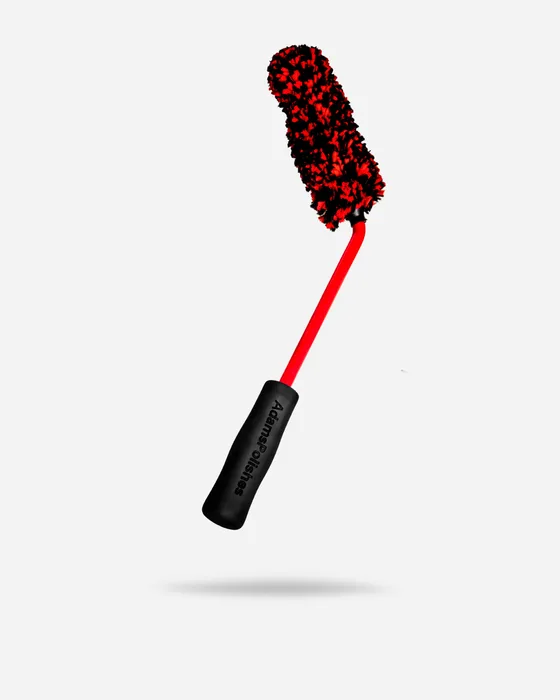
- Buy Adam's Polishes Large Angled Wheel Brush The only brush here with published dimensions, and the 45 degree angle is what gets it round a caliper. Amazon
- Buy Detail Factory Wheel Brush Mini The only one that mentions protecting the core, which is the part that actually scratches wheels. Amazon
- It depends Chemical Guys Gerbil Wheel and Rim Brush The only one that names the wheel finishes it is safe on, in a head too small to do a barrel. Amazon
- Skip P&S Detail Products Big EZ Wheel Brush, 18 in. Eighteen inches of reach with nothing published about what is under the bristles. Amazon
What actually matters
- Core construction - the wire or plastic spine the bristles are wound onto. Whether it is sheathed in foam or rubber decides whether the brush can mark a wheel face when the bristles compress.
- Length - determines barrel reach. Around 18 to 19 inches gets through a wheel and down a barrel; compact brushes of a few inches are for faces, spokes and lug pockets.
- Head diameter - how much space the fibres fill. Too small and the brush rattles around doing nothing; too large and it will not pass between the spokes.
- Bristle material - sheepskin and boar hair are soft and hold plenty of solution but need drying properly; synthetics last longer and clean more easily, and flagged synthetics with split ends are much softer.
- Handle - foam or rubber, gripped with wet hands covered in wheel cleaner. A slick plastic handle is a genuine control problem rather than a comfort one.
- Angle - a bent or angled handle lets the brush follow the curve of a barrel past a brake caliper, which a straight brush cannot do on most modern cars.
- Finish clearance - which wheel finishes the brand has cleared. Painted alloys are forgiving; polished, chrome, anodised and matte finishes are not.
The specs, in plain English
Green flags vs red flags
Green flags
- Core protection described, whether as a foam pad, a rubber sheath or a coated spine.
- Length and head diameter both published.
- The bristle material named specifically.
- A list of wheel finishes the brush is cleared for.
- An angled handle, and a grip material stated as foam or rubber.
Red flags
- Softness as the only property described.
- A long brush with no mention of what is under the bristles.
- No dimensions at all on a tool whose whole job is fitting a specific space.
- One brush sold as covering barrels and faces alike.
- A hard plastic handle on a tool used with wet, chemical-covered hands.
Who's who: the brands
- Adam's Polishes - Publishes brush dimensions and handle detail, and offers angled long brushes sized around modern brake calipers.
- Detail Factory - A brush and tool specialist distributed through The Rag Company, and unusual in describing core construction and contact pads rather than only bristle softness.
- Chemical Guys - Wide brush range including natural sheepskin heads, and one of the few brands naming which wheel finishes a brush suits.
- P&S Detail Products - A detailing supply brand with minimal published specification on its Big EZ wheel brush, which showed as sold out on its page when checked.
- Wheel Woolies - A specialist known for long, soft-sheathed barrel brushes.
How to read a listing without getting fooled
Look first for anything describing the core, because that is the part that damages wheels and almost nobody mentions it. Words like contact pad, sheathed, coated core or protected tip are what you want. Then find the length and the head diameter, and match them to your actual wheels: measure the gap between spokes and how deep the barrel is before you buy. Look for a named bristle material rather than the word soft, since soft is not a specification. Check whether the brand states which finishes the brush suits, and treat silence as a reason for caution on polished or matte wheels. Finally, plan on two brushes, because no single tool does both barrels and faces well.
How much should you spend?
Wheel brushes are cheap relative to what they can damage, which flips the usual advice. A budget brush with an unsheathed wire core used on a polished wheel can cost more in refinishing than a lifetime of good brushes. The mid-range is where angled handles, foam grips and described cores appear, and that is where to shop. Beyond that you are paying for materials and durability rather than safety. The best value in this category is buying two brushes instead of one, since the single most expensive mistake is using a flattened barrel brush against a wheel face.
Questions, answered
Can I use the same brush on wheels and tyres?
Better not to. Tyre sidewalls need a stiff bristle to lift old dressing and browning out of the rubber, and that stiffness is exactly what you do not want on a wheel finish. Tyre cleaning also releases a lot of black residue that then lives in the brush. Use a stiff dedicated tyre brush and keep the soft wheel brush for the wheel, and do the tyre first so any residue gets rinsed before the wheel is cleaned.
How do I clean the barrel without taking the wheel off?
A long angled brush, worked in from the outer edge and rotated around the barrel with the steering turned to expose each side. Turning the wheels to full lock gives you far better access to the front barrels than working straight on. If the brush cannot reach past the caliper, that is the argument for an angled handle rather than a straight one, and taking the wheel off remains the only way to do the job properly.
Does a wheel brush need its own bucket?
Yes, and it is not optional. Brake dust is embedded iron, and the water in a wheel bucket is full of it within minutes. Dipping a paint mitt into that water, or using the same bucket afterwards for the body, transfers ferrous grit onto the clear coat. A separate bucket with its own grit guard, plus wheel-only brushes and mitts, is the cheapest paint protection available.
When should I replace a wheel brush?
When the bristles have worn short enough that the core or the ferrule can reach the wheel, when the core becomes visible through the sheathing, or when a natural fibre head starts shedding. All three turn the tool from a brush into an abrasive. Given how cheap brushes are relative to refinishing a wheel, replacing early is the right instinct.
Or jump to the head-to-head: Adam's Polishes Large Angled Wheel Brush vs Detail Factory Wheel Brush Mini.