Explained
Tire Chains, Explained
After reading, you'll understand what SAE Class S really measures, why cross member pattern changes how a car behaves, and how to check whether a device is legal where you drive.
In this guide
Almost every tire chain mistake is a fitment mistake. People buy by tire size alone, discover the set will not clear the strut, and either force it or drive off with something rubbing. The vocabulary that prevents this is small but non-obvious, and most of it lives in a single SAE clearance standard plus your owner's manual. The rest is about how a device tensions itself and how the steel is laid out across the tread.
The 30-second version
- Clearance class beats brand, because a device that needs more room than your wheel well has cannot be made to work.
- Your owner's manual is the authority, and it can prohibit traction devices entirely on certain wheel and tire combinations.
- Pattern decides more than traction, since continuous cross members help with steering and braking, not just getting moving.
- Tensioning is where people fail, so a self-tightening or built-in-tensioner design is worth paying for.
- Legality is product-specific, and agencies publish approved device lists by name, sometimes even by drive layout.
The products this guide is about
Our verdict on each, with the full reasoning on the companion review.
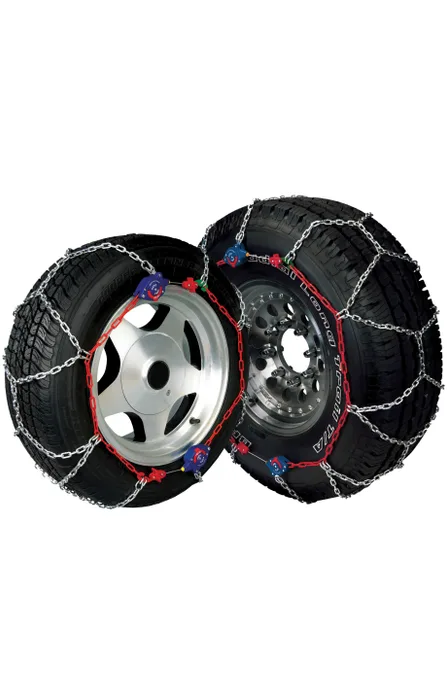
- Buy Peerless Auto-Trac Passenger Tire Chain An alloy diamond-pattern link chain that meets SAE Class S and tightens itself, so you fit it once and drive.
- Buy Security Chain Company Super Z6 Cable Chain The cable chain to buy when your car has almost no room at the inside sidewall, with rubber tensioners already built in. Amazon
- It depends AutoSock HP 870 A textile tire cover that goes on in three steps and rides quietly, as long as you accept that it is a wear item.
- Skip König CB-12 Snow Chain A properly certified entry-level European link chain that leaves out the one thing you want most in bad weather: a tensioning system. Amazon
What actually matters
- SAE clearance class - This is the standard that says how much space a traction device may occupy around the tire. Class S is the tight envelope most modern cars require; Class U is the roomier spec for vehicles with unrestricted wheel wells.
- Inside sidewall space - The measurement from the inside sidewall to the nearest obstruction is usually the binding constraint, not the tread face. Peerless publishes 0.59 in (15 mm) for its Class S link products and 6.3 mm for the Super Z6.
- Cross member pattern - Ladder, diagonal and diamond describe how the steel crosses the tread. Ladder gives grip in rungs with gaps between; diagonal and diamond keep something under the contact patch at all times.
- Tensioning system - Chains must stay tight or they flail and damage the car. Some designs ratchet themselves tight, some include rubber tensioners, and some require you to buy tensioners and re-tension by hand.
- Fitment method - Devices that fasten from outside the wheel and do not require moving or jacking the vehicle are dramatically easier to fit on a cold shoulder in the dark.
- Device type - Link chains, cable chains and textile covers behave differently on traction, ride quality, weight and lifespan, and they are regulated differently in some jurisdictions.
- Legal approval - Chain control rules vary by state and province, and alternative traction devices are typically approved by product name rather than as a category, so the specific model matters.
The specs, in plain English
Green flags vs red flags
Green flags
- The manufacturer states an SAE class explicitly, and publishes the clearance numbers behind it rather than just a badge.
- The listing gives an exact tire size range, and the maker offers a fitment lookup keyed to your tire size rather than your vehicle.
- Tensioning is handled by the product itself, either a self-tightening ratchet or tensioners that ship in the box.
- The device fastens from outside the wheel and does not require jacking the vehicle or reaching behind the tire.
- The product appears by name on a state or provincial approved device list if you plan to rely on it in a chain-control area.
Red flags
- The listing names a vehicle rather than a tire size, since two trims of the same car can take completely different sizes.
- The clearance claim is vague, for example low profile or fits most cars, with no SAE class and no measurement.
- Tensioners are shown in the product photos but described as sold separately in the fine print.
- A textile or mesh device is marketed as legal everywhere chains are required, without a link to the agency list that says so.
- There is no stated speed limit or wear indicator, which suggests the maker has not tested the product to a recognised standard.
Who's who: the brands
- Peerless - An American chain manufacturer whose passenger range spans ladder chains through the self-tightening Auto-Trac. It also owns Security Chain Company, so two of the names in a US store are one manufacturer.
- Security Chain Company - The Peerless traction brand behind the Z family, including the Super Z6 built for vehicles with almost no sidewall clearance.
- AutoSock - Maker of the textile snow sock it calls the original, made since 1998, with the HP 870 certified to EN16662-1:2020 and ÖNORM V5121.
- König - A European chain maker that publishes clearance figures and EN 16662-1 certification on its model pages, from the manual-tensioning CB-12 up to models with automatic tensioning.
- pewag - An Austrian chain manufacturer with self-tensioning passenger chain designs.
How to read a listing without getting fooled
Work through a listing in this order. Start with the tire size printed on your sidewall, not the vehicle name, and confirm the product covers that exact size. Then find the SAE class and, if the maker publishes them, the two clearance numbers behind it, because that is what tells you whether it will physically fit. Next look at how the device tensions and whether tensioners are included, since that line is where budget chains hide a required extra purchase. Check the cross member pattern to understand how the car will behave with them on. Confirm the stated speed limit and any wear indicator. Finally, if you are buying to satisfy a posted chain requirement, search for the product by name on the relevant transport agency or state patrol list before you rely on it.
How much should you spend?
Budget sets are ladder-pattern cable chains, basic twist-link chains and entry-level European link chains. They will get a car moving on packed snow, but the budget line is where tensioning gets left out: some expect you to buy rubber tensioners separately, and others, such as the König CB-12, expect you to stop after a few dozen metres and tighten by hand. Compare the working cost and the roadside effort, not the shelf cost. The mid-range covers the products most people should be looking at: cable chains with built-in tensioners and low clearance requirements, and certified textile covers. Premium buys you alloy link chains with self-tightening mechanisms, diamond patterns, and European self-tensioning designs with rim protection. The jump from budget to mid-range buys convenience and safety margin and is usually worth it; the jump to premium mostly buys durability and is worth it if you fit chains more than a few times a season.
Questions, answered
Can I leave chains on once the road clears?
No, and this is the fastest way to destroy a set. Cross members and textile fabric are designed to work against snow and ice, not asphalt, and bare pavement wears them out in a very short distance. Peerless advises not exceeding 30 mph with any traction product, which is also a hint that these are not for clear roads. Pull off safely and remove them once you are past the snow.
Do I need chains on all four wheels?
Usually you fit them to the drive wheels, and AutoSock's instructions say the same. Some jurisdictions require more in specific conditions, and vehicles towing trailers can be required to have a set on a trailer axle as well: under California's R-1 level, trailers with brakes must have chains on at least one axle. Follow the posted requirement and your manual rather than a general rule.
How long should a set last?
It depends far more on how you drive than on how much you paid. Link chains used only on snow can last many seasons; the same chains run on bare pavement can be worn out in one trip. Textile socks are explicitly consumable, and Washington State Patrol's chart says to replace an AutoSock once half of it shows black yarn. Avoiding wheelspin and avoiding clear road are the two habits that extend life.
Is it worth practising before winter?
Yes, and it also doubles as your fitment check. Peerless recommends pre-fitting any traction device and driving a short distance, stopping immediately if you hear a ticking sound that indicates contact. Doing this in a dry driveway tells you both that the device clears your suspension and that you know the sequence. Fitting a set for the first time on a snowy shoulder at night is where people get hurt.
Or jump to the head-to-head: Peerless Auto-Trac Passenger Tire Chain vs Security Chain Company Super Z6 Cable Chain.