

Automotive
The Best Tire Chains: 4 Compared (and One to Skip)
We compared four winter traction devices on the things that actually decide whether they work on your car: SAE clearance class, how much space they need at the inside sidewall, cross member pattern, and how they tension.
The short version
The Peerless Auto-Trac is the best all-round pick for most drivers who need real winter traction: it is an alloy diamond-pattern link chain that meets SAE Class S, and its ratcheting system tightens itself as you drive so you do not have to stop and re-tension. The Security Chain Company Super Z6 is the value and compatibility pick, because Peerless rates it to work in 6.3 mm of inside sidewall space when a typical Class S product wants 15 mm, which means it fits cars that link chains cannot. Both are Peerless products, and we say so rather than pretend the US chain aisle is more crowded than it is. The AutoSock HP 870 is the depends pick: it is a textile cover you can fit in three steps with clean hands, it is certified to EN16662-1:2020 and approved by the Washington State Patrol for passenger cars, but it is a consumable that wears out with distance and it is not accepted everywhere metal chains are. The one to skip is the König CB-12, an entry-level European link chain that is properly certified but has to be stopped and hand-tensioned a few dozen metres after fitting, and that König itself scores at 55 percent for ease of use and 50 percent for vehicle compatibility. Whatever you buy, check your owner's manual first, then pre-fit the device in your driveway before the storm. Best for: drivers who occasionally cross a chain-control pass and want something that fits their specific car and can be installed in the dark, in the cold, on the shoulder.
Our picks at a glance
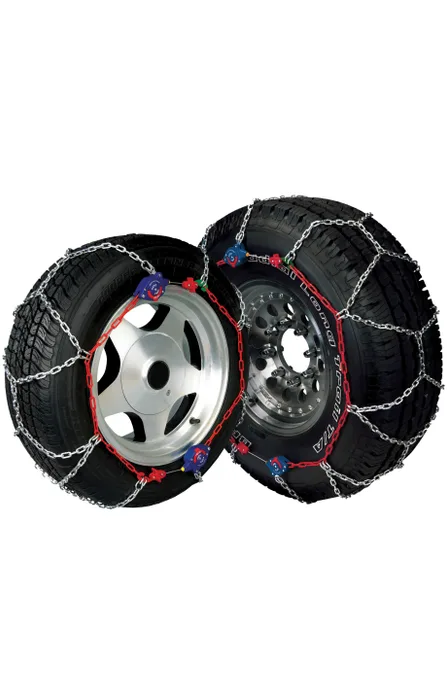
- Peerless Auto-Trac Passenger Tire Chain - Buy. An alloy diamond-pattern link chain that meets SAE Class S and tightens itself, so you fit it once and drive.
- Security Chain Company Super Z6 Cable Chain - Buy. The cable chain to buy when your car has almost no room at the inside sidewall, with rubber tensioners already built in.
- AutoSock HP 870 - It depends. A textile tire cover that goes on in three steps and rides quietly, as long as you accept that it is a wear item.
- König CB-12 Snow Chain - Skip. A properly certified entry-level European link chain that leaves out the one thing you want most in bad weather: a tensioning system.
The verdict in 30 seconds
What mattered most
- Device type
- Cross member pattern
- SAE clearance class
- Clearance space required
- Tensioning
- Fit without moving the vehicle
Tire chains are one of the few car purchases where the wrong choice is not just disappointing, it is physically impossible to fit. Modern cars leave very little room between the tire and the strut, brake line, or fender liner, and a chain that needs more space than your vehicle has will chew through something expensive. So this comparison starts with fitment and clearance and works outward from there. We picked four devices that between them cover the three main product types a passenger car owner will see on the shelf: alloy link chains, cable chains, and textile tire covers. One disclosure up front: our two buy picks both come from Peerless Chain, which also owns the Security Chain Company brand. That is not a favour to Peerless, it is what the American passenger chain aisle actually looks like, and we flag where the shared parent matters.
An alloy diamond-pattern link chain that meets SAE Class S and tightens itself, so you fit it once and drive.
Best for: Someone who crosses a chain-control pass more than once a winter and wants the most capable device that still fits a normal car.
- Peerless lists it as meeting Class S clearance on passenger cars, pickups and SUVs, which covers most modern vehicles that allow chains at all.
- The patented ratcheting system tightens the chain as you drive, and Peerless states no additional tensioners are needed or recommended.
- A diamond cross member pattern puts steel under the tire continuously rather than in gaps, which helps with steering and braking as well as pulling away.
- It is a link chain, so it is heavier and bulkier in the trunk than a cable chain or a textile cover.
- It costs more than a basic cable chain, which is hard to justify if you fit chains once every few winters.
- Peerless states chain tensioners should not be used with it, so the habit of adding aftermarket rubber tensioners will work against you here.
- Even a Class S product will not fit every car, and some owner's manuals prohibit chains on certain wheel and tire combinations outright.
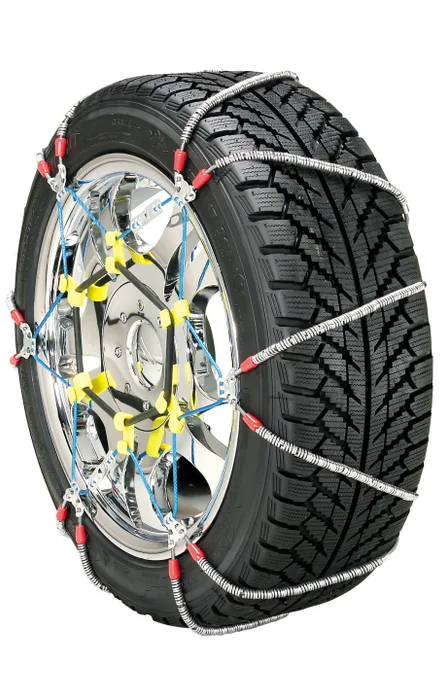
The cable chain to buy when your car has almost no room at the inside sidewall, with rubber tensioners already built in.
Best for: Drivers of low-clearance cars, EVs and crossovers whose manual leaves very little room around the drive tires.
- Peerless states it needs only 6.3 mm of operating space at the inside sidewall, against the 15 mm a typical Class S product wants, so it fits vehicles that rule out link chains.
- Rubber tensioners are designed in and included, so there is no separate part to buy and no stopping to retighten.
- It is lighter and easier to handle than a link chain, and it installs from outside the wheel without moving the vehicle.
- Cable cross members generally give less bite in deep or crusted snow than link chain, though Peerless claims better traction than conventional cables.
- Like any chain it wears quickly on bare pavement, which is easy to run on a pass that clears in patches.
- The diagonal pattern is quieter than a ladder chain but still transmits more noise and vibration than a textile cover.
- Because it fits so tightly, sizing has to be exact for your tire, and a near-enough size is not usable.
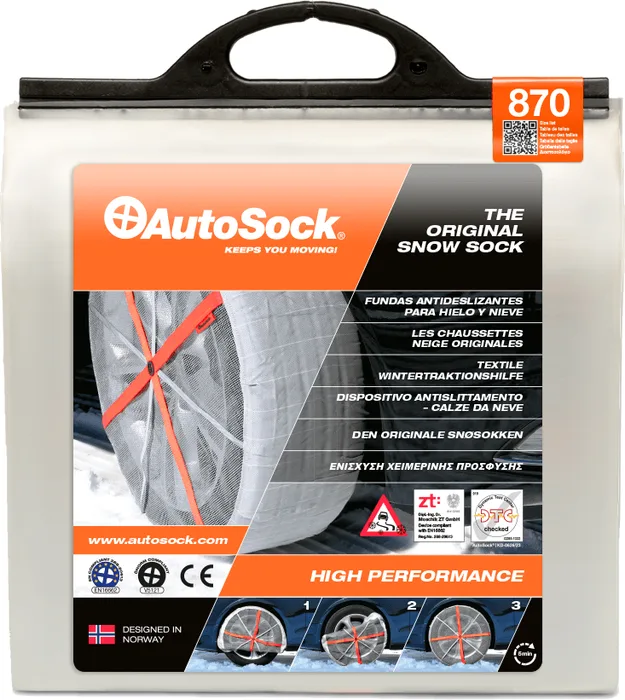
A textile tire cover that goes on in three steps and rides quietly, as long as you accept that it is a wear item.
Best for: Someone who needs to satisfy a chain requirement occasionally, values a three step install, and will not be driving long stretches of clear road.
- AutoSock states it fits in three steps and is self-centering, and the set weighs under 3.4 lbs, so it lives in a trunk without argument.
- It is certified to the European winter traction standard EN16662-1:2020 and to ÖNORM V5121, and the Washington State Patrol lists AutoSock as approved for front and rear wheel drive passenger cars under 10,000 lb.
- The fabric is safe on alloy rims and AutoSock states it is compatible with ABS and ESP, and it is machine washable at 40 degrees C for reuse.
- It is a consumable. Washington State Patrol's own guidance says to replace it once 50 percent of the sock shows black yarn.
- Bare pavement destroys it quickly, so it is poorly suited to a pass that alternates between snow and dry asphalt.
- Approval is granted device by device, not by category, so a textile product is not automatically acceptable wherever chains are required.
- Fitting requires moving the vehicle half a wheel turn, which is awkward on a narrow shoulder.
Amazon had no buyable listing for this when we last checked. The link still works if it returns.
Check price on Amazon Read our detailed assessment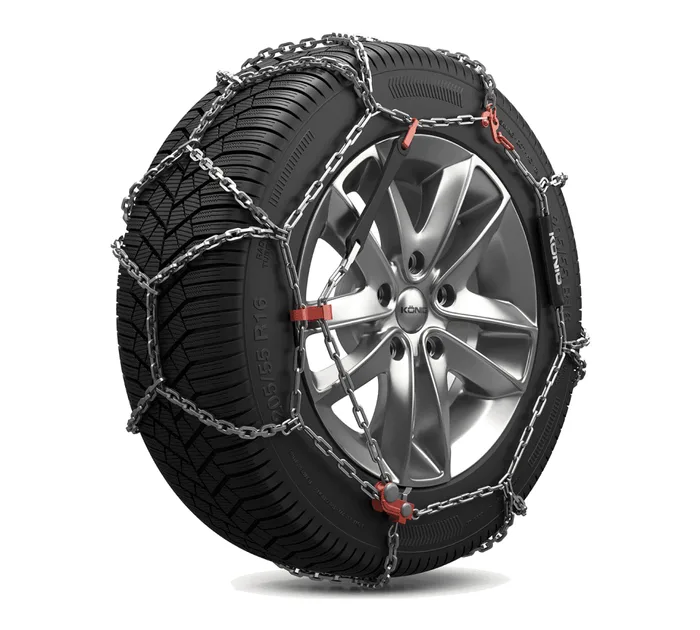
A properly certified entry-level European link chain that leaves out the one thing you want most in bad weather: a tensioning system.
Best for: A car with ordinary wheel well room whose owner has to satisfy a winter equipment law, fits chains once a season, and will do it in daylight.
- It is certified to Ö-Norm V5117 and EN 16662-1:2020, which König says fulfils any winter equipment legal requirement, and both the product and the packaging carry the markings the law asks for.
- The ground-up fitting system slides a flexible cable along the ground behind the wheel, so every part of the chain connects without moving the vehicle.
- Adjusting links on the front closing hook let you take the front of the chain in or out to suit tyre size, profile and wear, which is more sizing tolerance than budget chains usually give you.
- König's own published scoring gives it 80 percent for traction on snow and ice and 80 percent for side handling, so the steel itself is not the problem.
- König states that manual tensioning requires the driver to stop after a few dozen metres and retension the chain by hand, after which it is held by an elastic end hook.
- König scores its own product at 55 percent for ease of use, 60 percent for intuitiveness and 50 percent for vehicle compatibility, and says it carries a lower level of contents and features than the rest of the range.
- König describes it as destined to passenger cars unaffected by any kind of wheelhouse clearance limitations, so the cars most likely to need a low clearance device are the cars it is not for.
- It claims no SAE class. The certifications are European, so at a US chain control that talks in SAE terms there is nothing on the box to point at.
| Criteria | Auto-Trac Passenger Tire Chain Top pick | Super Z6 Cable Chain | AutoSock HP 870 | CB-12 Snow Chain |
|---|---|---|---|---|
| Verdict | Buy it | Buy it | It depends | Skip it |
| Best for | Someone who crosses a chain-control pass more than once a winter and wants the most capable device that still fits a normal car. | Drivers of low-clearance cars, EVs and crossovers whose manual leaves very little room around the drive tires. | Someone who needs to satisfy a chain requirement occasionally, values a three step install, and will not be driving long stretches of clear road. | A car with ordinary wheel well room whose owner has to satisfy a winter equipment law, fits chains once a season, and will do it in daylight. |
| Price tier | $$$ · premium | $$ · mid-range | $$ · mid-range | $ · budget |
| Device type | Alloy link chain | Steel cable chain | Textile tire cover | Steel link chain |
| Cross member pattern | Diamond | Diagonal | Not applicable | Interlocking diamond net (from König's product photos; not named in its text) |
| SAE clearance class | Meets Class S | Meets Class S, exceeds its clearance requirement | No SAE class claimed | None claimed; Ö-Norm V5117 and EN 16662-1:2020 |
| Clearance space required | Class S envelope, 15 mm | 6.3 mm | Not published | König rates it for vehicles with max 12 mm clearance requirements (EN 16662-1:2020 Class 13 mm) |
| Tensioning | Self-tightening ratchet, tensioners not recommended | Rubber tensioners built in and included | Elastic hem, self-centering | Manual, stop after a few dozen metres and tighten by hand |
| Fit without moving the vehicle | Yes | Yes | No, roll a half wheel turn | Yes, cable slides on the ground behind the wheel |
| Maker-stated approvals or compatibility | ABS and traction control compatible | ABS, traction control and AWD compatible | EN16662-1:2020, ÖNORM V5121, WSP approved for passenger cars | Ö-Norm V5117, EN 16662-1:2020 (Class 13 mm) |
| Maker's speed limit | 30 mph (Peerless guidance for any traction product) | 30 mph (Peerless guidance for any traction product) | 30 mph / 50 km/h | Not published for this model; König cites 50 km/h as the standards' test speed |
Which one is right for you?
- Someone who crosses a chain-control pass more than once a winter and wants the most capable device that still fits a normal car. Buy it Peerless Auto-Trac Passenger Tire Chain
- Drivers of low-clearance cars, EVs and crossovers whose manual leaves very little room around the drive tires. Buy it Security Chain Company Super Z6 Cable Chain
- Someone who needs to satisfy a chain requirement occasionally, values a three step install, and will not be driving long stretches of clear road. It depends AutoSock HP 870
- A car with ordinary wheel well room whose owner has to satisfy a winter equipment law, fits chains once a season, and will do it in daylight. Skip it König CB-12 Snow Chain
How we judged the field
Five things decide whether a traction device is worth owning. First is clearance, which is the whole game: SAE J1232 defines how much space a device may occupy measured from the tread face and from the inside sidewall, and Class S is the tight envelope of 1.46 in (37 mm) at the tread and 0.59 in (15 mm) at the sidewall that most modern cars require. Class U is the roomier spec for vehicles with unrestricted wheel wells. Second is fitment method, because a device you can install from outside the wheel without jacking the car is one you will actually use. Third is tensioning, since a chain that needs a separate rubber tensioner or a stop-and-retighten step introduces the two most common ways people get this wrong. Fourth is cross member pattern, which decides whether you get grip only when accelerating or also when steering and braking. Fifth is legality, which is set device by device by state and provincial agencies rather than by product category.
The field splits cleanly into three types. Link chains give the most bite and the most durability but need the most room and the most muscle. Cable chains trade some bite for a much smaller clearance envelope and far easier handling. Textile covers trade much of that durability for a quick three step install and near-silent running. We took the strongest current example of each: the Peerless Auto-Trac as the Class S link chain that tightens itself, the Security Chain Company Super Z6 as the cable chain built for cars with almost no sidewall room, and the AutoSock HP 870 as the certified textile option. Peerless owns Security Chain Company, so two of those four are one manufacturer; we kept both because they solve genuinely different clearance problems and because Peerless and SCC are most of what a US buyer will find on a shelf. The fourth is the trap: the König CB-12, an independent European chain that is correctly certified and cheap, and that its own maker rates poorly on everything except the traction itself.
Peerless Auto-Trac Passenger Tire Chain
Buy itThe Auto-Trac is the one we would put in most trunks. Peerless builds it with manganese alloy steel cross members in a diamond pattern, which matters more than it sounds: a diamond puts steel across the contact patch continuously instead of in rungs, so the chain helps you steer and stop rather than only pull away. It meets Class S clearance on passenger cars, pickups and SUVs, and it installs from outside the tire using a split outside chain with two ratchet connectors, so there is no jacking and no moving the vehicle. The patented ratchet then tightens the chain as you drive, and Peerless is explicit that additional tensioners are neither necessary nor recommended. That removes the step where people either forget to retighten or overtighten and score an alloy wheel. The trade-off is weight and cost: this is real link chain, and it takes up real trunk space. If you cross a chain-control pass more than once a winter, that is a trade worth making.
Security Chain Company Super Z6 Cable Chain
Buy itThe Super Z6 exists to solve one problem, and it needs less sidewall room than anything else on this list. Peerless rates it to operate in 6.3 mm of space at the inside sidewall, against the 15 mm a typical Class S product wants, which is why it fits cars whose manuals rule out conventional chains. It is a cable chain with alloy cross members on a diagonal pattern, so it is quieter and lighter than the Auto-Trac and easier to wrestle into place with cold hands. Rubber tensioners are designed into the product and included, so it stays tight without a separate purchase or a second stop. What you may give up is some bite: cable cross members generally do not dig like link chain in deep or crusted snow, and like any chain it wears quickly if you run any distance on bare pavement. Sizing also has to be exact. For a low-slung sedan, an EV, or a crossover on large optional wheels, this is the right answer.
AutoSock HP 870
It dependsThe AutoSock HP 870 is the most pleasant of these to live with and the least durable. It is a woven textile cover you pull over the top of the tire, roll forward half a wheel turn, and pull down over the rest. AutoSock says the set weighs under 3.4 lbs, self-centers as you drive, is safe on alloy rims, works with ABS and ESP, and can be machine washed at 40 degrees C between uses. It is certified to EN16662-1:2020 and ÖNORM V5121, and the Washington State Patrol lists AutoSock as approved for front and rear wheel drive passenger cars under 10,000 lb. The catch is that it is a wear item with a published wear indicator: replace it once half the sock shows black yarn. Bare asphalt eats it, so it is wrong for a pass that clears in patches, and because approvals are granted by product rather than by category, it is not automatically accepted wherever chains are required. Good for occasional, short, genuinely snowy use.
König CB-12 Snow Chain
Skip itThe CB-12 is the most honest product on this list about its own shortcomings, which is exactly why we would not buy it. König sells it as a basic but sturdy entry-level chain for passenger cars, certified to Ö-Norm V5117 and EN 16662-1:2020, fitted with a ground-up system where a flexible cable slides along the ground behind the wheel so every part connects without moving the car. All of that is true and none of it is the problem. Read König’s own key features and the problem is listed first: manual tensioning, which the company defines as the driver stopping after a few dozen metres to retension the chain by hand, with the chain held afterwards by an elastic end hook. König then publishes its own scores for the product, and they are 55 percent for ease of use, 60 percent for intuitiveness and 50 percent for vehicle compatibility, against 80 percent for traction on snow and ice. The maker is telling you the steel works and the experience does not. Add its own positioning, that the CB-12 is destined to passenger cars unaffected by any kind of wheelhouse clearance limitations, and the driver this suits is one with a roomy wheel well, good light and patience. If you might be fitting chains in the dark on a shoulder, buy something that tensions itself.
Sources
Specs in this review come from these pages.
- Peerless Auto-Trac passenger tire chain, manufacturer product page (peerlesschain.com)
- Peerless Super Z6 cable chain, manufacturer product page (peerlesschain.com)
- Peerless, Limited Clearance Issues and SAE J1232 clearance classes (peerlesschain.com)
- AutoSock HP 870, manufacturer product page (autosock.com)
- König CB-12, manufacturer product page (konigchain.com)
- König, The thickness of snow chains (static footprint and EN 16662-1) (konigchain.com)
- Washington State Patrol, Approved Alternative Traction Devices chart (wsp.wa.gov)
- Caltrans, Chain Controls and R-1 / R-2 / R-3 definitions (dot.ca.gov)
Peerless Auto-Trac Passenger Tire Chain vs Security Chain Company Super Z6 Cable Chain: which should you buy?
The choice between the Auto-Trac and the Super Z6 is not really about which is better; it is about how much room your car has and how often you will use them. Measure the space around your drive tires, or at least read what the owner’s manual says about traction devices. If your vehicle is fine with a standard Class S product, the Auto-Trac is the stronger device: link chain in a diamond pattern digs harder in deep snow. If your manual is restrictive, or you are on large optional wheels with a filled-out wheel well, the Super Z6’s 6.3 mm requirement is the reason it exists and the Auto-Trac is simply not an option.
After clearance, weigh frequency and handling. Someone who fits chains a handful of times a season and drives a heavy vehicle will get more out of the Auto-Trac’s link chain. Someone who wants a set in the trunk as insurance, who might have to fit them alone in the dark, will find the Super Z6 lighter to lift and quicker to fasten. Both install from outside the wheel and both hold their own tension, so neither punishes you for being cold and impatient. Whichever you pick, buy the size that matches the tire actually on the car, not the tire the car shipped with, and pre-fit it once at home.
One thing worth saying plainly, because a four-product list implies four companies and this one does not deliver that: Peerless Chain makes the Auto-Trac and owns Security Chain Company, which sells the Super Z6. We did not pad the list to reach a number. Peerless and SCC are simply most of what an American passenger car buyer will find in stock, and the two products answer different clearance questions. The genuine independents in this category are largely European. AutoSock is one, and it is our depends pick. König is another, and its entry-level chain is our skip.
What to look for
- Clearance class first: find out whether your vehicle needs an SAE Class S product or can take a Class U chain, because a device that does not fit will damage brake lines, struts and fender liners.
- Read the owner’s manual before the reviews: many manufacturers prohibit traction devices on specific wheel and tire combinations, and that instruction overrides any product’s clearance rating.
- Match the pattern to the driving: ladder patterns give grip in rungs with bare tire between them, while diagonal and diamond patterns keep steel under the contact patch continuously for steadier steering and braking.
- Check how the device tensions: self-tightening and built-in-tensioner designs remove the stop-and-retighten step, while a chain that requires separately sold tensioners, or that expects you to pull over after a few dozen metres and tighten by hand, costs more in effort than the shelf price suggests.
- Verify legality on an official source: state and provincial agencies approve alternative traction devices by product name and sometimes by drive layout, so check the transport or state patrol list rather than a retailer summary.
- Pre-fit in your driveway: install the set once in daylight, drive a short distance, and stop immediately if you hear ticking, because that is the only way to confirm the clearance on your actual car.
Our final take
Buy for your car, not for the conditions you imagine. The single most useful hour you can spend is reading the traction device section of your owner’s manual, then fitting a candidate set in your driveway and driving a hundred yards to listen for contact. Once fitment is settled, the Auto-Trac is the device that asks the least of you in bad weather: it goes on from outside the wheel, tightens itself, and puts steel under the tire in a pattern that helps you steer and stop. The Super Z6 is the answer when your car does not have the room, and it is close enough in real use that nobody should feel short-changed. Keep whichever you buy in the trunk from November, and keep the gloves with it.
Questions, answered
I have all-wheel drive and winter tires. Do I still need to carry chains?
Often yes, and in some conditions you have to actually fit them. California's chain controls run in three levels: under R-1 chains are required except on passenger vehicles and light trucks under 6,000 lb with snow tires on at least two drive wheels, under R-2 four-wheel and all-wheel drive vehicles with snow tread tires on all four wheels are exempt but must carry traction devices, and under R-3 chains or traction devices are required on all vehicles with no exceptions. So AWD plus winter tires gets you through the common conditions but not the worst ones. Carrying a set that actually fits your car is the point.
How do I know whether my car can take chains at all?
Start with the owner's manual, because that is the only document written about your exact vehicle. Many manufacturers prohibit traction devices on specific wheel and tire combinations, usually the larger optional wheels, and some prohibit them entirely. Peerless notes that carmakers often make those statements because the vehicle has less clearance than SAE Class S assumes, and that some of those vehicles can still use a low-clearance product. The practical test is a pre-fit: install the device in your driveway, drive a short distance slowly, and if you hear any ticking or contact, stop and take it off. Doing that in September is much better than discovering it on a shoulder in a storm.
Which wheels do the chains go on?
The drive wheels, unless your manual or the posted requirement says otherwise. AutoSock's own instructions say to fit to the driving wheels. Towing adds axles: under California's R-1 level, all vehicles towing trailers must have chains on one drive axle, and trailers with brakes must have chains on at least one axle. If you drive a rear-wheel drive car, note that some alternative traction devices are approved only for front wheel drive: the Washington State Patrol chart lists several products as approved for front wheel drive passenger cars and not approved for rear wheel drive. Check the specific product, not the category.
How fast can I drive with chains on?
Slowly. Peerless states that regardless of the type of traction product you use, do not exceed 30 mph, and AutoSock gives the same figure as 50 km/h. Those numbers are not conservative padding; cross members and textile fabric both fail from heat and impact, and a chain that lets go at speed can wrap a brake line or a fender liner. Speed also determines how long the device lasts, so the difference between 25 and 40 mph can be the difference between a set that survives the season and one that does not.
Are snow socks legal where chains are required?
Sometimes, and the approval is product-specific rather than category-wide. Washington approves alternative traction devices by name: its State Patrol chart lists AutoSock as approved for front and rear wheel drive passenger cars under 10,000 lb and for vehicle combinations over 10,000 lb with five or fewer axles, and not approved for combinations with six or more axles. Other listed devices are approved only for front wheel drive cars. California defines a tire traction device broadly in Vehicle Code section 605 without singling out textiles. Before you rely on a textile device to satisfy a posted requirement, check the state or provincial transport agency's current list rather than a retailer's summary, because these lists change.
Deciding between the top two? See our head-to-head: Peerless Auto-Trac Passenger Tire Chain vs Security Chain Company Super Z6 Cable Chain.
More Automotive reviews
 The Best Portable Tire Inflators: 4 Compared (and One to Skip)
  The Best Tire Plug Kits: 4 Compared (and One to Skip)
  The Best Tire Pressure Gauges: 4 Compared (and One to Skip)
  The Best Tire Shine and Tire Dressings: 4 Compared (and One to Skip)
  The Best Truck Bed Tonneau Covers: 4 Compared (and One to Skip)
  The Best Torque Wrenches: 4 Compared (and One to Skip)