Explained
Polishing Pads, Explained
After reading, you'll understand how pad aggressiveness is described, why colours are not comparable, and how many pads a car actually needs.
In this guide
Polishing pads are the half of paint correction that gets least attention, and the compound gets the credit for what the pad and the machine mostly do. The category is organised around colour codes that look like a standard and are not. Every manufacturer picks its own colours, its own vocabulary, and its own boundaries between cutting, compounding, polishing and finishing, so the same colour can mean opposite things two shelves apart.
The 30-second version
- Colour is brand-private, so the same orange can mean light cutting at one manufacturer and medium-heavy at another.
- Pad and compound work as a pair, and a hard pad with a fine polish behaves nothing like a soft pad with a compound.
- Size changes the cut, because a smaller pad concentrates the machine's energy into less contact area.
- One pad will not do a car, since a loaded pad stops cutting and starts smearing spent abrasive around.
- Wool belongs to rotaries, and foam is the right answer for the dual action polisher most people own.
The products this guide is about
Our verdict on each, with the full reasoning on the companion review.
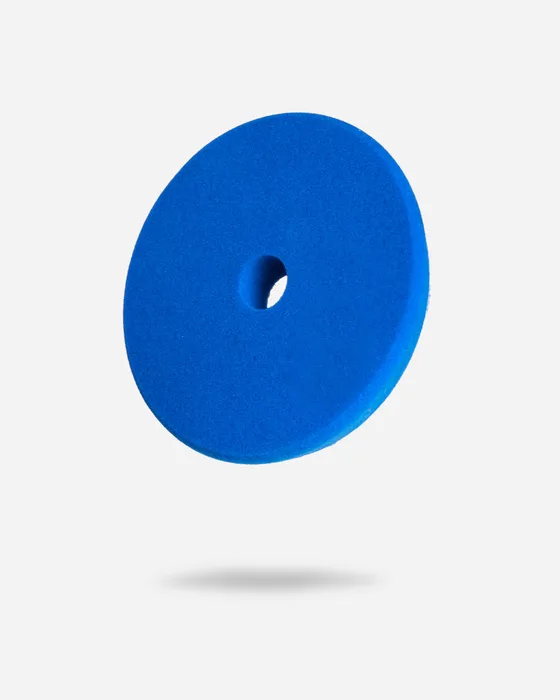
- Buy Adam's Polishes Blue Foam Compound Pad The most aggressive foam here, in the widest size range, and the only pad colour-matched to a named compound. Amazon
- Buy Chemical Guys Orange Hex-Logic Medium-Heavy Cutting Pad A genuine medium cutter in three sizes, with a hex face pattern that exists to manage heat and product spread. Amazon
- It depends P&S Detail Products Double Sided Cutting Pad Wool on one face and a 50/50 blend on the other, in 8 inches, which is a production tool rather than a weekend one.
- Skip Turtle Wax Orange Cutting Foam Pad with CCS Technology, 6.5 in. The title says cutting, the description says light-duty, and the listing offers one size.
What actually matters
- Aggressiveness - how much material the pad helps remove, described with words like cutting, compounding, polishing and finishing. There is no numeric scale, and no agreement between brands about where the boundaries sit.
- Material - foam is controllable and finishes well; wool cuts fastest and runs coolest; microfibre cuts hard for its softness and tends to leave haze that needs a refining pass.
- Cell structure - closed-cell foam is denser, cuts harder and holds more heat. Open-cell foam breathes, runs cooler and finishes better. Most brands do not publish which they use.
- Size - typically 2 to 8 inches. Smaller concentrates energy and reaches tight areas; larger covers ground and bridges over curves. Five and six inch are the standard for dual action polishers.
- Face design - flat faces maximise contact area; dimpled and holed faces trade some contact for heat management and product distribution.
- Mounting - hook and loop is standard on modern dual action and rotary backing plates. Bolt-on mounting appears on production wool pads and needs a matching machine.
- Pairing - which compound or polish the pad was designed around. Rarely stated, and it removes a real variable when it is.
The specs, in plain English
Green flags vs red flags
Green flags
- A written description of aggressiveness that matches the product name.
- A range of sizes from spot pads up to full panel pads within one line.
- The compound or polish the pad is designed to pair with, named.
- Foam type or cell structure stated rather than only a marketing name for the face pattern.
- Mounting type made explicit, so you know it fits your machine.
Red flags
- A colour presented as if it were a universal grade.
- A product title and description that describe different aggressiveness levels.
- One size only, on a pad sold as a general-purpose cutting pad.
- Bolt-on mounting on a pad marketed to home users.
- No indication anywhere of what the pad is meant to be used with.
Who's who: the brands
- Adam's Polishes - Colour-matches pads to its own compounds and polishes, and offers one of the widest size ranges from spot pads up.
- Chemical Guys - The Hex-Logic line is a widely stocked consumer pad range, organised by colour across a broad aggressiveness spread.
- P&S Detail Products - Professional supply, favouring wool and bolt-on production pads over consumer foam.
- Lake Country - A pad specialist whose ranges span foam, wool and microfibre across a wide spread of cuts.
- Rupes - Builds pads matched to its own polishers and throw sizes, sold as a system rather than as loose pads.
How to read a listing without getting fooled
Ignore the colour completely until you have read the words. Find the sentence that describes what the pad removes, and check that it agrees with the product name, because on two of the four pads compared here it does not. Then check the size options and pick against the tightest area you need to reach rather than the largest panel. Look at the mounting, since bolt-on will not fit a hook-and-loop backing plate. If foam type or cell structure is stated, use it: closed-cell cuts harder and holds heat, open-cell finishes cooler. Finally, look for any statement about which compound the pad was designed around, because pad and product work as a pair and only one brand here colour-matches them.
How much should you spend?
Pads are cheap individually and expensive in the quantity a real correction needs, which is the part people underestimate. Budget pads are usually thinner foam with a shorter working life, and they load faster, which means more pad changes rather than fewer. Mid-range is where the well-known consumer lines sit and where the described aggressiveness is generally reliable. Professional wool and production pads cost more per unit and are only worth it on a rotary at volume. The sensible way to spend is on quantity rather than on the premium tier: a few mid-range pads of the right grade will finish a car, and one premium pad will not.
Questions, answered
Can I use a cutting pad with a finishing polish?
You can, and it is a legitimate technique for stepping up cut slightly without changing product. The pad and the abrasive both contribute, so a firmer pad with a fine polish lands between a soft pad with fine polish and a firm pad with compound. What does not work is the reverse assumption, that a soft pad will make an aggressive compound safe. The compound's abrasives still cut; you just lose control of how evenly.
How do I clean pads during and after a job?
During the job, blow the face out with compressed air after every panel or brush it with a stiff pad brush while the machine spins slowly. That knocks spent abrasive out and buys you several more panels. Afterwards, wash them in warm water with a dedicated pad cleaner or a mild detergent, squeeze rather than wring so the foam does not tear from the backing, and air dry face up. Pads that dry with compound in them go hard and are finished.
What size backing plate should I use?
Slightly smaller than the pad. That lets the edge of the pad flex over a curve without the rigid plate touching the paint, which is how burns and edge damage happen. Using a 6 inch plate with a 5 inch pad is the mistake to avoid. Most polishers ship with a plate sized for the pads the manufacturer expects you to run.
Are microfibre pads better than foam?
They are different rather than better. Microfibre cuts noticeably harder than foam of similar softness, which makes it efficient at defect removal on a dual action polisher that would otherwise struggle. The trade is that it tends to leave a faint haze that needs a foam polishing pass afterwards, and the fibres mat down and need cleaning more often than foam does. If you want one-step results, foam is more predictable.
Or jump to the head-to-head: Adam's Polishes Blue Foam Compound Pad vs Chemical Guys Orange Hex-Logic Medium-Heavy Cutting Pad.