Explained
Radar Detectors, Explained
After reading this you'll understand what a radar detector really does, which specs matter, and how to avoid buying one that cries wolf.
In this guide
A radar detector is a small windshield device that listens for the radio signals police radar guns use and warns you before you reach them. The category is full of intimidating jargon: X, K, and Ka bands, directional arrows, GPS lockouts, and 'stealth.' What trips most first-time buyers up is assuming the longest-range unit is automatically the best, when in reality the biggest difference between a great detector and a maddening one is how well it ignores false alarms from other cars and store doors.
The 30-second version
- Range gets the headlines, filtering wins the day. how well a unit suppresses false alerts from other cars' safety radar matters more in daily driving than a few extra feet of detection distance.
- A detector is a warning aid, not a shield. it buys you a few seconds to check your speed, but it offers little help against laser and offers no protection against the ticket itself.
- One antenna or two changes the whole experience. dual-antenna units give you directional arrows and rear coverage, while single-antenna units tend to be simpler.
- GPS lockouts are what make a detector livable. a unit that learns to silence the same fixed false sources on your commute is far less annoying than one that alerts every day at the same door opener.
- Legality is not optional homework. detectors are flatly illegal in some places and in many commercial vehicles, so confirm your local law before you spend a cent.
The products this guide is about
Our verdict on each, with the full reasoning on the companion review.
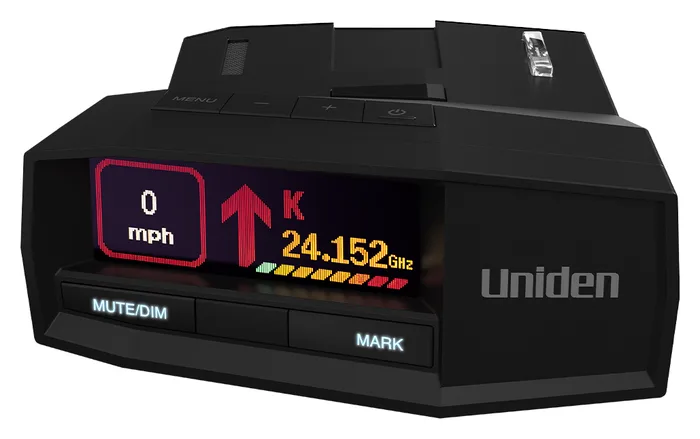
- Buy Uniden R8w The successor to the R8, with dual antennas and directional arrows, now updating itself over Wi-Fi. Amazon
- Buy Radenso DS1 The quiet one: near-flagship range with the best false-alert filtering and auto-lockouts.
- It depends Escort MAX 360c MKII Slick app ecosystem and full arrows, but you pay flagship money and the camera database is a paid subscription. Amazon
- Skip Cobra RAD 480i Cheap and app-connected, but weak filtering and short range make it more nuisance than protection. Amazon
What actually matters
- Ka-band range - Ka is the frequency most modern police radar uses, so how early a unit warns on Ka in the real world matters far more than the total number of bands it can technically pick up.
- False-alert filtering - today's biggest nuisance is not the police but the blind-spot-monitor and collision-avoidance radar in nearby cars, plus supermarket automatic doors; a good detector mutes these without hiding real threats.
- GPS lockouts - the ability to learn and permanently silence fixed false sources along your regular routes is the single biggest quality-of-life feature.
- Directional awareness - dual-antenna models show arrows telling you whether a signal is ahead or behind, which single-antenna models simply cannot do.
- Update and app support - free firmware updates keep a detector current as new car-radar sources appear, and a mature companion app can add crowd-sourced alerts.
- Stealth - in places where detectors are legal to use but enforcement uses detector-detectors, a low-emission ('stealth') unit is harder for radar-detector-detectors to spot.
- Size and fit - flagship dual-antenna units are large and eat real windshield space, so factor in where it will actually sit.
The specs, in plain English
Green flags vs red flags
Green flags
- Strong, well-reviewed Ka-band range from independent testing rather than a big band-count claim
- Automatic GPS lockouts that learn fixed false sources over time
- A reputation in owner reports for filtering out blind-spot-monitor and collision-avoidance falses
- Free, regularly issued firmware updates
- A clear interface and easy setup, so you actually use the features you paid for
Red flags
- Marketing that leads with the number of bands or '360-degree' buzzwords instead of real-world range
- Owner reports describing constant false alarms with no way to filter them
- No GPS lockout capability at all
- Updates that are rare, paid, or require awkward workarounds
- Vague or missing information about whether it can be legally used where you drive
Who's who: the brands
- Uniden - Enthusiast favorite known for long-range flagship detectors with strong Ka performance and directional arrows.
- Radenso - Smaller specialist whose owners praise its filtering and simple, hands-off operation.
- Escort - Established mainstream brand with polished displays and a connected app ecosystem for crowd-sourced alerts.
- Cobra - Budget-focused brand; inexpensive and app-connected, with mixed owner reports on false alerts.
How to read a listing without getting fooled
When you read a detector's spec sheet, resist being wowed by the number of bands or a headline range figure measured in ideal conditions. Instead, look for evidence of real-world Ka-band range from independent testing and owner reports, and confirm the unit has GPS lockouts and modern false-alert filtering, because those are what determine whether you'll actually keep it switched on. Note whether it has one antenna or two: two means directional arrows and rear coverage, one means a simpler unit with less information. Check that firmware updates are free and frequent, and if a listing pushes a companion app, read carefully which features are included and which require a paid subscription. Finally, cross-check the size against where you plan to mount it, since flagship units are physically large.
How much should you spend?
Spending more mostly buys you three things: longer usable range, smarter false-alert filtering, and a second antenna for directional arrows and rear coverage. The value sweet spot sits in the premium (not flagship) tier, where you get near-top range and excellent filtering without paying for the last few features. Budget units tend to be a false economy: they alert so often on harmless sources that many owners stop trusting them, which defeats the entire purpose. The most expensive flagships add polished displays and connected-app ecosystems, but those extras are only worth it if you'll genuinely use them, and camera database updates can require an ongoing subscription. Match the spend to how much highway you drive rather than to the spec sheet.
Questions, answered
Are radar detectors legal where I drive?
Not everywhere. In the United States they are illegal for civilian use in Virginia and Washington, DC, and federal rules ban them in commercial vehicles over 10,000 pounds. They are also generally not allowed on military bases, and many countries prohibit them outright. Laws and enforcement change, so always confirm your current state, provincial, or national law and any commercial-vehicle rules before mounting one.
Will a radar detector stop me from getting a ticket?
No. It only gives you a few seconds of advance warning to check your speed. It doesn't make speeding legal, and it offers little help against instant-on radar used at close range or against laser. Treat it as a driver-awareness aid, not a license to speed.
Do detectors work against laser (lidar) speed guns?
Barely. Lidar is a tight beam, so by the time a detector reacts the officer usually already has your speed. Detectors are built for radar bands. Defeating laser requires laser jammers, which are illegal in many places, so don't rely on a detector for lidar protection.
Why did my old detector go off constantly, and do newer ones fix that?
Most modern false alerts come from other cars' blind-spot monitors and collision-avoidance radar, plus automatic doors at stores. Newer premium units use signal filtering and GPS lockouts to silence these while still warning on genuine radar, which is exactly where cheap units struggle. Good filtering is the biggest real-world difference between models.
One antenna or two - which should I get?
Two antennas give you directional arrows and rear-approach warnings, so you know where a signal is coming from; this is best for heavy highway drivers who want the fullest picture. One antenna usually means a simpler unit that suits you if false-alarm fatigue is your main frustration and you don't mind not having arrows.
Do I still need a detector if I use a GPS speed-trap app?
They do different jobs. Crowd-sourced apps flag known fixed cameras and previously reported spots, while a detector senses live radar in real time, including mobile patrols an app hasn't logged. Many drivers run both; if you only want one and drive a lot of highway miles, a detector reacts to threats an app can't see.
Or jump to the head-to-head: Uniden R8w vs Radenso DS1.