

Automotive
The Best Radar Detectors: 4 Compared (and One to Skip)
We compared four current radar detectors on real-world range, false-alert filtering, arrows, and lockouts to find which actually earn a spot on your windshield.
The short version
After weighing independent testing and owner reports, the Uniden R8w is the best all-rounder, pairing dual-antenna directional arrows and rear detection with Wi-Fi updates and a Bluetooth app. The Radenso DS1 is nearly as capable and the champion at filtering out false alerts, just without arrows. The Escort MAX 360c MKII is excellent but sits at flagship pricing and its camera database is a paid subscription. The Cobra RAD 480i is cheap but its weak filtering and short range make it hard to recommend. Remember detectors are illegal in Virginia, Washington DC, and for many commercial vehicles, so confirm your local law first. Best for: highway and long-distance drivers who want the earliest, most trustworthy warning.
Our picks at a glance
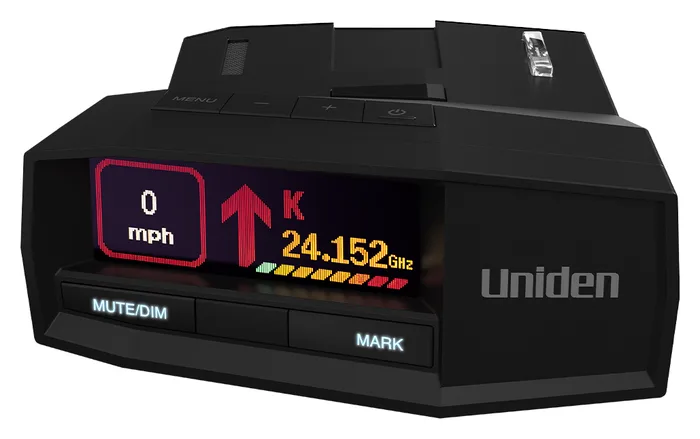
- Uniden R8w - Buy. The successor to the R8, with dual antennas and directional arrows, now updating itself over Wi-Fi.
- Radenso DS1 - Buy. The quiet one: near-flagship range with the best false-alert filtering and auto-lockouts.
- Escort MAX 360c MKII - It depends. Slick app ecosystem and full arrows, but you pay flagship money and the camera database is a paid subscription.
- Cobra RAD 480i - Skip. Cheap and app-connected, but weak filtering and short range make it more nuisance than protection.
The verdict in 30 seconds
What mattered most
- Long-range Ka detection
- False-alert filtering
- Directional arrows & rear coverage
- GPS lockouts & camera alerts
- Stealth vs detector-detectors
- App, updates & ease of use
A radar detector is only worth mounting if it warns you early without crying wolf every time you pass a grocery store's automatic doors. We synthesized independent bench and drive testing plus a large pool of owner reports across four models, spanning a serious flagship, two enthusiast favorites, and one popular budget unit. Two are easy recommendations, one is a 'depends on your ecosystem' call, and one is a clear skip. First, a reality check: detectors are illegal in some places, so read the legality FAQ before you buy.
The successor to the R8, with dual antennas and directional arrows, now updating itself over Wi-Fi.
Best for: Highway drivers who want early warning plus which-direction and rear coverage in one box.
- Front and rear antennas give directional arrows for front, side and rear threats
- Dual Blackfin DSPs and dual LNA, which Uniden says separate real police radar from door sensors and vehicle safety systems
- Built-in Wi-Fi updates firmware and the red light and speed camera database without a computer, and Bluetooth links the R/Tach app for live alerts and GPS lockouts
- Physically large at 4.88 by 3.85 by 1.52 inches and 7.4 oz, so it takes up real windshield space
- Its range claims are Uniden's own; most independent results so far are for the R8 it replaces
- The box includes a 12V RJ11 cord; the USB-C power cable is a separate accessory
Own the Uniden R8w? Tell us how it held up.
Thanks. Counted, and shown once enough owners have weighed in.
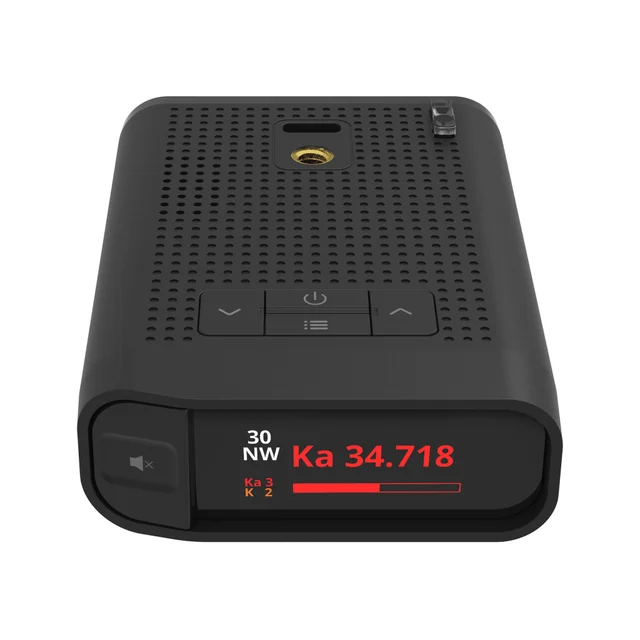
The quiet one: near-flagship range with the best false-alert filtering and auto-lockouts.
Best for: Daily commuters who are sick of false alarms and want a set-and-forget detector.
- Owner reports praise class-leading rejection of blind-spot-monitor and collision-avoidance falses
- Automatic GPS lockouts and a genuinely simple interface mean it mostly runs itself
- Stated as stealth to VG2 and Spectre Elite detector-detectors
- No directional arrows or rear antenna listed in its specs
- Firmware and camera database updates are free but install over USB-C, rather than Wi-Fi
Amazon had no buyable listing for this when we last checked. The link still works if it returns.
Find it on Amazon Read our detailed assessmentOwn the Radenso DS1? Tell us how it held up.
Thanks. Counted, and shown once enough owners have weighed in.
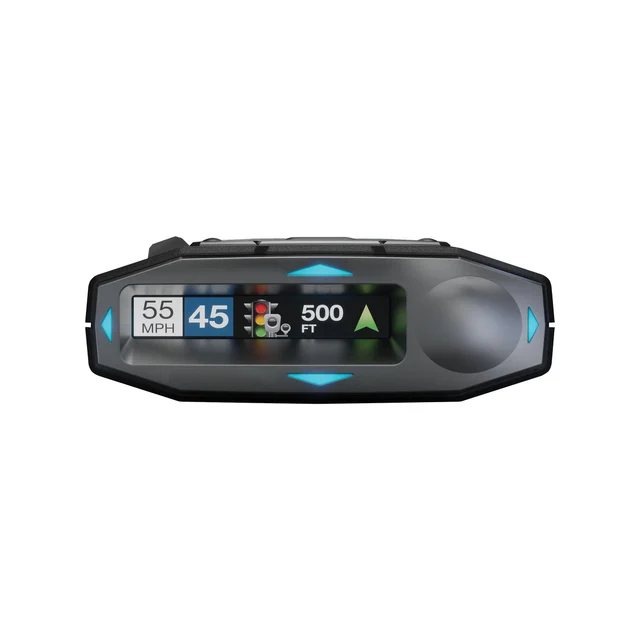
Slick app ecosystem and full arrows, but you pay flagship money and the camera database is a paid subscription.
Best for: Drivers already invested in the connected app who value live community alerts over raw range.
- Front and rear antennas with clear directional arrows and a polished color display
- Dual-band Wi-Fi for automatic updates, plus the Drive Smarter app for shared alerts and camera locations
- Refined auto-learning lockouts that reviewers find easy to live with
- Flagship pricing, and the Defender speed and red light camera database is a paid subscription
- Independent testing generally puts its outright Ka range a step behind the Uniden and Radenso
Own the Escort MAX 360c MKII? Tell us how it held up.
Thanks. Counted, and shown once enough owners have weighed in.
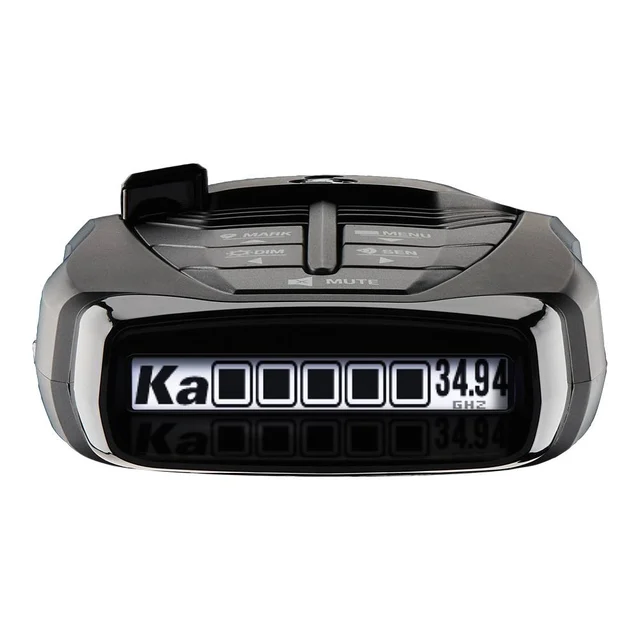
Cheap and app-connected, but weak filtering and short range make it more nuisance than protection.
Best for: Almost no one seriously worried about tickets; better saved toward a mid-tier unit.
- Inexpensive and simple to mount and run
- Connects to a companion app for basic community alerts
- Some owners report frequent false alerts, especially on Ka band, despite its stated blind-spot-monitor filtering
- Real-world range and late warning lag well behind the premium units
- No directional arrows listed for this model
Own the Cobra RAD 480i? Tell us how it held up.
Thanks. Counted, and shown once enough owners have weighed in.
| Criteria | Uniden R8w Top pick Buy it Buy | Radenso DS1 Buy it | Escort MAX 360c MKII It depends Buy | Cobra RAD 480i Skip it Buy |
|---|---|---|---|---|
| Best for | Highway drivers who want early warning plus which-direction and rear coverage in one box. | Daily commuters who are sick of false alarms and want a set-and-forget detector. | Drivers already invested in the connected app who value live community alerts over raw range. | Almost no one seriously worried about tickets; better saved toward a mid-tier unit. |
| Price tier | $$$$ · flagship | $$$ · premium | $$$$ · flagship | $ · budget |
| Long-range Ka detection | Extreme long-range, per Uniden (dual DSP, dual LNA) | Excellent, near the top | Very good, a step behind the leaders | Behind the premium units, per owner reports |
| False-alert filtering | Dual DSP filtering plus GPS lockouts | Best in this group | Very good, refined auto-learn | Weaker, owner reports of frequent falses |
| Directional arrows & rear coverage | Yes, front and rear antennas | No arrows or rear antenna listed | Yes, front and rear antennas | No arrows |
| GPS lockouts & camera alerts | Yes, via the R/Tach app, plus camera database | Yes, automatic | Yes, plus app camera data | Camera alerts with app connected |
| Stealth vs detector-detectors | Not stated | Stated stealth to VG2 and Spectre Elite | Not stated | Not stated |
| App, updates & ease of use | Wi-Fi updates, Bluetooth R/Tach app | Free updates, very simple | Wi-Fi updates and app, camera database by subscription | Basic app, limited control |
| Size & build | 4.88 x 3.85 x 1.52 in, 7.4 oz | Size not stated | Medium, premium finish | Compact, budget plastic |
| Price tier | $$$$ · flagship | $$$ · premium | $$$$ · flagship | $ · budget |
Which one is right for you?
- Highway drivers who want early warning plus which-direction and rear coverage in one box. Buy it Uniden R8w
- Daily commuters who are sick of false alarms and want a set-and-forget detector. Buy it Radenso DS1
- Drivers already invested in the connected app who value live community alerts over raw range. It depends Escort MAX 360c MKII
- Almost no one seriously worried about tickets; better saved toward a mid-tier unit. Skip it Cobra RAD 480i
How we judged the field
We do not run our own radar range. Instead, we synthesize credible independent bench and drive testing with a large pool of verified owner reports, then weight the criteria that actually change your driving day. Four things matter most. First, usable range: how early a unit warns on Ka band, the frequency most modern police radar uses, on real open road rather than a spec sheet. Second, false-alert filtering: today’s biggest annoyance is not the police, it is the blind-spot-monitor radar in the car next to you and the automatic doors at the supermarket, so a detector’s ability to suppress those without also muting real threats is decisive. Third, situational awareness: directional arrows and rear detection that tell you where a signal is coming from. Fourth, the boring-but-important stuff: GPS lockouts, ease of setup, update support, size, and price.
Uniden R8w
Buy itThe R8w is the current version of the R8, which Uniden now lists as unavailable, and it keeps what made the R8 the enthusiast’s default. Its two antennas, one facing forward and one rear, show directional arrows and warn you about signals coming up from behind, which single-antenna detectors cannot do. Uniden pairs dual Blackfin DSPs with dual LNA and says the processing separates real police radar from automatic doors and vehicle safety systems. What is new is the connectivity: built-in Wi-Fi updates the firmware and the red light and speed camera database without a computer, and Bluetooth links the R/Tach app for live alerts and for marking GPS lockouts on false sources along your regular routes. The trade-offs are size, at 4.88 by 3.85 by 1.52 inches and 7.4 oz, and the fact that its range claims are Uniden’s own, since most independent results are for the R8. For anyone who logs serious highway miles, this is the safe recommendation.
Radenso DS1
Buy itIf the R8w is about maximum coverage, the DS1 is about serenity. Owners consistently single it out for the cleanest experience in this group, rejecting the flood of blind-spot-monitor and collision-avoidance falses that make lesser detectors exhausting to live with, while still warning early on genuine radar. Its automatic GPS lockouts and refreshingly plain interface mean it largely runs itself, and Radenso states it is stealth to VG2 and Spectre Elite detector-detectors. The catch is that its specs list no directional arrows or rear antenna. If you would rather have a quiet, trustworthy companion than a wall of information, the DS1 is the one to buy.
Escort MAX 360c MKII
It dependsThe MAX 360c MKII is genuinely good and the most polished device here, with front and rear antennas, clear arrows, a crisp color display, and dual-band Wi-Fi plus the Drive Smarter app for shared alerts and camera locations. The reasons it lands on ‘depends’ are money and model. It sits at flagship pricing, and the Defender camera database is a paid subscription, so its value hinges on whether you will actually use that ecosystem. On raw Ka range, independent testing generally puts it a small step behind the Uniden R8 and the Radenso. If you are already an app-driven driver who values live community data over the last mile of detection range, it makes sense; if not, you can spend less and detect more.
Cobra RAD 480i
Skip itThe RAD 480i is cheap, easy, and app-connected, and for a lot of buyers that is where the good news ends. Some owner reports describe frequent false alerts, particularly on Ka band, despite Cobra’s stated blind-spot-monitor filtering, and its real-world range and warning distance lag well behind the premium units, which is the opposite of what you want from a device whose entire job is early warning. There are no directional arrows listed for this model. It is not dangerous, it is just not effective enough to trust, and a detector you learn to ignore because it cries wolf is worse than no detector at all. Put the money toward a mid-tier unit instead.
Sources
Specs in this review come from these pages.
Uniden R8w vs Radenso DS1: which should you buy?
These two are the head-to-head that matters, because both are excellent and they optimize for different drivers. The Uniden R8w wins on completeness: dual antennas mean directional arrows and rear-approach warnings, and Wi-Fi updates plus the R/Tach app keep its camera database and lockouts current, so it tells you the most about what is around you. The Radenso DS1 wins on refinement: it is the quietest and best-filtered detector here, simpler, stated as stealth to VG2 and Spectre Elite, and it mostly manages itself. Choose the R8w if you want the fullest possible picture and do not mind a large unit and a busier display. Choose the DS1 if false alarms are what drove you crazy about detectors before and you would trade arrows for a calm, near-flagship experience. Neither is a wrong answer; they are two honest philosophies of the same job.
What to look for
- Filtering first. The biggest real-world difference between a great detector and a frustrating one is how well it suppresses other cars’ blind-spot-monitor radar and store door openers. Prioritize this over headline range.
- GPS lockouts. A unit that learns and silences fixed false sources along your routes is far more livable day to day.
- Directional arrows and rear coverage. Dual-antenna models tell you where a signal is coming from; single-antenna models are quieter and smaller but less informative.
- Range on Ka band. Ka is what most modern police radar uses, so judge range there rather than on total band count.
- Update and app support. Look for free firmware updates and, if you want live community alerts, a mature companion app, noting which features require a subscription.
- Legality and fit. Confirm the law where you drive, and remember big flagship units take up meaningful windshield space.
Our final take
For most drivers, the Uniden R8w is the one to buy: it combines true arrows and rear detection with Wi-Fi updates and app-managed lockouts. The Radenso DS1 is the equally smart pick if a quiet, false-free experience matters more to you than directional arrows. The Escort MAX 360c MKII is a fine choice only if you will genuinely use its connected app ecosystem and accept flagship pricing, and the Cobra RAD 480i is best skipped in favor of a mid-tier unit. Whatever you choose, a detector is a driver-awareness aid, not a shield against consequences, and it is flatly illegal in places like Virginia and Washington DC and in many commercial vehicles, so check your local law before it ever touches the glass.
Questions, answered
Are radar detectors legal where I drive?
Not everywhere. In the United States they are illegal for civilian use in Virginia and Washington DC, and federal rules prohibit them in commercial vehicles over 10,000 pounds; many other countries ban them outright. They are also generally not allowed on military bases. Laws change and enforcement varies, so always check your current state, provincial, or national law and any commercial-vehicle rules before mounting one.
Will a radar detector stop me from getting a ticket?
No. A detector only gives you advance warning so you can check your speed; it does not make speeding safe or legal, and it offers little help against instant-on radar used at close range or against laser. Treat it as a driver-awareness aid, not a license to speed.
Do these work against laser (lidar) speed guns?
Barely. By the time a detector chirps on laser, the officer usually already has your speed, because lidar is a tight beam. Detectors are built for radar bands (X, K, Ka). Defeating laser requires laser jammers, which are illegal in many places, so do not count on any of these units for lidar protection.
Why did my old detector go off constantly, and do these fix that?
Most modern false alerts come from other cars' blind-spot monitors and collision-avoidance radar, plus automatic doors at stores. The Radenso DS1 and the premium Uniden and Escort units use signal filtering and GPS lockouts to silence these, which is exactly where the budget Cobra struggles. Good filtering is the single biggest real-world quality-of-life difference between these models.
Do I still need a detector if I use a GPS speed-trap app?
They do different jobs. Crowd-sourced apps flag known fixed cameras and previously reported spots, while a radar detector senses live radar in real time, including mobile patrols an app has not logged yet. Many drivers run both; if you only want one and you drive a lot of highway miles, a detector reacts to threats an app cannot see.
Deciding between the top two? See our head-to-head: Uniden R8w vs Radenso DS1.
More in Automotive
Radar Detectors, Explained Plain-English guide → Uniden R8w vs Radenso DS1 Head-to-head →  The Best Rinseless Washes: 4 Compared (and One to Skip)
  The Best Rooftop Cargo Boxes: 4 Compared (and One to Skip)
  The Best Steering Wheel Covers: 4 Compared (and One to Skip)
  The Best Tire Chains: 4 Compared (and One to Skip)