Explained
Polishing Compounds, Explained
After reading, you'll understand how compound aggressiveness is described, and why the pad and the abrasive type change what you get.
In this guide
Compound is abrasive suspended in a carrier, and paint correction is controlled sanding at a very fine scale. What makes the category hard to shop is that there is no agreed scale for cut. Some brands anchor themselves by naming the sanding grit their product can erase, which is checkable. Others use words like heavy, max and super-micro, which sound like grades and mean whatever the brand wants. Around that sit two properties, abrasive type and filler content, that change the result more than the headline does.
The 30-second version
- Cut is only checkable as a grit, so a compound that names the sanding grade it removes can be compared and one that says heavy cannot.
- Diminishing abrasives break down, starting coarse and finishing fine, which is why they need to be worked for a full cycle.
- Fillers hide what you did not fix, so the swirls come back a few weeks later when the silicone washes out.
- The pad supplies half the cut, and a compound tied to one specific pad is half of a system rather than a bottle.
- Compounding usually needs refining, because a cutting step leaves its own finer scratch pattern behind.
The products this guide is about
Our verdict on each, with the full reasoning on the companion review.
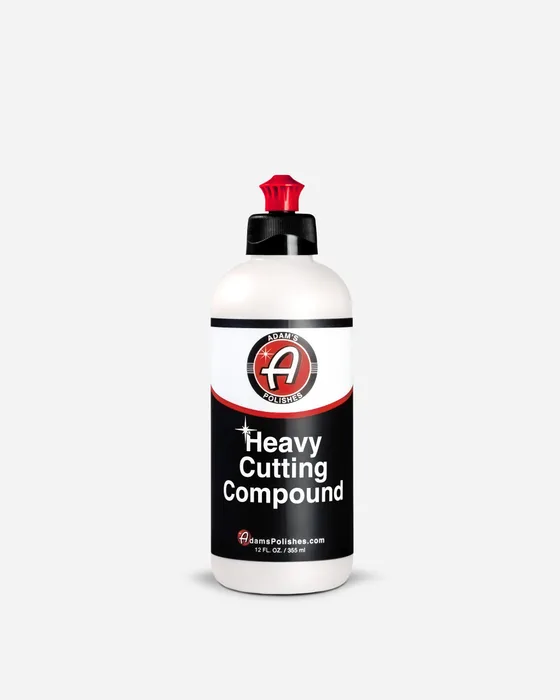
- Buy Adam's Polishes Heavy Cutting Compound States the sanding grit it removes, says the abrasives diminish, and tells you there are no fillers hiding the result. Amazon
- Buy P&S Detail Products Ballistic Max Cut Compound Removes 1000 grit sanding scratches, works on rotary or DA with wool or foam, and comes by the quart.
- It depends Meguiar's DA Microfiber Correction Compound D300 A fine correction compound built around one specific pad, which makes it half a system rather than a bottle. Amazon
- Skip Chemical Guys C4 Clear Cut Correction Compound Called heavy-cut in one line and moderately abrasive in the next, and Chemical Guys rates it below its own V32 for cut. Amazon
What actually matters
- Cut - how much clear coat the product removes. The only comparable expression of it is the sanding grit whose scratch pattern the compound can erase, quoted at 1000 to 1200 grit by the products in the comparison.
- Abrasive type - diminishing abrasives break down as worked and finish finer than they start; non-diminishing abrasives cut the same throughout. It changes technique and the need for a refining pass.
- Fillers and silicones - cosmetic additives that temporarily mask uncorrected defects. Body shop safe means none are present, which matters both for resprays and for judging your own work honestly.
- Dusting and sling - how much residue the product throws. Low dusting saves a great deal of cleanup on a full car, and sling ends up on glass and trim.
- Machine clearance - whether the compound is formulated for rotary, dual action, or a specific pad system. Rotary generates far more heat, and not every product is stable at that temperature.
- Pad pairing - which pad the compound was developed with. Foam, microfibre and wool all change the effective cut, and a stated pairing removes a variable.
- Working time - how long a pass should take. Diminishing products need the full cycle to finish properly, and stopping early leaves the coarse stage of the abrasive as your result.
The specs, in plain English
Green flags vs red flags
Green flags
- A sanding grit reference stating what the compound removes.
- The abrasive type named as diminishing or non-diminishing.
- An explicit statement that the product contains no fillers or silicones.
- Machine clearance covering rotary as well as dual action where relevant.
- A published working method with pass counts or timing.
Red flags
- Cut described only as heavy, max or micro with no grade behind it.
- No mention of fillers on a product sold for correction rather than for shine.
- No pad guidance on a product where the pad contributes half the cut.
- A page that lists defects it fixes and says nothing about the abrasive.
- A compound sold as a system component without the system being mentioned.
Who's who: the brands
- Adam's Polishes - Publishes grit references, abrasive type and a working method, and states its compounds are free of fillers and silicones.
- P&S Detail Products - Professional supply, quoting sanding grit removal and clearing its compounds for rotary as well as dual action machines.
- Meguiar's - Builds compounds as pad and product systems, particularly the DA microfibre line, with low dusting as a stated design goal.
- Chemical Guys - A broad consumer compound range that leads with the defects each product addresses and lists grit and cut details further down the page.
- Rupes - Sells compounds matched to its own polishers and pad range, sold as a calibrated system rather than as loose bottles.
How to read a listing without getting fooled
Look for a number first. If the page says the compound removes 1000 grit sanding marks, you have something you can compare against another bottle making the same kind of claim, and you know roughly how deep it works. If it says heavy cut, you have an adjective. Next find the abrasive type, because diminishing products want a full working cycle and non-diminishing ones do not, and that changes your technique before you start. Look for a statement about fillers, and treat body shop safe as the shorthand for none. Then read the machine and pad clearance, remembering that the pad supplies as much cut as the compound. Finally check the size against the job, because a full car uses much more than a small bottle holds.
How much should you spend?
Compounds are not expensive per bottle and are expensive per correction, because a full car goes through far more than most people budget for. The budget tier tends to be non-diminishing consumer products with filler content that flatters the result, which is fine if you want the car to look good this month and misleading if you are trying to correct it. Mid-range is where grit references, diminishing abrasives and filler-free formulations appear, and that tier is the whole answer for anyone doing this properly. Buying a large enough bottle matters more than buying the premium one, since running out mid-panel is worse than a slightly slower cut.
Questions, answered
How much clear coat does compounding remove?
A heavy cutting step removes only a thin layer of the factory clear coat, but that layer is finite: a car can only be fully corrected a handful of times in its life before the clear coat gets thin enough to fail. This is the argument for using the least aggressive combination that solves the defect, and for measuring with a paint depth gauge on an older or previously polished car.
Why do my swirls come back after a few weeks?
Almost always fillers. A compound or polish containing silicone or heavy oils fills the scratches rather than removing them, so the paint looks perfect when you wipe it down and the fillers wash out over the following weeks. The fix is to use a filler-free product, described as body shop safe, and to inspect your work under strong direct light before deciding the panel is finished.
Do I need a rotary polisher, or is a dual action enough?
A dual action is enough for almost all home correction, and it is far harder to burn paint with. A rotary cuts faster and generates more heat, which is why body shops use it and why it takes practice. Not every compound is formulated for both, so check the clearance: two products in the comparison above name rotary use specifically, which tells you they were formulated with it in mind.
Can I compound by hand?
You can improve an isolated scratch, and you will not correct a panel. Machine polishing works because it applies consistent pressure and speed over a large area, and hand pressure varies with every stroke, so the result is uneven and the abrasive never breaks down properly on a diminishing product. For a single deep mark on a door edge, hand work is reasonable. For swirls across a car, a machine is the only route.
Or jump to the head-to-head: Adam's Polishes Heavy Cutting Compound vs P&S Detail Products Ballistic Max Cut Compound.